AI agents are moving beyond simply answering questions.
They can now search for information, use tools, execute workflows, and make decisions based on specific goals. The next step is even more interesting: letting AI agents hold digital assets, make payments, and work with other AI agents.
That is where blockchain becomes important.
With a crypto wallet, an AI agent can potentially hold assets, interact with smart contracts, and pay for digital services. Another AI agent can then provide that service and receive payment.
This creates a new possibility for the digital economy: AI agents could work, pay, and collaborate with other AI agents.
BSEtec works at the intersection of AI, blockchain, smart contracts, and Web3 development, helping businesses explore this emerging model of autonomous digital systems.
Why Would an AI Agent Need a Crypto Wallet?
Most AI agents can perform tasks, but they usually depend on humans or traditional payment systems whenever money is involved.
A crypto wallet can change that.
With the right permissions and spending limits, an AI agent could make approved blockchain transactions on its own.
For instance, a research agent could pay for access to a data service. Similarly, a coding agent could purchase approved computing resources when it needs additional capacity.
The important shift is that AI would not only decide what needs to happen. It could also participate in the transaction required to complete the task.
When Bots Start Hiring Other Bots
This is where the concept becomes much more powerful.
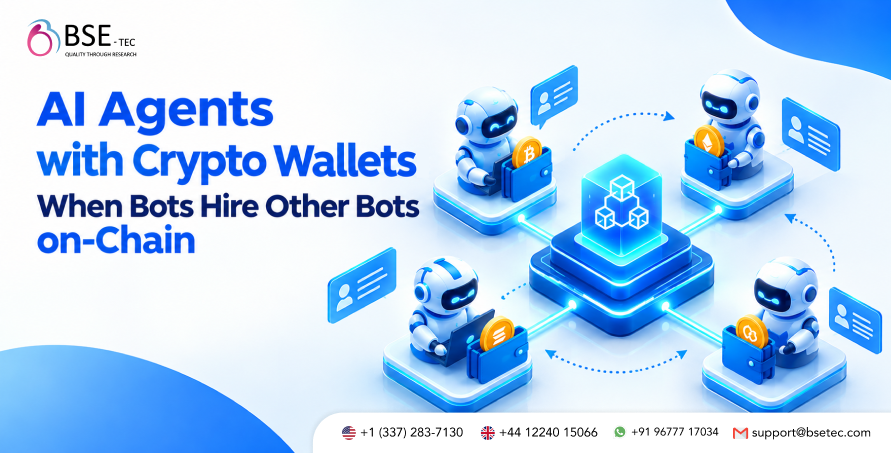
Imagine an AI agent receives a task but does not have every capability required to complete it. Instead of stopping, it could find another specialized agent and pay for that service.
A simple example:
Business Agent → Finds Data Agent → Pays for Data → Completes Analysis
Another possibility could be:
Travel Agent → Finds Flight Agent → Pays for Search → Returns Options
In this model, one AI agent becomes the customer while another becomes the service provider.
Blockchain-based payments can provide a programmable way for these systems to exchange value.
Ethereum’s ERC-8004 initiative is also exploring agent identity, reputation, and discovery, which are important foundations for AI agents interacting across different applications and organizations.
Smart Contracts Can Control the Transaction
Payment alone is not enough.
Both agents need clear rules about what is being purchased, how much it costs, and when the payment should happen.
Smart contracts can help define these conditions.
A smart contract could specify:
- The service being requested
- The maximum payment
- Approved wallet addresses
- Conditions for releasing funds
- Transaction expiry
- Emergency or cancellation conditions
This allows AI agents to operate with some independence while keeping transactions inside predefined boundaries.
However, smart contracts cannot automatically determine whether an AI-generated service is actually useful or accurate.
That means businesses still need quality checks, monitoring, identity verification, and security controls.
How Do AI Agents Know Who to Trust?
Once agents begin hiring other agents, trust becomes a major requirement.
A human may check reviews, qualifications, reputation, or previous work before hiring a service provider. AI agents need similar information in a machine-readable form.
This is where agent identity and reputation become important.
Blockchain can provide a verifiable record of identities, transactions, and other relevant information. Initiatives such as ERC-8004 are designed around this idea of helping agents discover and evaluate other agents.
Over time, this could support a more open machine-to-machine economy, where software systems can find services, evaluate available options, and complete approved transactions.
Where Could Agent-to-Agent Payments Be Used?
1. AI Data Services
An AI agent could purchase market data, datasets, research information, or real-time information from another specialized service.
2. Computing Resources
An agent could request additional computing power when its workload increases and pay for approved resources automatically.
3. Digital Commerce
A shopping agent could compare products, select an option according to user preferences, and complete an approved transaction.
4. Software and APIs
Instead of relying only on fixed subscriptions, agents could potentially access and pay for specific digital services when required.
5. Enterprise Automation
Business agents could request services from specialized agents for reporting, analysis, document processing, customer support, and other workflows.
The Biggest Challenge: Giving AI Access to Money
Autonomous payments also introduce serious security considerations.
An AI agent could misunderstand an instruction, interact with an unreliable service, or make an unexpected transaction. Therefore, financial autonomy needs strong controls.
Businesses should consider:
- Spending Limits – Set transaction and daily spending limits.
- Permissions – Clearly define which actions the agent can perform.
- Wallet Security – Protect keys and transaction authorization.
- Monitoring – Track unusual or unexpected activity.
- Human Approval – Require confirmation for high-value transactions.
- Audit Trails – Maintain records of important agent actions.
The goal is not to give AI unlimited access to money.
Instead, businesses need controlled autonomy, where agents can act independently within clearly defined boundaries.
How BSEtec Can Help
The combination of AI agents and blockchain requires more than connecting an AI model to a crypto wallet. Businesses need secure architecture, smart contracts, wallet infrastructure, integrations, and monitoring.
BSEtec’s AI and blockchain development capabilities are relevant to this emerging technology landscape.
BSEtec AI & Blockchain Solutions
BSEtec can help businesses explore areas such as:
- AI Agent Development – Build intelligent agents for business workflows and autonomous tasks.
- Smart Wallet Integration – Connect AI agents with controlled digital-asset wallets.
- Smart Contract Development – Create programmable rules for transactions and automated execution.
- Agent-to-Agent Workflows – Enable specialized agents to communicate and coordinate tasks.
- Blockchain Integration – Connect AI applications with blockchain and Web3 infrastructure.
- Security and Permission Controls – Define spending limits, access rules, and transaction permissions.
- Enterprise Integration – Connect AI agents with APIs, databases, and existing business systems.
This approach can help businesses move from basic AI automation toward secure, controlled, blockchain-powered autonomous systems.
What Could the Future Look Like?
AI agents may eventually do much more than automate individual tasks.
One agent could discover a service, another could provide it, and a smart contract could handle the agreed transaction.
The model could look like:
AI Agent → Service Agent → Smart Contract → Blockchain Settlement
For example, a business agent might hire a data agent. That data agent could use another specialized service for processing or computing. Each step could happen through predefined rules and approved transactions.
The technology is still developing, and businesses will need to address security, identity, regulation, accountability, and transaction control before these systems can operate widely.
Still, the direction is becoming clearer.
AI gives software the ability to make decisions. Blockchain can give those decisions a verifiable way to become economic actions.
Final Thoughts
AI agents are becoming increasingly capable of acting on behalf of people and businesses.
Adding blockchain wallets gives them another important capability: the ability to transact.
The bigger opportunity is not simply putting a crypto wallet inside an AI agent. It is creating an ecosystem where AI agents can discover, hire, pay, and collaborate with other agents under defined rules.
For businesses preparing for this shift, BSEtec can bring together AI agents, blockchain, smart contracts, wallets, and secure automation to build practical solutions for emerging autonomous digital ecosystems.
The future may not be an internet where only people do business. It could also become an internet where intelligent software can do business with other intelligent software.
When AI gets a wallet, software can become an economic participant.