
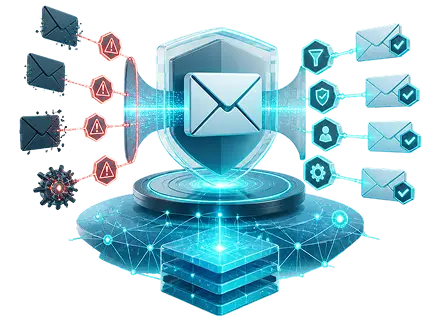
Most organizations assume their spam filter is doing the heavy lifting and move on. BSEtec looks deeper — how your authentication protocols are actually configured, whether your finance team's approval process could be talked around by a convincing message, and how your people respond when something genuinely slips through. Attackers have gotten sharper: polished, error-free messages no longer signal legitimacy, and a growing share of phishing attempts now carry clear signs of AI-assisted crafting. Our email security assessment services are built against how threats actually look today, not a checklist from a few years ago.

A hands-on audit of SPF, DKIM, and DMARC configuration, checking not just whether they're enabled but whether they're set up to actually stop spoofed domains through effective email authentication security.
Attack simulations modeled on current techniques — credential phishing, QR-code payloads, CAPTCHA-gated campaigns — instead of outdated templates.
A close look at how wire transfers, vendor detail changes, and other high-risk requests get approved, since BEC succeeds through process gaps, not malware.
Simulation data analyzed to pinpoint which teams or roles carry the highest exposure, so phishing security awareness training gets targeted instead of generic.
Findings ranked by actual exploitability and business impact, so the biggest email security risks get closed first, not just the easiest wins.
A recommended monitoring and retesting schedule, because a secure email posture that's solid today can quietly erode as attack techniques shift.
We assess authentication, process, and human behavior together, not just whether a filter is switched on.
Every simulation reflects current phishing and BEC techniques, updated as the threat landscape shifts.
We hand over findings prioritized by real exploitability, so your team knows what to fix first.
We look at the business processes around high-risk requests, not just the technical filters guarding the inbox.
Findings framed in the risk language leadership actually responds to, not just a technical scorecard.
We recommend and support an ongoing email security assessment cadence, because email threats don't stop evolving.

No: 2300 Stanwell dr suite A, concord California 94520, United states.
(+1) 3372-837-130
No: 8 rue Charles Martel, -1 Level, 1000 brussels Belgium.
(+32) 467-616-037
No: 242, Morning star Level 3, 6th cross, Indiranagar First Stage, Bangalore - 560038, Karnataka, India.
(+91) 950-090-2222No: 8, 20 Feet Extension Road, 70 Feet Road, Ellis Nagar, Madurai - 625016.
(+91) 967-771-7038