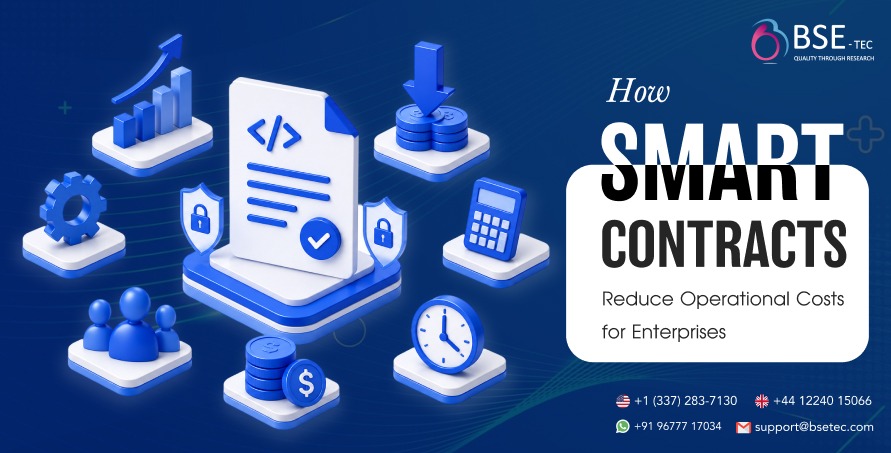
Imagine running your business without manual approvals, lengthy payment cycles, or repetitive paperwork. That’s the advantage smart contracts bring to modern enterprises. In 2026, businesses are using smart contracts to automate workflows, reduce operational costs, and improve efficiency across industries. According to Mordor Intelligence, the global smart contracts market is expected to reach USD 3.12 billion in 2026, reflecting the growing demand for blockchain-powered automation. Meanwhile, MarketsandMarkets projects the global blockchain market to reach USD 54.08 billion in the same year.
If you’re looking to streamline operations and reduce costs, smart contracts offer a smarter way forward. This guide explores their key benefits and explains how BSEtec, a trusted Blockchain development company, delivers secure Blockchain development services and smart contract solutions for enterprises.
What Are Smart Contracts?
Smart contracts are self-executing digital agreements stored on a blockchain. Instead of depending on manual approvals or third-party intermediaries, they automatically execute predefined conditions.
For example:
- A supplier delivers goods.
- The shipment is verified.
- The smart contract confirms delivery.
- Payment is released automatically.
No paperwork, delays, manual reconciliation. As a result, businesses reduce administrative costs while improving transparency across every transaction.
Why Enterprises Are Investing in Smart Contracts in 2026
Business leaders are under constant pressure to reduce costs without sacrificing security or compliance.
However, traditional workflows still depend heavily on Manual documentation, Multiple approval layers, Third-party verification, Human data entry, and Long settlement cycles. Each of these activities consumes time, money, and valuable employee resources.
Smart contracts solve these inefficiencies through automation. Therefore, enterprises can redirect their workforce toward innovation instead of repetitive administrative tasks. Furthermore, industry forecasts indicate continued growth in enterprise blockchain adoption, driven by increasing demand for automation, digital trust, and secure data sharing across organizations.
How Smart Contracts Reduce Operational Costs
1. Eliminate Manual Processing
Every manual task increases operational expenses. For instance, your finance team may spend hours verifying invoices before processing payments. Similarly, procurement teams often compare purchase orders, shipping documents, and supplier invoices manually.
Smart contracts automate these processes. Once predefined conditions are satisfied, execution happens automatically. Therefore, businesses reduce Administrative work, Processing delays, Human intervention, and Operational overhead. As a result, employees spend less time on repetitive tasks and more time on strategic initiatives.
2. Reduce Human Errors
Mistakes are expensive. A single typo in financial records or contract terms can create payment disputes, compliance issues, or costly legal challenges. Fortunately, smart contracts execute the exact logic programmed into them.
Because blockchain records cannot be altered without consensus, every participant works from the same trusted data. Consequently, enterprises experience Fewer reconciliation errors, Improved data accuracy, Better financial reporting, and reduced compliance risks
3. Remove Expensive Intermediaries
Traditional business agreements often require intermediaries such as Banks, Escrow providers, Legal verification services, and Settlement agencies
Each intermediary introduces additional costs. Moreover, every extra approval extends transaction timelines. Smart contracts automate trust through blockchain technology. Instead of relying on multiple third parties, businesses establish predefined rules that execute automatically. Therefore, enterprises significantly lower transaction costs while accelerating business operations.
4. Accelerate Payment Settlements
Cash flow directly impacts business growth. Unfortunately, conventional payment systems often involve lengthy settlement cycles. Cross-border transactions may require several days because financial institutions must verify and process payments through multiple networks. Smart contracts simplify this process.
Once contractual conditions are fulfilled, payments are executed automatically. As a result, Suppliers receive faster payments, Businesses improve liquidity, Finance teams spend less time tracking outstanding invoices, and Operational efficiency increases across departments.
5. Improve Compliance While Reducing Audit Costs
Compliance often requires significant time and resources. However, smart contracts automatically record every transaction on the blockchain, creating a secure and tamper-proof audit trail. As a result, businesses reduce manual documentation, simplify audits, improve transparency, and lower compliance costs.
6. Increase Supply Chain Efficiency
Managing multiple suppliers and logistics partners can be expensive and time-consuming. Smart contracts automate shipment verification, inventory updates, and supplier payments once predefined conditions are met. Consequently, businesses reduce delays, eliminate disputes, and improve supply chain visibility while lowering operational costs.
7. Strengthen Security and Reduce Fraud
Traditional systems are vulnerable to data manipulation and fraud. In contrast, blockchain secures transactions with immutable records, while smart contracts execute predefined rules automatically. Therefore, enterprises reduce fraud risks, improve data integrity, and strengthen customer trust without increasing operational expenses.
8. Scale Business Operations Efficiently
As businesses grow, managing contracts and approvals becomes more complex. Smart contracts automate repetitive processes, allowing enterprises to handle larger transaction volumes without expanding administrative teams. As a result, organizations improve productivity while controlling operational costs.
Real-World Enterprise Applications
Financial Services: Banks use smart contracts for payments, lending, and trade finance. This reduces settlement times, reconciliation efforts, and intermediary costs.
Healthcare: Healthcare providers automate insurance claims and securely manage patient records, improving efficiency while reducing paperwork.
Supply Chain & Logistics: Businesses automate inventory tracking, shipment verification, and supplier payments to improve visibility and reduce delays.
Insurance: Insurers streamline policy management and claims processing, leading to faster settlements and reduced fraud.
Real Estate: Smart contracts simplify property transactions by automating agreements and payment settlements, reducing paperwork and legal costs.
Why Choose BSEtec for Smart Contract Development?
Implementing smart contracts requires technical expertise and industry knowledge. As a trusted Blockchain development company, BSEtec helps enterprises automate business processes with secure and scalable blockchain solutions.
BSEtec’s Blockchain development services include:
- Custom smart contract development
- Enterprise blockchain solutions
- Smart contract security audits
- dApp development
- Tokenization solutions
- Blockchain integration with ERP and CRM systems
- Blockchain consulting and maintenance
As an experienced smart contract development company, BSEtec develops reliable blockchain applications that improve efficiency, reduce operational costs, and support long-term business growth.
Conclusion
Smart contracts are transforming enterprise operations by automating workflows, reducing manual effort, and improving transparency. As businesses continue their digital transformation in 2026, adopting blockchain-based automation can significantly lower operational costs and increase efficiency.
Partnering with an experienced Blockchain development company like BSEtec ensures your business benefits from secure, scalable, and customized smart contract solutions. Whether you need enterprise blockchain applications or expert Blockchain development services, BSEtec helps you build future-ready solutions that support sustainable business growth.
:
,