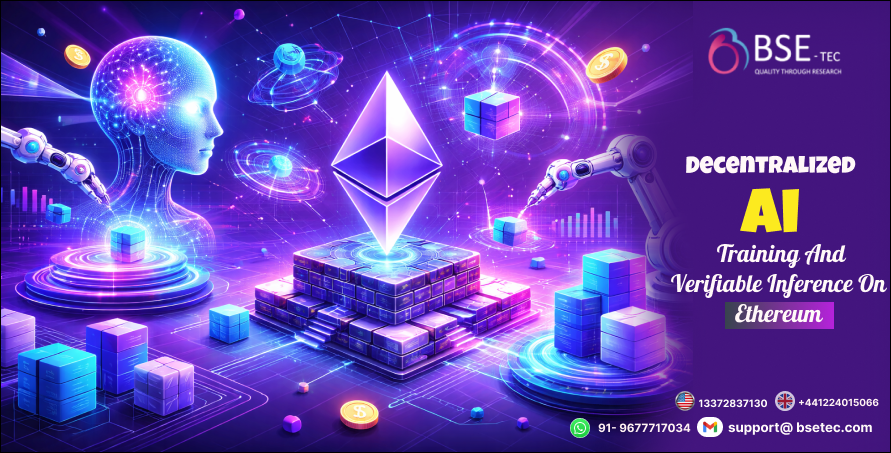
AI is transforming intelligence, and blockchain is redefining trust—now they’re converging. But rising concerns like bias, opacity, and data misuse demand change. Enter Decentralized AI—bringing transparency, security, and trust to the future of intelligent systems.
So, what makes AI truly decentralized, and why does it matter now?
Understanding Decentralized AI
Decentralized AI merges Blockchain with artificial intelligence to distribute data and processing across a global network instead of a single server.
Core concept — Initially, standard AI systems require massive, centralized data centers. In contrast, Decentralized AI uses a peer-to-peer framework where participants share their computing power (GPU) and data, often earning rewards in return. This ensures that no single corporation owns the intelligence.
Primary benefits:
- Enhanced Privacy: Data remains encrypted across multiple nodes, reducing the risk of large-scale breaches.
- Accessibility: Additionally, it allows developers to build and scale models without needing multi-million dollar infrastructure.
- Transparency: Open-source protocols make the AI’s decision-making process more auditable.
Consequently, this shift promotes a more open and resilient digital ecosystem where AI is a public utility rather than a corporate secret.
Now that we understand the concept, how do we train AI in a decentralized world?
Decentralized Training: Rethinking How AI Models Learn
The shift toward decentralized training represents a move away from Siloed Intelligence toward a collaborative, global network. Instead of a single company controlling the entire learning process, the workload is distributed.
The core transformation — Traditionally, training a large language model (LLM) requires thousands of interconnected GPUs in one physical location. On the contrary, decentralized training allows these calculations to happen across geographically dispersed nodes. Through this approach, the hardware barrier that usually protects big tech monopolies is effectively dismantled.
How the Network Collaborates
- Parallel Processing: Large tasks are split into micro-chunks. Specifically, different nodes work on separate parts of the model simultaneously.
- Secure Aggregation: Once a node finishes its segment, it sends only the mathematical updates back to the main chain. Accordingly, the central model learns without the source data ever leaving its original location.
- Cryptographic Verification: Furthermore, validators use proofs to ensure that no node is submitting junk data or trying to poison the model’s intelligence.
Strategic Advantages
Decentralized training is the democratization of compute. It transforms expensive hardware into a shared, liquid commodity.
- Cost Efficiency: Tapping into idle global GPUs is often cheaper than renting cloud space.
- Resilience: In addition, the network has no single point of failure; if one data center goes dark, the training continues elsewhere.
- Data Sovereignty: Hence, organizations can contribute to a collective model while keeping their proprietary data strictly on-premises.
In the long run, this approach opens AI development to everyone, using blockchain to create an open, verifiable, and scalable ecosystem.
Training is only half the equation—what happens when we use these models?
Verifiable Inference: Building Trust in AI Outputs
Verifiable Inference solves the black box problem of AI by providing cryptographic proof that a specific model produced a particular answer without any tampering.
The trust gap
Currently, when you interact with a centralized AI, you must blindly trust that the provider hasn’t manipulated the output or swapped a high-quality model for a cheaper, less accurate one. In response, Verifiable Inference introduces a Verify, Don’t Trust layer to the process.
How verification works:
- Zero-Knowledge Proofs (zkML): This technology generates a mathematical certificate alongside the AI’s answer. Specifically, it proves that the computation followed the model’s rules exactly, while keeping the underlying data or model weights private.
- Optimistic Verification: Alternatively, the system can assume the answer is correct but allow a challenge period. If a watcher detects an error, they can submit a fraud proof, leading to the provider being penalized.
- Economic Security: Additionally, many networks require providers to stake assets. Consequently, the risk of losing money ensures that providers remain honest when delivering results.
Core advantages
- Integrity: You gain absolute certainty that the AI hasn’t been biased or censored by a middleman.
- Security for High-Stakes Tasks: Furthermore, this level of trust is essential for using AI in sensitive fields like medical diagnostics or automated financial trading.
- Auditability: As a result, every inference leaves a permanent, verifiable trail on the blockchain, making the AI’s behavior fully transparent.
Verifiable inference turns AI into a transparent, trustworthy system by ensuring outputs are accurate and tamper-proof through cryptographic security.
While the technology is powerful, implementing it at scale requires deep expertise and the right development approach.
How BSEtec is Powering Decentralized AI on Ethereum (Core Section)
BSEtec enables the integration of advanced machine learning into the Ethereum ecosystem by providing the critical infrastructure required for secure, scalable, and verifiable AI.
1. Scaling with Layer 2 and Layer 3
Initially, the high cost of Ethereum prevented complex AI operations on-chain. To solve this, BSEtec utilizes Layer 2 (L2) and custom Layer 3 (L3) app-chains to handle heavy AI computations off-chain. As a result, businesses achieve high-speed AI interactions while maintaining Ethereum’s security at a fraction of the cost.
2. Implementing Verifiable Trust
One major hurdle in decentralized AI is ensuring the model hasn’t been manipulated.
In response, BSEtec incorporates cryptographic frameworks:
- zkML: They use Zero-Knowledge proofs to mathematically verify that the AI’s answer is accurate and untampered.
- OPML: Additionally, they implement Optimistic systems where results are assumed correct but can be challenged, ensuring accountability through economic staking.
3. Powering Agentic AI
Furthermore, BSEtec is at the forefront of the 2026 Agentic Web by utilizing the ERC-8004 standard. Consequently, they enable AI agents to hold their own digital identities and execute autonomous financial transactions directly on-chain, moving beyond simple chatbots to functional digital workers.
BSEtec connects raw compute with decentralized finance, enabling enterprises to deploy AI that is transparent, secure, and community-driven.
Real-World Applications of Decentralized AI
Decentralized AI (DeAI) has transitioned from experimental theory to practical, real-world utility in 2026, touching industries that require high levels of trust, privacy, and cost-efficiency.
1. Healthcare: Privacy-First Diagnostics — Initially, sharing medical data was difficult due to privacy laws. However, decentralized networks enable federated learning. Case Study: Hospitals train AI models without sharing patient data, improving accuracy while maintaining full privacy.
2. Finance: Verifiable DeFi — Traditional finance uses black-box credit systems. In contrast, DeFi uses zkML for secure processing. Benefit: Users prove creditworthiness without revealing data, while risk models remain fully auditable.
3. Infrastructure: DePIN & GPU Marketplaces — Additionally, DePIN disrupts centralized cloud systems. Real-World Use: Startups use global GPU networks, reducing costs and avoiding reliance on big cloud providers.
4. Supply Chain: Predictive Logistics — Managing supply chains often faces data issues. To solve this, DeAI agents monitor in real time. Mechanism: AI predicts delays and triggers smart contract actions automatically.
5. Governance: AI-Enhanced DAOs — DAOs struggle with complex decisions and voter fatigue. Accordingly, AI agents assist governance. Impact: They analyze proposals, detect risks, and help users make better decisions.
The Barriers to Decentralized AI
Decentralized AI is a revolutionary shift, yet it faces critical hurdles before it can achieve mainstream dominance.
- The Speed Gap: Initially, centralized systems are faster due to localized hardware. In contrast, decentralized networks sync across global nodes. As a result, training slows down, so BSEtec utilizes Layer 3 app-chains to slash this latency.
- The Proof Burden: Next, cryptographic proofs ensure untampered outputs. However, these are resource-heavy, so speed is often sacrificed. Consequently, BSEtec integrates optimized verification frameworks to maintain real-time responsiveness without losing security.
- Regulatory Gaps: Finally, a lack of central control creates compliance issues. Therefore, regulations are harder to manage. Ultimately, BSEtec bridges this by using modular standards, making DeAI both legally viable and user-friendly.
The Future of Decentralized AI
The future of decentralized AI on Ethereum is moving toward an Agentic Web, where intelligence and value merge. Initially limited by high costs and opacity, advancements like Layer 3 and zkML now enable fast, verifiable AI. Ultimately, Ethereum is evolving into a true Truth Layer for transparent, trustless systems.
Conclusion: A Trustless Future for AI
Decentralized AI is redefining how we build and trust intelligent systems, with Ethereum acting as the backbone that ensures transparency and verifiability.
At the center of this transformation, BSEtec, a leading Blockchain development company, is driving innovation—empowering enterprises to move from opaque AI models to secure, decentralized, and scalable solutions.
The future of AI isn’t just intelligent—it’s decentralized, verifiable, and built on trust—powered by BSEtec.