Let’s face it: if we want the world to embrace decentralized applications (dApps), we have to stop asking regular users to act like high-security vault managers.
For years, the crypto space has forced a frustrating trade-off on everyone. You either deal with the terrifying anxiety of writing down a 12-to-24-word seed phrase on a piece of paper, or you give up your control to a centralized exchange. Consequently, millions of potential users take one look at the onboarding process and walk away.
Leading this charge is BSEtec, a premier Web3 development company that is actively building these seamless, secure authentication methods directly into custom dApps.
The Ultimate Friction Point: Why Seed Phrases Must Go
To understand this shift, consider the traditional setup. Standard crypto wallets use Externally Owned Accounts (EOAs), which rely on a single private key. If users lose that key or seed phrase, they permanently lose access to their funds. Likewise, if attackers obtain it, they can quickly steal the assets.
This model creates a massive UX (User Experience) barrier for three major reasons:
- Zero Safety Net: There is no Forgot Password button in traditional Web3.
- Terrible Mobile UX: Copying, pasting, or typing a seed phrase on a smartphone is an awkward, clunky process.
- Constant Anxiety: The burden of self-custody scares away casual users who just want to play a Web3 game or use a decentralized social media platform.
Enter Passkeys and Biometrics: The Web2 Experience with Web3 Security
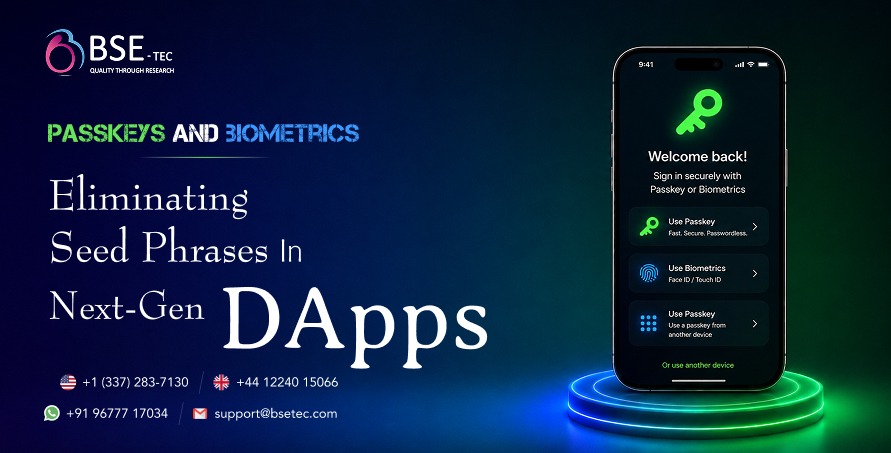
So, how exactly does this work without sacrificing self-custody? The answer lies in Passkeys, an authentication standard created by the FIDO Alliance and backed by tech giants like Apple, Google, and Microsoft.
- User initiates login
- Device requests TouchID / FaceID
- Secure Enclave signs the blockchain transaction
- dApp confirms identity securely — without a seed phrase
As a result, accessing a next-gen dApp becomes incredibly simple. Instead of hunting for a hidden notebook with your seed phrase, you simply scan your fingerprint (Touch ID) or look at your camera (Face ID). The device verifies your identity locally, signs the blockchain transaction securely, and lets you right in.
The Secret Sauce: Account Abstraction (AA)
You might be wondering: If there’s no seed phrase, how does the blockchain know the passkey is valid? This is where Account Abstraction (specifically standards like ERC-4337 and EIP-7702) comes into play.
Traditionally, a blockchain could only understand one specific type of signature. However, account abstraction turns standard wallets into programmable smart contracts.
The Game-Changing Benefits of Account Abstraction
In addition to eliminating seed phrases, this tech unlock opens up powerful features that completely revolutionize how users interact with decentralized applications:
1. Social Recovery (No More Permanent Loss)
If you lose your phone or upgrade your device, you are no longer locked out forever. Trusted friends, family, or a secure third-party service can be designated as “guardians” to help you recover your wallet automatically through a smart contract rule.
2. Gas Sponsorship (Sponsored Transactions)
Apps can pay for your transaction fees behind the scenes. As a result, users don’t even need native crypto tokens (like ETH or MATIC) just to try out an application or mint a basic NFT.
3. Batched Transactions (One-Click Actions)
Instead of signing five separate pop-ups to approve, swap, and stake your assets, account abstraction allows you to approve multiple on-chain actions with a single biometric scan.
Why Biometric Security Beats Traditional Hardware Wallets
While hardware wallets are incredibly secure, they are completely impractical for daily, casual dApp usage. In contrast, biometric authentication offers the best of both worlds: extreme security combined with instant access.
Traditional Seed Phrase / EOA wallets require manual recovery phrase storage, take around 5–10 minutes to set up, and remain vulnerable to phishing attacks. Similarly, Hardware Wallets offer stronger security but depend on external USB devices and longer setup times of 15–30 minutes. In contrast, Passkeys + Biometrics enable users to access DApps in under 5 seconds using Face ID or fingerprints, while also providing built-in phishing protection and programmable recovery without needing seed phrases or physical backups.
Evidently, passkeys offer a level of convenience that hardware wallets simply cannot match, without compromising the core principles of self-custody.
Overcoming Technical Hurdles: Cryptographic Compatibility
To be fair, integrating passkeys directly with blockchains hasn’t always been easy. Passkeys use a specific cryptographic curve known as secp256r1, while major networks like Ethereum natively use secp256k1.
Historically, validating a passkey signature on-chain was incredibly expensive in terms of network gas fees. Consequently, developers can now offer biometric log-ins that are both blazing fast and highly affordable.
How BSEtec is Building the Future of dApp Onboarding
Transitioning to this new era of user-friendly Web3 requires sophisticated engineering and deep cryptographic knowledge. This is precisely why partnering with an experienced development firm is so vital. BSEtec stands out as a pioneering Blockchain development company that builds these exact security and UX paradigms into custom dApps.
By doing so, they allow businesses to launch Web3 platforms where a user can:
- Sign up effortlessly using just an email or social media login.
- Create a secure, non-custodial wallet via Face ID in seconds.
- Start interacting with the blockchain immediately without buying native gas tokens first.
Whether you are building a DeFi platform, a next-gen Web3 game, or an enterprise supply chain solution, BSEtec focuses heavily on a user-centric design philosophy. They bridge the gap between Web2 convenience and Web3 security, ensuring your application is accessible to everyone, not just crypto experts.
Conclusion: The Era of Invisible Crypto
Ultimately, the most successful technology is the kind that becomes completely invisible. We don’t think about complex HTTP protocols when we browse the web, and users shouldn’t have to think about private keys or seed phrases when they use a dApp.
By replacing seed phrases with the biometrics we already use every day, passkeys are removing the final barrier to mainstream Web3 adoption. If you are ready to build a next-generation dApp that users will actually love using, BSEtec has the deep blockchain architecture and development expertise to make it happen.