
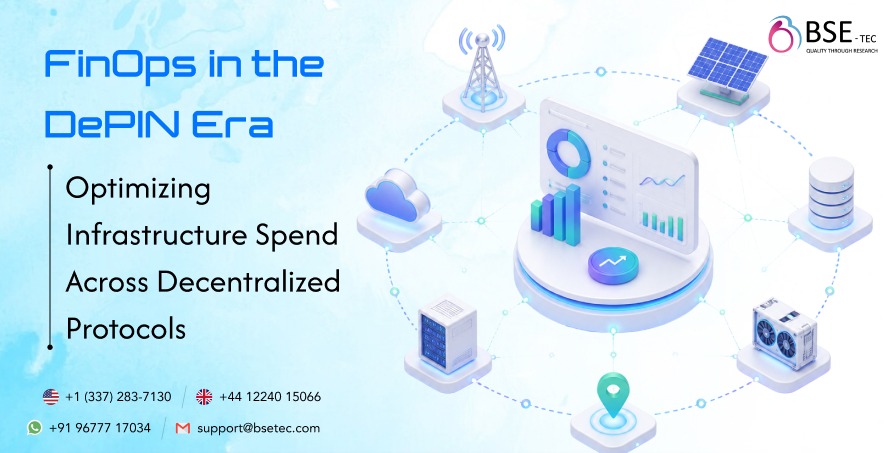
In 2026, building a decentralized platform is easier than ever. But managing the infrastructure cost behind it? That is where most projects are struggling.
A few years ago, Web3 teams mainly focused on launching tokens, attracting communities, and scaling users. Today, the conversation has completely changed. Founders are now asking: How do we reduce infrastructure burn without slowing down the network?
That question is exactly why FinOps has massively entered the DePIN world.
And honestly, it makes sense.
Because modern DePIN ecosystems are no longer small experimental networks. They now handle AI compute workloads, decentralized storage, edge rendering, wireless coverage, GPU marketplaces, IoT data streams, and even enterprise-grade cloud services. As usage grows, infrastructure spending grows even faster.
In fact, according to multiple 2026 Web3 infrastructure reports, some mid-sized DePIN protocols are now spending between $300,000 to $2 million annually on distributed node incentives, compute balancing, bandwidth allocation, and data availability layers.
That is a serious operational challenge.
Understanding FinOps in the Modern DePIN Ecosystem
Let’s simplify this naturally. In traditional cloud systems, FinOps means optimizing cloud spending across AWS, Azure, or Google Cloud.
But in DePIN, the situation is very different.
Here, infrastructure is decentralized. Instead of one cloud provider, protocols rely on thousands of distributed contributors providing storage, GPU power, bandwidth, wireless coverage, or computing resources.
So the cost structure becomes unpredictable.
For example:
- Node rewards fluctuate
- Token incentives change daily
- Validator participation varies
- GPU demand spikes during AI workloads
- Storage replication costs increase suddenly
- Cross-chain data settlement becomes expensive
Without proper financial operations, protocols start overspending very quickly.
That is why DePIN FinOps has become one of the fastest-growing operational strategies in Web3 infrastructure during 2026.
Why Infrastructure Spending Is Exploding Across DePIN Protocols
The biggest reason is simple. DePIN networks are finally moving into real-world adoption.
Earlier, decentralized infrastructure was mostly community-driven experimentation. Now, enterprises are actively using decentralized compute, decentralized AI inference, and distributed storage because centralized cloud pricing has become extremely expensive.
For instance, AI-focused DePIN networks offering GPU marketplaces saw infrastructure demand grow nearly 4x between 2024 and 2026 due to enterprise AI model training requirements.
Similarly, decentralized storage protocols are now competing directly with traditional cloud vendors by offering lower-cost archival storage.
However, scaling decentralized systems creates new financial problems.
Because, unlike centralized infrastructure, DePIN networks must constantly balance Token economics, Node profitability, User demand, Network performance, Geographic distribution, Incentive sustainability, and if even one layer becomes inefficient, the entire protocol starts leaking money.
That is why modern Web3 companies are now hiring FinOps analysts alongside blockchain engineers.
Yes, that shift is already happening in 2026.
The Real Problem Nobody Talks About: Invisible Infrastructure Leakage
Most founders only look at visible expenses. But the actual problem usually comes from invisible inefficiencies.
For example, A protocol may think it is paying fairly for node operators.
However, duplicate storage replication across underutilized regions could silently waste thousands every month.
Similarly, some decentralized GPU marketplaces continue rewarding inactive providers because monitoring systems are outdated.
Then there are bandwidth-heavy protocols that overpay for redundant data routing simply because real-time optimization logic was never implemented. All these micro-leaks eventually become massive operational losses. And this is exactly where FinOps becomes critical.
Why Smart DePIN Companies Are Building Real-Time Cost Intelligence Systems
In 2026, successful protocols will no longer treat infrastructure monitoring as a backend feature.
Instead, they are building full-scale real-time financial visibility systems.
Modern DePIN FinOps platforms now track Cost per node region, Compute efficiency ratios, Validator reward utilization, Bandwidth-to-revenue mapping, Token emission efficiency, AI workload profitability, and Real-time infrastructure ROI
This allows teams to instantly identify where spending becomes inefficient.
For example, some AI DePIN platforms now automatically reroute workloads toward lower-cost GPU providers during peak demand periods.
That alone reduces infrastructure expenditure significantly. And honestly, this level of optimization is becoming necessary, not optional.
How BSEtec Is Helping Web3 Businesses Control DePIN Infrastructure Costs
One major shift happening in 2026 is that companies no longer want just blockchain development partners. They want infrastructure intelligence partners.
That is where BSEtec is gaining strong attention in the Web3 infrastructure space.
Instead of only focusing on blockchain deployment, BSEtec is actively helping businesses optimize operational efficiency across decentralized ecosystems, especially for DePIN, AI-integrated Web3 platforms, and scalable decentralized applications.
For example, BSEtec works on:
- DePIN platform architecture optimization
- Smart contract efficiency improvements
- Cross-chain infrastructure planning
- Node ecosystem management systems
- AI-integrated blockchain infrastructure
- Token utility optimization
- Real-time analytics dashboards
- Decentralized storage integration
- Scalable validator ecosystem design
What makes this important is that infrastructure optimization directly impacts long-term project sustainability. In many Web3 projects, poor infrastructure planning increases operational spending by 20%–40% within the first scaling phase.
BSEtec focuses heavily on reducing those inefficiencies early through scalable architecture planning and optimized decentralized system design.
And in 2026, that approach matters a lot more than simply launching another blockchain product quickly. Because investors now care about sustainability metrics just as much as user growth.
DePIN FinOps Is Also Changing Investor Expectations
This is another huge trend happening quietly.
Earlier, investors mostly evaluated:
Tokenomics
Community size
Market hype
Exchange listings
Now they are asking operational questions like:
What is the infrastructure burn rate?
How sustainable are node incentives?
Can the protocol survive token volatility?
How efficient is the compute allocation model?
What is the actual cost per active user?
That is a massive mindset shift.
Protocols with strong FinOps visibility are now attracting more institutional interest because they demonstrate operational maturity. In fact, several 2026 Web3 investment reports show that infrastructure-efficient protocols retain significantly better long-term treasury stability during market volatility.
That alone makes FinOps a competitive advantage.
AI + DePIN + FinOps: The Next Major Infrastructure Battle
The next phase is already starting. AI workloads are becoming the biggest pressure point for decentralized infrastructure networks. Training, inference, rendering, and distributed computing require enormous GPU coordination. Without FinOps automation, costs become uncontrollable.
This is why modern DePIN ecosystems are integrating AI-based workload balancing, Predictive infrastructure scaling, Dynamic reward allocation, Real-time compute pricing, Autonomous node optimization, and this trend will only accelerate throughout 2026 and beyond.
The future is not just decentralized infrastructure. The future is a financially intelligent decentralized infrastructure.
Finally, the DePIN industry in 2026 is no longer just about decentralization. Today, scalability, infrastructure efficiency, and financial sustainability matter more than ever.
As decentralized networks continue expanding across AI, storage, telecom, and compute ecosystems, FinOps is becoming a core part of long-term Web3 success.
That is why businesses are partnering with companies like BSEtec for smarter DePIN architecture, scalable blockchain solutions, and optimized infrastructure planning.
In the DePIN era, the smartest infrastructure wins, not the most expensive one.