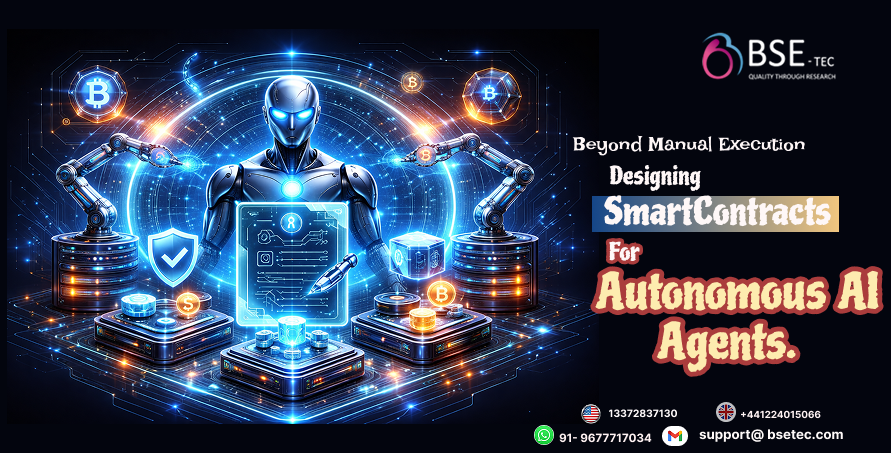
Beyond Manual Execution: Designing Smart Contracts for Autonomous AI Agents.
Smart contracts used to wait; now they’re starting to think. As automation demands rise and AI agents enter the scene, blockchain is rapidly evolving. So, instead of relying on user-triggered actions, we’re stepping into a new era of self-operating smart contracts that can act, adapt, and decide on their own.
What Are Autonomous AI Agents in Blockchain?
Autonomous AI agents are self-operating programs that use blockchain to execute smart decisions without human help.
Core features: First, these agents possess their own crypto wallets. As a result, they can sign transactions and manage assets independently. Furthermore, they use LLMs to reason, allowing them to handle complex tasks rather than just simple if-then commands.
Key uses:
- DeFi: Monitor markets 24/7 and act instantly on price changes
- Gaming: Function as intelligent NPCs that own and trade NFTs
- Governance: Analyze DAO proposals and simplify insights
They act as digital coworkers—shifting Web3 from manual actions to intelligent automation.
The Problem with Traditional Smart Contracts
The most significant problem is that code is inherently literal and permanent. While this prevents human tampering, it also means that any underlying security flaw is locked in forever. As a result, the system cannot adapt to unforeseen errors or changing circumstances without a complete and costly migration.
Key Vulnerabilities:
- Immutable Errors: Once deployed, code cannot be easily patched; therefore, bugs lead to permanent exploits.
- Oracle Dependency: They are blind to the real world and consequently rely on external data feeds that can be manipulated.
- Scalability Walls: High demand leads to network congestion; specifically, gas fees often exceed the value of the contract itself.
- Zero Nuance: The code lacks a good-faith interpretation; hence, it cannot handle complex legal disputes or human context.
Simply put, traditional smart contracts are reactive—not proactive.
Designing Smart Contracts for AI-Driven Autonomy
Designing smart contracts for AI-driven autonomy means moving beyond rigid logic to adaptive systems. To handle fast AI decisions and data, these contracts must bridge blockchain precision with AI flexibility—something a smart contracts development company enables.
Here is how these smart contracts must be reimagined:
1. Dynamic Parameter Adjustment
Furthermore, smart contracts must evolve from static code to adaptive frameworks. Traditional contracts have fixed variables, but AI-driven contracts can utilize hooks that allow the AI to update parameters—such as interest rates in DeFi or pricing in a supply chain—based on real-time market sentiment and off-chain data analysis.
2. Integration with Decentralized Oracles
In addition to internal logic changes, there is a critical need for robust data pipelines. Since AI agents rely on massive datasets, smart contracts must be tightly integrated with decentralized oracles (like Chainlink) to verify external AI computations. This ensures that the intelligence triggering the contract is both verifiable and tamper-proof.
3. Verification of AI Proofs (zkML)
Consequently, a major challenge arises: how does the blockchain trust an AI’s decision without re-running the entire expensive model on-chain? The solution lies in Zero-Knowledge Machine Learning (zkML). Smart contracts can be designed to accept a cryptographic proof that an AI model was executed correctly, allowing for complex autonomy without compromising network efficiency.
4. Agentic Permissioning and Governance
Moreover, the legal and operational structure of these contracts must account for agentic behavior. This involves creating multi-signature schemas where the AI agent holds a key, but human circuit breakers or DAO-led governance protocols can intervene if the AI’s autonomous actions deviate from the intended goals or safety parameters.
5. Automated Escrow and Settlement
Finally, to achieve true autonomy, these contracts must serve as the agent’s bank account. By using programmable escrow accounts, the smart contract can automatically release payments to third-party services or other agents once the AI provides proof of task completion, eliminating the need for human intermediaries in the transaction loop.
Real-World Use Cases
The integration of AI and blockchain is moving beyond theory into practical, high-impact applications. To understand how these autonomous systems function, here are the primary real-world use cases:
Supply Chain: Consequently, AI agents predict shipping delays and use smart contracts to autonomously re-route cargo or trigger insurance payouts.
Energy Trading: Moreover, AI monitors home battery levels and interacts with smart contracts to sell excess power to the grid during peak hours.
Retail Payments: Similarly, AI-driven carts track purchases in real-time, while smart contracts execute instant, cashier-less checkouts upon exiting the store.
Asset Management: Furthermore, AI bots analyze market volatility to trigger smart contracts that rebalance investment portfolios and lock in profits automatically.
Digital Licensing: Finally, AI identifies unauthorized media use and uses smart contracts to collect micro-royalties for creators without manual intervention.
Challenges to Overcome
While the potential is massive, designing autonomous systems comes with challenges:
- Security risks in AI decision-making
- Data reliability from external sources
- Transparency vs complexity in AI logic
- Regulatory uncertainty
Why BSEtec Leads This Transformation
BSEtec is transforming the digital economy by combining decentralized systems with autonomous intelligence. As a leading Blockchain development company and AI development company, it enables smart contracts to evolve into intelligent, self-operating systems that can think, act, and execute independently.
- Agentic Execution: Specifically, BSEtec designs contracts that respond to AI-driven triggers rather than manual signatures, allowing agents to manage assets and supply chains 24/7.
- Dedicated Layer 3 Chains: Furthermore, the firm utilizes hyper-specialized L3 “App-Chains” to provide a high-speed, low-cost environment where AI agents can execute millions of transactions without congestion.
- Verifiable Trust (zkML): Moreover, by integrating Zero-Knowledge Machine Learning, BSEtec ensures that every autonomous AI decision is cryptographically verifiable on-chain without exposing private data.
- Seamless Smart Accounts: In addition, the use of Account Abstraction (ERC-4337) allows AI agents to manage their own gas fees and execute complex tasks as independent economic actors.
- Modular Enterprise Tools: Finally, BSEtec provides a scalable suite of tools that allow businesses to automate workflows like predictive maintenance and real-time royalties through a unified, autonomous framework.
The Future: Self-Operating Digital Economies:
As we move forward, users will no longer interact with systems step-by-step; instead, they will simply define goals, and intelligent agents will handle the rest. Consequently, smart contracts will evolve from static agreements into living systems that continuously execute, learn, and optimize.
Ultimately, in this transformation, BSEtec stands at the forefront—turning blockchain from a passive tool into a powerful, autonomous engine of growth.
Conclusion:
Blockchain is no longer just about execution—it’s about intelligence. As smart contracts evolve into autonomous systems, this shift goes beyond a technical upgrade and becomes a true paradigm change.
So, while forward-thinking businesses gain speed, efficiency, and a clear competitive edge, others risk falling behind in a rapidly advancing landscape.
BSEtec transforms smart contracts from static code into intelligent, autonomous systems—powering the next era of blockchain innovation.