Your Mobile App Isn’t Competing Against Other Apps Anymore, It’s Competing Against Hackers
Imagine spending months building a mobile application. Your developers finish the features. The UI looks polished. The testing team signs off. Everything seems ready for launch. Then, just days before App Store submission, a critical security vulnerability is discovered. Suddenly, your launch timeline collapses.
Unfortunately, this is not a rare scenario anymore.
In 2026, mobile applications have become one of the biggest attack surfaces for cybercriminals. From fintech wallets and healthcare apps to eCommerce platforms and AI-powered mobile assistants, attackers are actively targeting mobile ecosystems because that is where users spend most of their digital time.
According to recent industry security reports, mobile application attacks increased by more than 38% globally during the last year, while nearly 70% of security vulnerabilities identified in production environments could have been detected much earlier during development.
That statistic reveals a simple truth: Security can no longer be a final checkpoint. It must become part of the development pipeline itself.
This is exactly where DevSecOps is transforming mobile app development.
Why Traditional Mobile Security Is Failing in 2026
For years, security testing happened near the end of the development cycle.
Developers built the application.
QA teams tested functionality.
Security teams reviewed the final build.
Only then were vulnerabilities identified.
However, modern mobile applications are far more complex.
Today, a single mobile app may include AI-powered features, Third-party APIs, Open-source libraries, Cloud-native backend services, Blockchain integrations, Payment gateways, and real-time analytics tools
As a result, the number of potential attack points has expanded dramatically.
Consequently, waiting until the final stage to perform security checks creates unnecessary risk, delays, and compliance challenges. Organizations are now realizing that security must move left, meaning vulnerabilities should be identified while code is still being written.
What DevSecOps Actually Means for Mobile Development
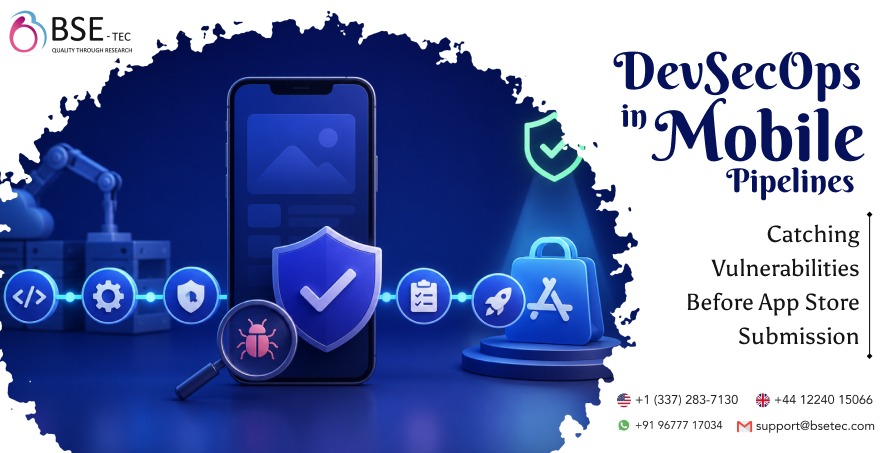
DevSecOps is the practice of integrating security into every phase of the software development lifecycle. Instead of treating security as a separate activity, it becomes an automated part of CI/CD pipelines.
Think about it this way.
Every time developers commit code, automated systems immediately check vulnerable dependencies, insecure API configurations, hardcoded secrets, authentication flaws, data exposure risks, and compliance violations. As a result, they detect issues within minutes instead of waiting weeks to find them. This dramatically reduces remediation costs and accelerates release cycles.
The New Security Layers Leading Mobile Pipelines in 2026
The most advanced mobile development teams are no longer relying on basic vulnerability scans. Instead, they are implementing multiple automated security layers.
AI-Powered Code Security Analysis
AI-driven security scanners can now analyze thousands of code changes in real time. Rather than simply matching known vulnerability patterns, these tools can predict risky coding behavior before deployment.
This allows teams to identify potential attack paths much earlier than traditional static analysis tools.
Dependency and Supply Chain Protection
One of the biggest security risks today comes from third-party packages. Recent industry findings indicate that over 90% of modern applications contain open-source components, making software supply chain security a major concern.
Therefore, organizations are increasingly deploying automated dependency monitoring tools that continuously scan libraries for newly discovered vulnerabilities.
Secret Detection Before Build Completion
API keys, cloud credentials, and authentication tokens accidentally committed to repositories remain one of the most common causes of security incidents. Modern DevSecOps pipelines automatically block builds when secrets are detected.
This prevents sensitive credentials from reaching production environments.
Mobile API Security Validation
Many mobile attacks no longer target the app itself. Instead, attackers exploit backend APIs. As a result, leading DevSecOps teams now include API security testing directly inside CI/CD workflows to validate authentication, authorization, rate limiting, and data protection controls before release.
The Growing Connection Between Mobile Security, AI, and Blockchain
An interesting trend emerging in 2026 is the convergence of mobile security, AI, and blockchain technologies.
For example, AI-powered mobile applications process enormous volumes of user data.
Similarly, blockchain-enabled mobile apps handle digital assets, tokenized transactions, and decentralized identity systems. Both require stronger security standards than traditional applications. This is where organizations need development partners capable of managing multiple technology stacks while maintaining secure delivery pipelines.
Companies increasingly seek expertise that combines mobile development, DevSecOps, blockchain implementation, and AI integration under a unified development framework.
How BSEtec Helps Organizations Build Secure Mobile Applications
As mobile ecosystems continue evolving, businesses need more than just app development.
They need secure-by-design delivery models. This is where BSEtec plays a critical role.
With expertise spanning Mobile App Development, Blockchain Solutions, AI Integration, Cloud Infrastructure, and DevSecOps implementation, BSEtec helps organizations embed security directly into development pipelines rather than treating it as a post-development activity.
By integrating automated vulnerability scanning, dependency management, CI/CD security controls, infrastructure monitoring, and compliance-focused deployment practices, BSEtec enables businesses to identify risks before applications reach app stores.
More importantly, this approach reduces release delays, improves customer trust, and supports long-term scalability.
Why App Store Approval Is No Longer the Finish Line
Many organizations still believe security ends when their application gets approved by Apple or Google.
In reality, that is only the beginning. Attackers continuously analyze newly published applications, looking for Weak authentication mechanisms, Exposed APIs, Vulnerable libraries, Insecure data storage, Poor encryption implementations. Therefore, security must become a continuous process rather than a one-time review. The organizations winning in 2026 are not necessarily releasing apps faster. They are releasing secure apps faster.
Final Thoughts
Here’s the question every mobile business should ask:
If a critical vulnerability exists in your application today, would you discover it before attackers do?
The answer depends on your pipeline. In 2026, successful mobile applications will no longer be built with DevOps alone. They are built with DevSecOps at the core. Because every vulnerability caught before App Store submission saves time, protects users, preserves reputation, and prevents costly security incidents.
And if you’re looking to build mobile applications with security integrated from day one—not added as an afterthought—BSEtec can help you create future-ready, secure development pipelines designed for the next generation of mobile, AI, and blockchain-powered applications.
The best time to fix a vulnerability is before users ever download your app.