For years, trillions of dollars in real estate, private credit, treasury bonds, commodities, and alternative assets remained trapped inside slow-moving financial systems. Selling them often required intermediaries, extensive paperwork, jurisdictional approvals, and settlement periods that could stretch for days or even weeks. Today, that reality is changing. In 2026, Real-World Asset (RWA) tokenization is no longer a futuristic concept. Instead, it is becoming the foundation of a new financial infrastructure where assets move as efficiently as information. Tokenized RWA markets have expanded rapidly, with industry reports showing the sector surpassing $19 billion in on-chain value by Q1 2026, while several analysts project the market could grow into the multi-trillion-dollar range by 2030.
However, the real story is not tokenization itself.
The real story is the rise of RWA Liquidity Vaults, programmable financial engines designed to transform traditionally illiquid assets into globally accessible, yield-generating, and continuously tradable digital products.
And if you’re watching where institutional capital is heading next, this is the infrastructure you need to understand.
Why Tokenization Alone Is Not Enough
Many people assume tokenization simply means converting an asset into a digital token.
That is only the first step.
Imagine a commercial property worth $100 million. You can tokenize ownership into thousands of digital shares. Yet if those tokens cannot be traded efficiently, used as collateral, integrated with lending protocols, or accessed by global investors, liquidity remains limited.
In other words:
Tokenization creates digital ownership.
Liquidity vaults create digital markets.
This distinction is becoming increasingly important as institutions seek not only blockchain-based assets but also blockchain-native liquidity. Research shows that while tokenized assets are growing rapidly, only a portion of them are actively participating in DeFi ecosystems where liquidity generation occurs.
Consequently, the next wave of innovation is focused on making tokenized assets productive rather than merely digital.
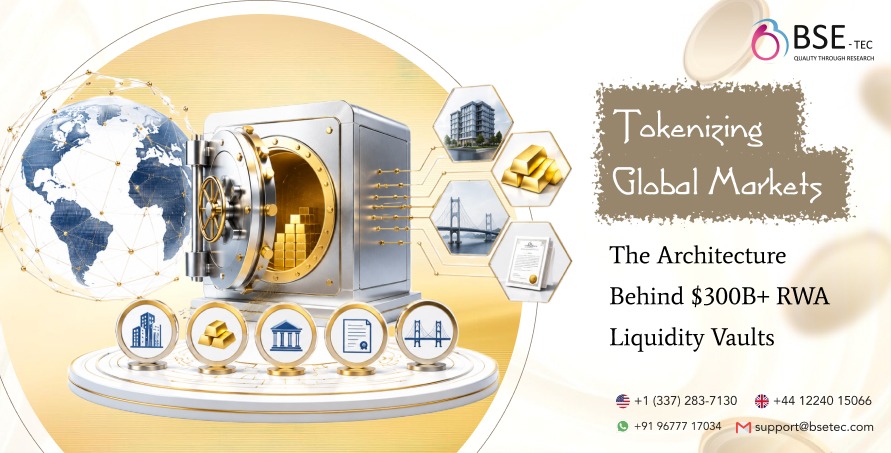
The Rise of $300B+ Liquidity Vault Ecosystems
Across global markets, financial institutions are building vault architectures that aggregate multiple asset classes into programmable liquidity pools.
These vaults are designed to hold Tokenized treasury securities, Private credit portfolios, Real estate assets, Infrastructure investments, Commodity-backed assets, Trade finance instruments, Revenue-generating business assets
Rather than keeping these assets isolated, vaults package them into interoperable blockchain ecosystems where capital can move continuously.
As a result, investors gain access to Fractional ownership, Instant settlement, Automated yield distribution, Real-time asset transparency, Global participation, and 24/7 liquidity access
This shift explains why tokenized treasuries have become one of the fastest-growing segments of the RWA sector, surpassing billions in on-chain value as institutions search for stable, yield-bearing blockchain assets.
The Architecture Behind Modern RWA Liquidity Vaults
To understand how these vaults function, think of them as a stack of interconnected layers rather than a single blockchain application.
Layer 1: Asset Origination
Everything begins with a real-world asset.
This could be Government bonds, Corporate debt, Commercial real estate, Renewable energy projects, Supply chain financing, or private equity positions
The asset is legally structured so ownership rights can be represented digitally. Without this foundation, tokenization has no enforceable value.
Layer 2: Tokenization Layer
Next, ownership rights are converted into blockchain-based tokens.
These tokens contain programmable rules defining Ownership rights, Transfer restrictions, Investor eligibility, Redemption mechanisms, and Revenue distributions
This is where traditional finance begins transforming into programmable finance.
Layer 3: Compliance Engine
Institutional adoption depends on regulatory compliance.
Therefore, modern vaults integrate KYC verification, AML monitoring, Investor accreditation checks, Jurisdiction-specific restrictions, and automated reporting frameworks
In 2026, compliance is no longer an add-on feature. It is embedded directly into the architecture itself.
Layer 4: Liquidity Layer
This is where the real innovation happens.
Instead of sitting idle, tokenized assets are deposited into liquidity vaults.
The vault enables assets to serve as collateral, generate lending yields, support structured products, participate in secondary markets, and facilitate cross-border transactions.
As liquidity increases, market efficiency improves. And when liquidity improves, institutional capital follows.
Layer 5: Automated Settlement Layer
Traditional settlement cycles can take days. Blockchain-based vaults reduce settlement times dramatically through smart contract automation.
Transactions that previously required Custodians, Clearing houses, Brokers, and multiple banking intermediaries
can now be executed through programmable workflows operating around the clock. This capability is becoming one of the strongest drivers behind institutional interest in tokenized finance.
Why Institutions Are Moving Now
A few years ago, RWA tokenization was viewed as an experimental blockchain use case.
Today, major financial players are exploring tokenized funds, treasury products, private credit instruments, and digital asset infrastructure. Market reports indicate that tokenized RWAs have grown more than 250% within a relatively short period, highlighting accelerating institutional adoption.
The reason is simple.
Institutions see three major advantages:
Greater Liquidity: Previously illiquid assets become globally accessible investment opportunities.
Faster Capital Movement: Capital no longer waits for banking hours or regional settlement systems.
Improved Transparency: Every transaction, transfer, and ownership update can be verified on-chain.
Together, these benefits create a more efficient financial ecosystem than traditional market structures.
Where BSEtec Is Building the Future of RWA Liquidity Infrastructure
As tokenized RWAs gain traction, businesses need complete ecosystems for compliance, liquidity, investor management, and cross-border transactions—not just token creation.
As a result, BSEtec is actively helping enterprises transform traditional assets into globally accessible digital investment opportunities.
According to recent market reports, the tokenized RWA sector has crossed $19 billion in on-chain value in 2026. Meanwhile, leading institutions such as BlackRock, Franklin Templeton, and JPMorgan continue expanding their blockchain-based asset strategies. Furthermore, analysts project that the broader RWA market could exceed $16 trillion by 2030, making it one of the fastest-growing segments in global finance.
Given this rapid growth, technology infrastructure has become the deciding factor for businesses looking to participate in this transformation.
To address this need, BSEtec delivers end-to-end RWA tokenization solutions that go beyond simple asset digitization. From asset tokenization and smart contract development to compliance frameworks, investor onboarding, liquidity management, and secure blockchain integration, BSEtec provides the foundation businesses need to unlock new investment opportunities and scale in the evolving digital asset economy.
The company helps organizations build:
- Real Estate Tokenization Platforms
- Asset-backed Security Token Solutions
- RWA Investment Marketplaces
- Smart Contract-Based Liquidity Vaults
- Fractional Ownership Platforms
- Digital Asset Custody Integrations
- Investor & Compliance Management Systems
- Multi-chain Blockchain Infrastructure
As a leading Blockchain development company, BSEtec helps businesses transform illiquid assets into globally tradable digital assets.
Through advanced Blockchain development services, BSEtec builds liquidity-driven ecosystems that unlock new capital and expand investor access.
With a creation. transparency, automation, and instant settlement, BSEtec enables enterprises to build the future of tokenized finance.
Final Thoughts
Tokenization started as a way to digitize ownership.
However, the future belongs to platforms that can create liquidity, automate trust, and connect global capital efficiently.
As RWA markets continue expanding and institutional adoption accelerates, liquidity vaults will become one of the most valuable layers of blockchain infrastructure. Consequently, the focus is shifting from simple asset tokenization to building sustainable financial ecosystems. In the years ahead, the winners will not simply tokenize assets; instead, they will create ecosystems where those assets can continuously generate value. Ultimately, the organizations that combine liquidity, accessibility, and utility will lead the next phase of tokenized finance.
For you, whether you’re a financial institution, asset manager, enterprise, or innovator exploring tokenization, the question is no longer if RWA tokenization will reshape markets.
The question is whether you’re building on the infrastructure that will power the next generation of global liquidity.
And that is exactly where BSEtec is helping businesses lead the transformation.
Discover how RWA liquidity vaults are transforming global markets by turning real-world assets into liquid, tradable, and yield-generating digital investments at scale.