As blockchain adoption grows in 2026, startups aren’t asking if they should use it—they’re asking how to scale it without hurting user experience. For high-volume apps like DeFi, gaming, and marketplaces, choosing between Layer 2 and Layer 3 becomes crucial.
But which one is right for your startup?
Let’s break it down in a practical: Layer 2 and Layer 3
Understanding Layer 2 (L2): The First Step to Scaling
Layer 2 (L2) is a secondary protocol built on top of a main blockchain (Layer 1) to make transactions faster and cheaper.
How it works
Initially, the main blockchain (Layer 1) gets congested and expensive. To solve this, Layer 2 handles the bulk of the transaction work off-chain. Subsequently, it bundles thousands of these transactions into a single summary and sends it back to Layer 1 for final security.
Essentially, Layer 2 acts like an express lane that reduces fees and increases speed, while still relying on the main network for ultimate safety. In short, it is the key to scaling blockchain for everyone.
L2 solves many problems—but what happens when your startup grows beyond its limits?
Enter Layer 3 (L3): Scaling for High-Volume Applications
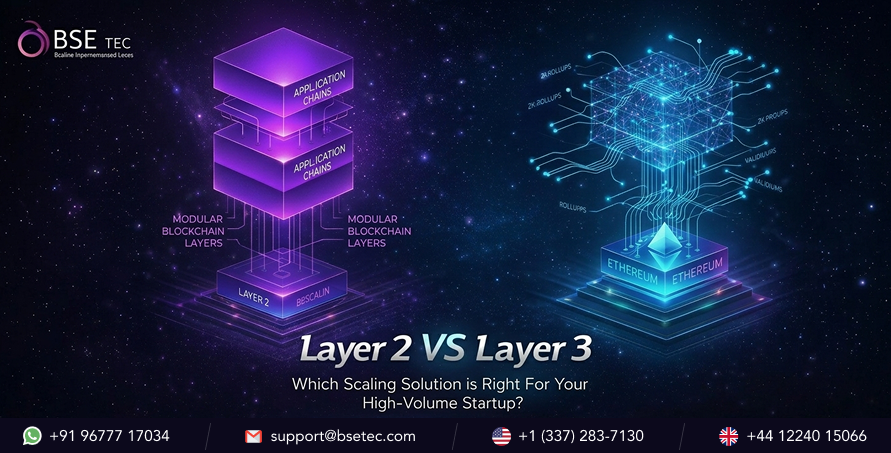
Layer 3 (L3) is a highly specialized protocol built on top of Layer 2 (L2) to provide hyper-scalability and customization for high-volume apps.
The role of Layer 3
Initially, Layer 2 scales the main blockchain (Layer 1) for general use. Building on this, Layer 3 creates a dedicated, application-specific environment for things like gaming or high-frequency trading.
How it scales
- Isolation: Transactions occur within the private L3 sub-network.
- Compression: Subsequently, thousands of L3 actions are rolled up into a single transaction on Layer 2.
- Settlement: Layer 2 then settles those records on Layer 1.
Why it matters
Essentially, Layer 3 offers near-zero fees and complete control over network rules. In short, if Layer 2 is the highway, Layer 3 is a dedicated exit built specifically for a single, massive destination.
Now that we understand both, let’s compare them side by side.
Layer 2 vs Layer 3: What’s the Real Difference?
The primary difference between Layer 2 (L2) and Layer 3 (L3) lies in their purpose: L2 is for general scaling, while L3 is for application-specific customization.
Key differences:
The Scope: Network vs. App: Initially, Layer 2 is designed as a general-purpose scaling layer. It aims to improve the performance of an entire ecosystem (like all of Ethereum). In contrast, Layer 3 is often an App-Chain. It is a dedicated network for a single application, ensuring that a surge in users for a popular game doesn’t spike the fees for everyone else on the network.
Data Availability & Interoperability: Finally, Layer 2 nodes must constantly post data to Layer 1 to stay secure. On the other hand, Layer 3 can be more flexible. It can store data in cheaper locations or use the Layer 2 as a fast communication hub to talk to other L3s instantly without ever touching the slower Layer 1 mainnet.
Customization & Sovereignty: Furthermore, Layer 2 protocols generally must follow the strict rules of the Layer 1 on which they sit. Building on this, Layer 3 grants developers total sovereignty. Consequently, developers can customize their own network rules, such as allowing users to pay gas fees in a custom token (like $USDC) or keeping specific data private.
Recursive Scaling: Furthermore, Layer 3 uses a concept called Recursive Rollups.
- L2 bundles transactions into one and sends them to L1.
- L3 bundles its own transactions and sends them to L2.
Consequently, this creates an exponential jump in capacity. If an L2 makes things 100x faster, an L3 on top can make things 10,000x faster ($100 \times 100$).
Cost: While L2 significantly reduces costs, Layer 3 can make transactions nearly free by bundling data a second time before it ever hits the main blockchain.
Understanding the differences is just the start—applying them the right way is what truly drives scalable growth.
Where BSEtec Comes In
Choosing a scaling solution isn’t just about the tech; it’s about execution.
This is where BSEtec acts as a strategic partner for your startup.
- Architectural Consulting — Initially, BSEtec evaluates your startup’s specific traffic patterns and budget. Instead of a one-size-fits-all approach, they help you determine if your volume justifies the complexity of an L3 or if a robust L2 framework provides a better ROI.
- Custom Blockchain development — Furthermore, BSEtec specializes in building blockchain environments. Whether you need an L2 rollup or a dedicated L3 AppChain, their engineers handle the heavy lifting of smart contract deployment and node infrastructure.
- Interoperability & Integration — Moreover, a major hurdle for high-volume startups is fragmentation. BSEtec ensures that your scaling solution remains interoperable with other chains. This means your users can move assets seamlessly between your platform and the broader Web3 ecosystem.
- Security Auditing and Maintenance — Because high volume attracts high risk, BSEtec provides rigorous security protocols. They don’t just launch your solution; they continuously monitor the network to prevent bottlenecks and protect against vulnerabilities in the scaling bridge.
With the right foundation in place, let’s look at when choosing Layer 2 becomes the smartest move for your startup.
Choosing Layer 2: When Simplicity Wins
While crypto often leans toward complexity, Layer 2 proves that simplicity scales best—offering faster transactions and lower costs without compromising security. Here is why keeping it simple with Layer 2 wins, and how BSEtec accelerates that journey:
Why simplicity wins:
- Cost Efficiency: L2s drastically reduce gas fees, making micro-transactions viable for the first time.
- User Experience: Faster confirmation times mean blockchain apps feel as snappy as traditional web apps.
- Developer Familiarity: Most L2s are EVM-compatible, allowing developers to migrate without learning a new language.
How BSEtec Accelerates Your L2 Launch
At BSEtec, we specialize in helping startups navigate this landscape. We don’t just provide code; we provide a launchpad. Our experts help you:
- Identify the right L2 stack (Optimistic vs. ZK-Rollups) for your specific needs.
- Deploy scalable L2 solutions with optimized smart contracts.
- Ensure a smooth transition from concept to a live, high-performance application.
But if your app demands more control, dedicated block space, and extreme performance, L2 may not be enough. In those cases, it’s time to look toward the next frontier: Layer 3 and App-Chains.
Choosing Layer 3: When Performance is Everything
While Layer 2 boosts scalability, some apps need more control and speed—this is where Layer 3 (L3) steps in with app-specific performance.
Why L3? The Need for Extreme Performance
Furthermore, L3 protocols are built on top of Layer 2, acting as a specialized environment for a single application. This architecture is essential for:
- Hyper-Scale Gaming: High-fidelity Web3 games require thousands of micro-transactions per second without any latency.
- High-Frequency Trading (HFT): Enterprise-grade DeFi platforms need dedicated block space to avoid noisy neighbor congestion from other apps.
- Complex Supply Chains: Private or semi-private ecosystems that require specific data privacy and custom gas tokens.
How BSEtec Builds Tailored L3 Infrastructures
At BSEtec, we move beyond general-purpose scaling to provide hyper-specialized App-Chains. We don’t just deploy a network; we architect a private highway for your application. Our experts help you:
- Architect Custom Execution Environments tailored to your specific transaction logic for maximum efficiency.
- Integrate Invisible Blockchain UX features like gas abstraction and session keys to hide complexity from users.
- Deploy Dedicated Infrastructure, including custom RPC nodes, explorers, and secure bridges back to L2/L1.
Here’s the interesting part—many successful startups don’t actually choose just one.
The Hybrid Approach: L2 + L3 Together
Instead of choosing between Layer 2 and Layer 3, many modern startups are combining both to unlock the best of scalability and performance. This hybrid approach uses Layer 2 for secure settlement while leveraging Layer 3 for fast execution and app-specific performance. The result is a powerful setup where your application can handle high volumes efficiently without compromising on security or user experience.
Why this approach works:
- Better scalability for growing user demand
- Greater flexibility with app-specific customization
- Seamless, faster user experience
With deep expertise in both layers, BSEtec helps startups design and implement this combined architecture, ensuring a future-ready and high-performing blockchain solution.
Conclusion: Make the Right Scaling Move
In simple terms, Layer 2 gives you efficient and reliable scaling, while Layer 3 delivers powerful, customizable performance for demanding applications. The key is not just choosing a layer—but choosing what aligns best with your startup’s growth strategy.
With the right approach—and the support of a trusted Blockchain Development Company like BSEtec—your startup can scale seamlessly and deliver the fast, smooth experiences users truly expect.