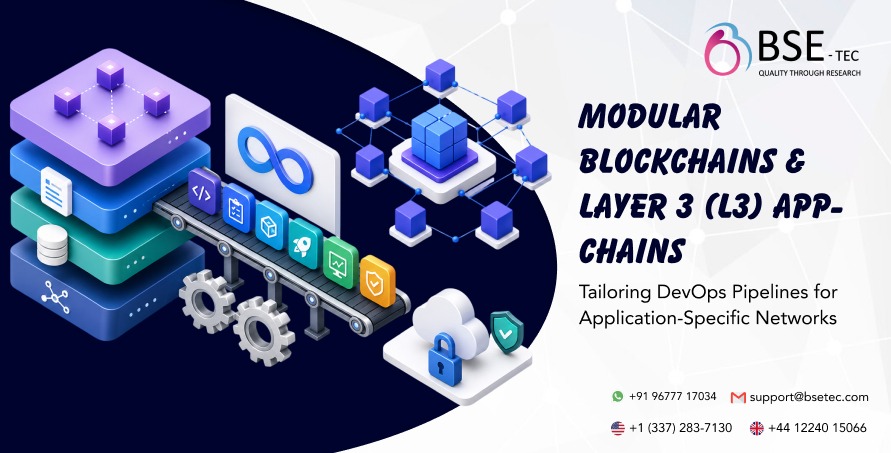
The blockchain industry in 2026 looks very different from what it did just a few years ago. Earlier, most projects competed to build on a handful of monolithic blockchains where execution, consensus, data availability, and settlement happened on the same network. Today, however, the conversation has shifted toward modular architectures and Layer 3 (L3) application-specific chains.
This transition is driven by growing business demand for scalable blockchain solutions that offer predictable performance, lower costs, greater customization, and a seamless user experience.
As blockchain adoption expands across finance, gaming, supply chain, AI marketplaces, tokenized assets, and digital identity systems, organizations are realizing that a one-size-fits-all blockchain is no longer sufficient. They need networks optimized for their specific workloads. That is exactly where modular blockchains and Layer 3 app-chains are creating new opportunities.
At the same time, this architectural evolution is changing another critical area that often receives less attention: DevOps. Building an application-specific blockchain requires a completely different deployment, monitoring, testing, and automation strategy compared to deploying a smart contract on a shared Layer 1 network.
Let’s explore why modular blockchain infrastructure is becoming the foundation of next-generation Web3 applications and how DevOps pipelines are evolving alongside it.blockchain layer 3blockchain layer 3
Why Modular Blockchain Architecture Is Dominating Blockchain Discussions in 2026
For years, blockchain developers faced a difficult tradeoff.
Networks could be decentralized and secure, but often struggled with scalability. Others achieved higher throughput but sacrificed decentralization or flexibility.
Modular blockchains emerged as a response to this challenge.
Instead of forcing a single blockchain to handle every function, modular architectures separate key responsibilities into specialized layers:
- Execution Layer
- Settlement Layer
- Consensus Layer
- Data Availability Layer
This separation allows developers to select the infrastructure components that best fit their application’s requirements.
For example, a blockchain-based gaming platform may prioritize fast execution and low latency. A tokenized asset platform may prioritize settlement security and regulatory transparency. An AI data marketplace may focus on high-volume data availability.
Rather than adapting the application to the blockchain, modular architecture allows the blockchain stack to adapt to the application.
As a result, development teams gain greater flexibility while maintaining scalability.
The Rise of Layer 3 (L3) App-Chains
As Layer 2 scaling solutions matured, Layer 3 (L3) app-chains emerged as a powerful way to support application-specific blockchain networks. Built on top of Layer 2 infrastructure, these chains provide dedicated performance, customizable fee models, greater governance control, and a smoother user experience. By offering enhanced scalability and flexibility, L3 app-chains are becoming an attractive choice for enterprises seeking efficient and tailored blockchain solutions.
Why DevOps Becomes More Complex in Modular Blockchain Environments
While modular blockchain infrastructure creates tremendous opportunities, it also introduces operational complexity.
A traditional blockchain application may require Smart contract deployment, Node monitoring, and Wallet integration
An L3 app-chain environment requires significantly more.
Teams must manage Sequencers and Rollup infrastructure, Data availability services, Settlement integrations, Cross-chain messaging systems, Validator coordination, Security monitoring, and Automated recovery systems
Because multiple infrastructure layers interact continuously, DevOps pipelines become mission-critical.
A deployment failure in one layer can affect the entire ecosystem. Therefore, blockchain organizations are increasingly investing in automated DevOps frameworks specifically designed for modular architectures.
What Modern Blockchain DevOps Pipelines Look Like in 2026
The blockchain DevOps landscape has evolved dramatically. Manual deployments are rapidly disappearing. Instead, organizations are implementing automated blockchain delivery pipelines that include:
Every component of the blockchain environment is version-controlled and reproducible. Infrastructure configurations, node deployments, monitoring policies, and network settings are managed through code repositories.
This minimizes configuration drift and improves deployment reliability.
Continuous Integration and Continuous Deployment (CI/CD)
Smart contracts, rollup components, validators, APIs, and supporting services move through automated testing environments before reaching production. This approach enables faster releases while reducing operational risks.
Automated Security Validation
Security testing now happens continuously.
Modern pipelines automatically scan for Smart contract vulnerabilities, Configuration errors, Access control issues, Infrastructure misconfigurations, and network security weaknesses
As blockchain ecosystems grow more complex, automated security validation has become a necessity rather than an optional feature.
Observability and Real-Time Monitoring
Organizations increasingly rely on distributed tracing, Node health monitoring, Rollup performance analytics, Transaction throughput dashboards, and cross-chain bridge monitoring
This visibility allows teams to identify issues before users experience disruptions.
Real-Time Industry Trends Driving L3 Adoption (2026)
The demand for Layer 3 (L3) app-chains is growing rapidly as blockchain adoption enters a large-scale production phase.
Tokenized real-world assets (RWAs) surpassed $27 billion globally in early 2026, driving demand for specialized blockchain infrastructure.
AI-powered decentralized applications are creating higher transaction volumes, requiring scalable and dedicated networks.
Blockchain gaming platforms are targeting 100,000+ TPS, making application-specific chains increasingly important.
Enterprises are moving from blockchain pilots to production deployments, seeking greater control, performance, and customization.
As a result, organizations are increasingly adopting modular blockchain architectures and L3 app-chains to build scalable, high-performance Web3 ecosystems.
Where BSEtec Fits into This Evolution
As modular blockchain ecosystems continue to mature, businesses need more than development resources. They need partners capable of designing, deploying, and managing complex blockchain infrastructure.
This is where BSEtec’s blockchain engineering expertise becomes particularly valuable.
Rather than treating a Blockchain development company as only smart contract creation, BSEtec focuses on building complete blockchain ecosystems that align with business objectives.
For organizations exploring Layer 3 app-chain strategies, BSEtec helps address critical areas such as:
- Blockchain architecture consulting
- Smart contract development
- Multi-chain ecosystem integration
- DevOps automation workflows
- Infrastructure monitoring solutions
- Cross-chain interoperability implementation
- Enterprise blockchain deployment strategies
More importantly, BSEtec approaches blockchain projects with scalability in mind from the beginning.
As application-specific networks grow, operational efficiency becomes just as important as functionality. By integrating automated deployment pipelines, infrastructure monitoring, and security-first engineering practices, BSEtec helps businesses prepare for long-term blockchain growth rather than short-term experimentation.
The Future Is Application-Specific
Looking ahead, the blockchain industry appears to be moving toward a future where every major application operates on infrastructure optimized specifically for its requirements.
Instead of asking:
“Which blockchain should we build on?”
Organizations are increasingly asking:
“What blockchain architecture should we build for our application?”
That distinction is significant.
Modular blockchains and Layer 3 app-chains are transforming blockchain infrastructure from a shared resource into a customizable platform.
As a result, DevOps is no longer a supporting function operating behind the scenes. It has become a strategic capability that directly influences scalability, security, reliability, and user experience.
In 2026, blockchain success requires both the right architecture and scalable DevOps automation for application-specific networks.
The organizations that combine modular blockchain design with automated, resilient, and scalable DevOps operations will be best positioned to deliver the next generation of Web3 products. And as this transition accelerates, technology partners like BSEtec are helping businesses bridge the gap between blockchain innovation and production-ready infrastructure that can scale in the real world.