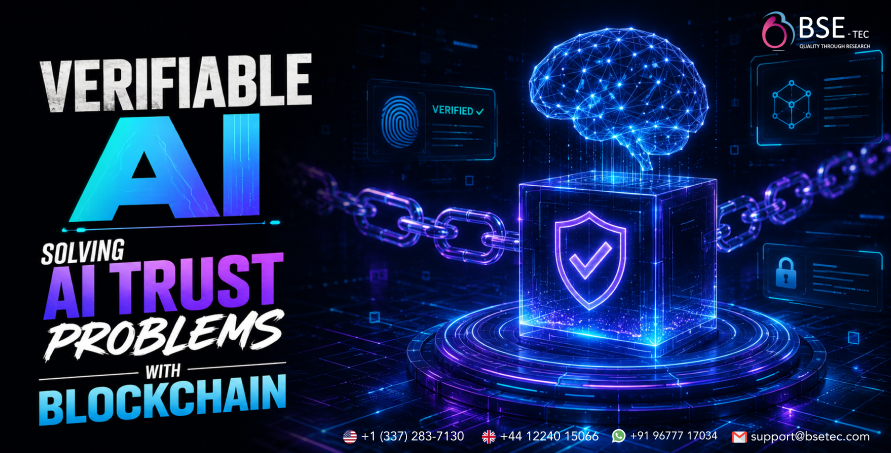
AI is evolving from simple chatbots into autonomous systems that can analyze data, make decisions, generate content, and perform actions. As AI becomes more powerful, a critical question emerges: How can businesses verify that AI systems, data, decisions, and outputs can be trusted? This is where Verifiable AI is gaining attention in 2026.
Rather than asking users to blindly trust an AI model, Verifiable AI focuses on creating evidence around how an AI system operates. Blockchain can strengthen this approach by providing tamper-evident records for identity, provenance, model versions, permissions, decisions, and transactions.
The need is becoming urgent. According to Stanford’s 2026 AI Index, 88% of surveyed organizations reported using AI in at least one business function in 2025, while generative AI was regularly used in at least one business function by 79%. At the same time, documented AI incidents increased to 362 in 2025, compared with 233 in 2024.
Therefore, the next phase of AI adoption is not only about making models smarter. It is also about making their actions and outputs verifiable, traceable, and accountable.
Why AI Needs a Trust Layer
AI can be powerful, but it is not always reliable. Stanford’s 2026 AI Index found hallucination rates ranging from 22% to 94% across 26 leading models in one benchmark.
The transparency layer of AI systems is also becoming harder to evaluate. The Foundation Model Transparency Index score dropped from 58 in 2024 to 40 in 2025, highlighting growing concerns around data, computing resources, and AI impacts. Why evidence matters: Businesses need proof that an AI model is the version tested, that outputs have reliable sources, and that AI agents operate within approved permissions. Where blockchain fits: Blockchain can provide a verifiable trust layer by recording model versions, data origins, permissions, and important AI actions in a tamper-resistant way.
How Blockchain Can Make AI More Verifiable
Blockchain provides a decentralized, tamper-evident record of important AI information. Therefore, it can support key parts of a Verifiable AI architecture.
1. AI Model Provenance
AI models frequently change through new versions, system instructions, data sources, safety policies, or providers.
As a result, businesses may struggle to identify which exact configuration produced a specific AI result. Blockchain can record cryptographic hashes and attestations of model versions and configurations, making AI outputs easier to verify and trace.
For example: Model Version → Hash → Timestamp → Deployment Record → Verification
The actual model does not need to be stored directly on-chain. Instead, the blockchain can record a cryptographic fingerprint that helps prove which version existed at a particular point in time. As a result, organizations can create stronger model governance without putting sensitive model assets directly onto a public ledger.
2. Data provenance
AI outputs depend heavily on the data used to generate them. Therefore, knowing where the data came from is essential for trust and verification. NIST highlights provenance tracking as a way to trace the origin and history of AI-generated content, including sources, timestamps, creators, and modifications.
Blockchain can strengthen this process by creating tamper-evident records of important data events. For example, a supply-chain AI system could track when datasets were received, verified, updated, and used. As a result, AI decisions become easier to trace and audit.
3. Verifiable AI Agent Identity
One of the major AI trends in 2026 is the growth of agentic AI, where agents can interact with APIs, applications, databases, and other agents. However, autonomous actions create new trust and security challenges. Blockchain-based identity can give AI agents a verifiable digital identity with Decentralized identifiers, Cryptographic credentials, defined permissions, Reputation records, Authorized capabilities, and Transaction history
As a result, systems can verify an AI agent’s identity, permissions, and history before allowing sensitive actions. This is especially important as AI agents begin handling economic transactions and autonomous payments.
AI Agents + Blockchain = A New Trust Model
The combination of AI agents and blockchain is becoming increasingly important as autonomous systems interact across organizations. For example, an AI procurement agent could find suppliers, compare prices, verify credentials, negotiate terms, and initiate payments.
A verifiable architecture can connect:
Agent Identity → Permission → Decision → Evidence → Transaction → Audit Record
Each step can generate cryptographic evidence. As a result, businesses can verify what an AI agent was authorized to do and what it actually did. This is especially relevant to machine-to-machine commerce, where AI systems are increasingly expected to discover products, negotiate, and execute transactions on users’ behalf.
Blockchain Does Not Solve Every AI Problem
Blockchain is not a universal solution for AI trust. It can protect the integrity of records, but it cannot verify whether the original information is true. If false data is recorded, blockchain simply preserves that false record.
A Multi-Layer Trust Architecture
Verifiable AI requires multiple technologies working together:
AI Model + Cryptography + Data Provenance + Blockchain + Identity + Policy Engine + Human Oversight
Each layer has a specific role. AI provides intelligence, cryptography enables verification, blockchain preserves records, identity tracks actors, policy engines control permissions, and human oversight supports high-impact decisions. Together, these layers create a stronger and more reliable AI trust architecture.
Verifiable AI and AI-Generated Content
AI-generated images, videos, audio, documents, and text are becoming harder to distinguish from human-created content. Therefore, content provenance is becoming increasingly important. From 2 August 2026, certain AI Act transparency obligations under Article 50 apply in the EU, increasing the need for clear AI-generated content disclosure.
What Can Be Verified?
Platforms can examine:
- Who created the content
- Which AI system generated it
- When it was created
- Whether it was modified
- What transformations occurred
- Whether provenance data remains intact
Blockchain can add a tamper-evident verification layer for provenance records while complementing existing content provenance standards. Verifiable AI becomes especially valuable when AI systems make important business decisions.
For example, financial institutions can record evidence such as model versions, policy versions, data references, timestamps, and approval workflows alongside AI decisions.
Enterprise use cases
- Healthcare: Track datasets, model versions, and AI decision-support outputs.
- Supply Chain: Verify suppliers, monitor logistics, and record critical events.
- Education: Add verifiable provenance to AI assessments and certificates.
- Insurance: Maintain auditable evidence for AI-assisted claims processing.
Therefore, the real value is not simply “AI + blockchain.” It is AI + Evidence + Accountability.
BSEtec and the Future of Verifiable AI
At BSEtec, the growing intersection of AI, blockchain, Web3, and autonomous systems represents an important area for technology development.
BSEtec’s approach to emerging technology focuses on building practical solutions around modern digital infrastructure rather than treating blockchain as an isolated technology.
For organizations exploring Verifiable AI, a strong development strategy can include:
- AI model integration
- Blockchain infrastructure
- Smart contract development
- Decentralized identity
- AI agent identity
- Data provenance systems
- Cryptographic verification
- Web3 wallets and authentication
- AI governance workflows
- Audit and compliance systems
- Secure API and backend architecture
This is especially important because enterprise AI is moving toward autonomous workflows. As adoption grows, organizations will increasingly need systems that can prove what an AI system did, why it was allowed to do it, and whether the resulting action can be independently audited.
For businesses exploring these opportunities, BSEtec can play an important role as a blockchain development company by combining blockchain engineering with AI-focused application development and Web3 architecture.
The Rise of Proof-Based AI
The next generation of AI is moving beyond “trust the model” toward “verify the system.”
- Traditional AI focuses mainly on: Prediction → Generation → Automation
- Verifiable AI adds: Identity → Provenance → Verification → Accountability
Why Proof Matters
As AI becomes more autonomous, stronger verification is essential. While simple content generation may need limited checks, AI agents handling loans, financial transactions, infrastructure, or enterprise data require robust controls. Therefore, verification must scale with AI autonomy.
What Could Verifiable AI Look Like by 2030?
By 2030, AI systems could operate with machine-readable trust credentials. An AI agent may have a verifiable identity, registered model version, programmable permissions, and cryptographically signed action records. Blockchain could maintain selected audit records while keeping sensitive data off-chain.
Privacy + Verification
Zero-knowledge proofs could also help AI systems prove that requirements were met without revealing sensitive information. For example, an AI service could prove that a transaction passed a compliance check without exposing private customer data. Therefore, privacy and verifiability can work together to support more trustworthy autonomous AI systems.
The bigger picture
AI adoption is accelerating rapidly. Stanford’s 2026 AI Index reports 88% organizational AI adoption, while generative AI reached 53% population adoption within three years.
However, faster adoption also increases the need for verification. As AI becomes more autonomous, trust will require technical evidence, not just benchmarks or reputation.
Blockchain’s role
Blockchain can support verifiable records for identity, provenance, permissions, model versions, and AI actions. However, it should work alongside cryptography, security, privacy, governance, evaluation, and human oversight.
The Future of Verifiable AI
The core idea is simple:
AI should not only be intelligent. It should be accountable.
As autonomous AI expands across finance, enterprise, Web3, and digital commerce, proving what an AI system did may become as important as what it can do.
BSEtec is exploring this emerging intersection through blockchain development, Web3 solutions, AI-powered applications, and verifiable digital infrastructure.
The future may belong not only to AI systems that can do more, but to systems that can prove what they did.