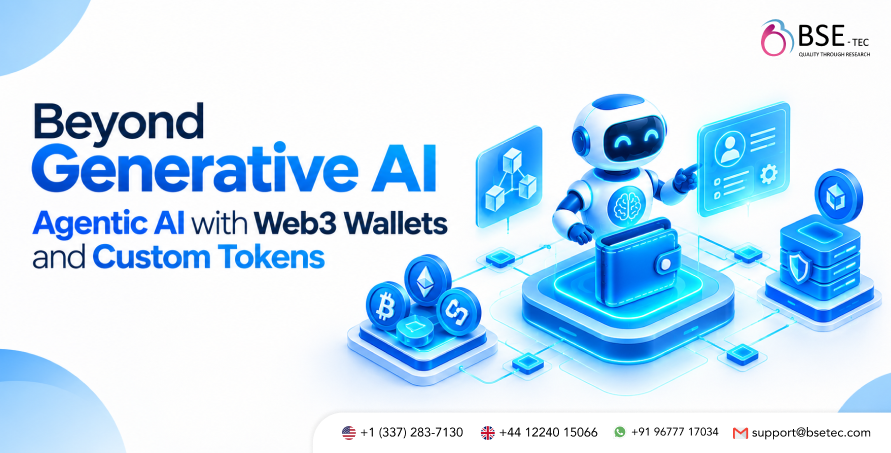
At BSEtec, we see AI moving beyond simple content generation toward systems that can understand goals, make decisions, and take action. Today, many AI systems can understand a request and recommend what to do. However, the next generation of AI is expected to go further. It will plan tasks, use tools, make decisions, interact with other agents, and complete actions with less human involvement.
This is the shift from generative AI to agentic AI.
Yet, autonomous action requires more than intelligence. An agent also needs identity, permissions, a way to hold value, and secure payment infrastructure.
This is where Web3 wallets and custom tokens become important.
In 2026, this idea is moving from a concept toward real infrastructure. Companies such as Circle and Coinbase are already developing wallet and payment systems designed specifically for AI agents.
When AI Starts Taking Action
Generative AI mainly creates content.
Agentic AI focuses on completing goals.
Instead of simply answering a question, an agent can:
- Understand the objective.
- Plan the required steps.
- Find the right service or information.
- Interact with external systems.
- Make a transaction when permitted.
- Complete the task and report the result.
For example, imagine an enterprise procurement agent. A user could ask it to find a software service within a specific budget. The agent could compare providers, check requirements, purchase access, and record the transaction.
That requires the agent to do more than communicate. It needs the ability to act economically.
A Wallet Gives AI an Economic Identity
A Web3 wallet can give an AI agent a controlled way to hold and move digital assets.
However, this does not mean giving an AI unlimited access to money.
Modern agent-wallet infrastructure is being designed around programmable controls. Coinbase’s 2026 Agentic Wallets, for example, include spending limits, transaction limits, security isolation, and other guardrails for autonomous operations.
Similarly, Circle’s Agent Wallets allow developers to define controls such as spending limits, service caps, allowlists, and time-based permissions.
This creates a more practical model:
AI gets autonomy, while humans define the boundaries.
As a result, that combination could become essential for enterprise AI systems handling payments, subscriptions, data access, cloud resources, and digital assets.
Custom Tokens Can Create the Agent Economy
Wallets provide the ability to transact. Custom tokens can provide the economic logic behind those transactions.
A business could create tokens for different purposes, such as:
- Access to an AI service
- Usage credits
- Rewards
- Governance
- Data access
- Agent-to-agent payments
- Platform incentives
For instance, an AI platform could allow agents to purchase additional processing capacity using programmable credits.
Likewise, one AI agent could pay another agent for data, computation, verification, or a specialized service.
This creates a new possibility: AI agents becoming participants in digital economies rather than simply users of software.
The token itself is only one part of the system. Token supply, utility, permissions, pricing, and incentives still need careful design.
2026 Is Putting Agentic Payments Into Practice
The movement toward machine-driven payments is already visible.
In May 2026, Circle introduced its Agent Stack, including Agent Wallets, an Agent Marketplace, and nanopayments. Its infrastructure is designed to let agents hold assets, discover services, and transact programmatically using USDC. Circle also introduced nanopayments as small as $0.000001 for high-frequency machine-to-machine transactions.
Coinbase has also introduced Agentic Wallets built around autonomous spending, earning, and trading. Its announcement said the x402 payment protocol had already processed more than 50 million transactions.
Meanwhile, Reuters reported in September 2026 that India’s payments ecosystem was preparing a framework for AI agents to make certain UPI payments under predefined rules and controls.
Together, these developments show that agentic commerce is expanding beyond simple AI conversations.
Trust Becomes Part of the Architecture
Autonomous agents create a new challenge: How do we know which agent is acting, what it is allowed to do, and whether its actions can be trusted?
That makes identity and permissions important parts of agentic infrastructure.
An enterprise agent may need a verified identity, spending limits, approved vendors, transaction rules, and an auditable activity history. To support these requirements, blockchain can provide programmable wallets, smart contracts, transaction records, and verifiable identities.
This is also connected to the growing idea of blockchain becoming a trust layer for AI. BSEtec has explored this direction through its work on AI identity and blockchain-based trust infrastructure.
BSEtec: AI Identity on Blockchain BSEtec: Blockchain as the Trust Layer for AI
Where Businesses Could Use This Model
The combination of agentic AI and Web3 infrastructure could support several emerging use cases.
An AI procurement agent could discover and purchase digital services.
A financial agent could monitor predefined conditions and execute approved transactions.
A data agent could pay for premium datasets only when required.
A software agent could purchase compute resources based on workload.
Meanwhile, multiple AI agents could interact with each other and settle payments without requiring a human to approve every small transaction.
The important point is that autonomy does not have to mean unlimited control.
Businesses can design rules around what an agent can access, spend, purchase, and execute.
How BSEtec Can Build the Agentic Layer
This is where BSEtec can connect AI development with blockchain infrastructure.
BSEtec can design solutions involving AI agents, Web3 wallets, smart contracts, custom tokens, tokenomics, decentralized applications, and blockchain-based identity.
For an enterprise use case, the architecture could combine an AI agent with a programmable wallet, predefined spending rules, smart-contract execution, and a custom token or stablecoin payment layer.
The goal is not simply to give an AI access to a wallet.
Instead, the focus is on building a controlled agentic system where intelligence, identity, payments, permissions, and blockchain execution work together.
What Comes Next?
The next phase of AI will not be defined only by better conversations.
It will be defined by what AI can actually do.
As agents become capable of purchasing services, paying other agents, accessing data, managing digital assets, and completing business workflows, financial and identity infrastructure will become increasingly important.
Web3 wallets can provide the economic identity.
Custom tokens can provide programmable value.
Smart contracts can provide execution rules.
And AI agents can provide the intelligence that connects these components.
Final Thoughts
The move beyond generative AI is creating a new model where AI does not simply produce an answer — it can plan, transact, and complete tasks.
Web3 wallets and custom tokens can give these systems the financial capabilities required for autonomous digital activity, while programmable permissions can keep that autonomy within defined boundaries.
For businesses exploring this emerging agentic economy, BSEtec can help turn the concept into a practical AI + blockchain architecture, from autonomous AI agents and smart wallets to custom tokens, smart contracts, and Web3 infrastructure.
The future of AI may not be just about asking machines for answers.
It may be about giving machines the ability to act, transact, and participate in the digital economy.