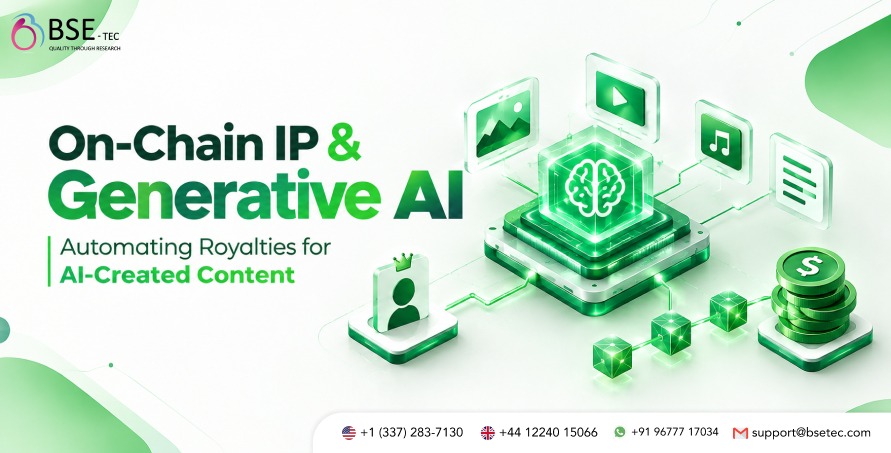
Generative AI can now create images, videos, music, voices, and other digital assets at a scale traditional creative workflows cannot match.
But as AI-generated content becomes commercially valuable, one question is becoming harder to ignore:
Who gets paid when AI-created content generates revenue?
A single AI asset can involve a creator, model provider, rights holder, dataset contributor, platform, and commercial user. Tracking those relationships through separate contracts and manual royalty systems becomes increasingly difficult.
At BSEtec, we see an emerging opportunity to connect AI-generated content royalties, blockchain-based rights management, and on-chain IP so that licensing, attribution, and payments can become programmable.
The goal is not simply to put AI content on a blockchain.
It is to create infrastructure where rights, usage, licensing, and revenue can work together.
Why AI-Generated Content Is Creating a New Royalty Problem
AI changes how content is produced — and potentially how its value is distributed.
Consider a commercial AI-generated campaign. A business provides the brief, a creative team develops the concept, an AI model generates assets, licensed material may contribute to the output, and a platform distributes the final work.
If that content generates revenue, how should the value be attributed?
This question becomes more complex when AI models, prompts, training data, creators, and platforms all contribute to the workflow.
The U.S. Copyright Office continues to examine generative AI, including copyrightability, AI training, licensing, and the role of human contribution. Its guidance has emphasized that copyright protection depends on sufficient human creative expression rather than prompts alone.
Therefore, AI-generated content copyright is becoming not only a legal question, but also a technology and infrastructure challenge.
On-Chain IP Could Become the Missing Layer
Traditional systems may record an asset and its owner.
An on-chain IP system could potentially connect:
Creator → AI Model → Source Rights → License → Usage → Revenue → Royalty Split
That is where on-chain IP becomes interesting.
Blockchain does not automatically decide who legally owns an AI-generated work. Ownership and licensing still depend on applicable law and contractual agreements.
Instead, blockchain can provide a programmable layer for recording agreed rights, licensing events, provenance, and payment rules.
For example, a commercial AI asset could have predefined revenue-sharing rules between a creator, model contributor, rights holder, and platform.
When an agreed commercial event occurs, a smart contract can execute the corresponding automated royalty payments.
This turns IP into a more programmable component of the digital economy.
How Blockchain Can Track AI Content and Licensing Rights
The real opportunity is bigger than proving who created an asset.
A blockchain-based IP system can potentially connect several important events:
- Creation — Register the AI-generated asset and relevant metadata.
- Attribution — Record participating creators, contributors, or licensed sources.
- Licensing — Define who can use the asset and under what conditions.
- Usage — Identify commercial events that trigger payment.
- Revenue — Connect eligible revenue to the agreed royalty rules.
- Distribution — Automatically calculate and distribute the defined shares.
This can become particularly useful when AI assets move between different businesses, platforms, or marketplaces.
BSEtec’s blockchain royalty solutions include smart-contract-based royalty automation, digital rights management, licensing workflows, and royalty tracking.
How Automated Royalties Work for AI-Created Content
The basic flow can be simple:
AI Asset → IP Registration → License → Usage Event → Smart Contract → Royalty Payment
Imagine a creator develops an AI-generated visual asset and licenses it to an international advertising company.
The agreement defines the permitted commercial usage and revenue-sharing rules.
When the predefined usage or revenue condition is met, the smart contract can calculate the agreed distribution and trigger payment.
For example:
Revenue generated → Royalty rule → Automatic calculation → Payment distribution
The percentages would depend on the actual commercial agreement. The important change is that the payment logic becomes programmable instead of completely manual.
That is the core opportunity behind blockchain royalties.
From AI Model to Creator: A Future Royalty Flow
Consider a future enterprise AI marketplace.
A creator registers an AI workflow or model. Its licensing terms are recorded alongside the asset. A marketing company discovers it, purchases commercial rights, and uses it to generate thousands of assets for clients.
Instead of creating a separate royalty calculation process afterward, the platform can connect the license to predefined payment rules.
The future workflow could look like:
Creator
↓
AI Model / Prompt / Workflow
↓
On-Chain IP Record
↓
Commercial License
↓
AI Content Generation
↓
Usage / Revenue Event
↓
Smart Contract
↓
Creator + Rights Holders + Contributors
This creates a more connected IP economy where licensing and payment infrastructure can operate alongside the AI creation process.
Real-World Signals and 2026 Trends
AI rights are already becoming a major business discussion.
The U.S. Copyright Office continues publishing analysis around generative AI training, copyright, and licensing. Meanwhile, platforms are increasing transparency around AI-generated and AI-altered content. In 2026, YouTube announced expanded disclosure labels for meaningfully altered or AI-generated content.
These developments do not create a universal blockchain royalty standard.
However, they show the direction of the market:
AI content needs better provenance, attribution, licensing, and rights management.
That creates several future opportunities.
AI Music and Video: AI-generated music, voices, characters, and video assets could involve multiple contributors. Programmable royalty rules could help manage agreed revenue splits.
AI Models and Prompts: Specialized models, prompts, and workflows could become licensable digital assets instead of one-time products.
BSEtec has also explored this direction through its work on tokenizing generative AI prompts and models, connecting AI assets with tokenization and programmable royalty concepts.
AI Agent Commerce: The most interesting future may involve autonomous AI agents.
An AI agent could discover a licensed model, check its usage terms, obtain permission, use the service, and trigger payment through blockchain infrastructure.
That creates a potential future where AI systems become participants in IP licensing and machine-to-machine commerce.
The Challenge: Copyright Is Not the Same as Code
Blockchain can automate a payment.
It cannot automatically determine whether that payment is legally required.
That distinction matters.
AI-generated content can involve different rights across jurisdictions, and questions around human authorship, training data, attribution, licensing, and ownership remain active.
Therefore, successful generative AI royalties infrastructure needs more than smart contracts.
It requires:
Legal agreements + Identity + Provenance + Licensing Logic + Blockchain + Payment Infrastructure
The technology should support the rights framework rather than pretend to replace it.
How BSEtec Can Help Build AI + Blockchain IP Solutions
Building this infrastructure requires multiple technologies to work together.
BSEtec can combine AI development, blockchain, smart contracts, tokenization, digital rights management, and royalty automation to create solutions for businesses building AI-powered IP ecosystems.
A commercial platform can include:
- AI Asset Registration — Register models, prompts, workflows, and generated assets.
- On-Chain IP Records — Track provenance, licensing references, and transactions.
- Smart-Contract Licensing — Encode agreed commercial usage rules.
- Automated Royalty Payments — Trigger payments based on defined events.
- Rights Management — Manage attribution, permissions, and contributors.
- Marketplace Integration — Enable businesses to discover and license AI assets.
- Revenue Splits — Distribute agreed payments between creators, rights holders, platforms, and contributors.
This makes BSEtec’s role broader than blockchain development alone: building the infrastructure that connects AI-generated assets with programmable IP and commercial workflows.
Final Thoughts
The next stage of generative AI will not be defined only by how quickly machines create content.
It will also depend on how businesses track, license, attribute, and monetize the value created by that content.
AI-generated content royalties could become an important part of that future. Blockchain can provide programmable records, smart contracts can automate agreed payment rules, and on-chain IP can connect provenance with licensing and revenue distribution.
The opportunity is not simply putting AI-generated content on-chain.
It is building a system where rights can be identified, licenses can be managed, usage can trigger commercial rules, and payments can move automatically.
At BSEtec, we help businesses explore this intersection of AI + blockchain + intellectual property, from AI asset tokenization and smart-contract royalty systems to digital rights management and automated payment infrastructure.
The future of generative AI may not just be about creating content faster.
It could be about turning intellectual property into programmable, licensable, and revenue-generating digital infrastructure.