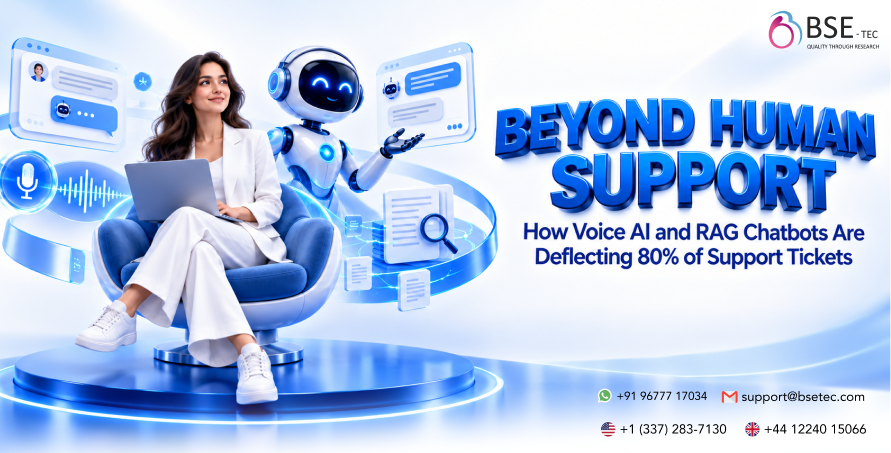
BSEtec helps businesses rethink this model through AI-powered customer support solutions, including Voice AI, RAG-based chatbots, and intelligent support agents. Instead of making customers wait in queues, these systems can understand requests, retrieve relevant information, and resolve routine issues across digital and voice channels.
The goal is ambitious: reduce repetitive support tickets by up to 80% in suitable workflows while giving customers faster, more consistent assistance. However, businesses need the right data, integrations, and escalation process to reach that level.
Why Traditional Customer Support Cannot Keep Up
Customers expect immediate answers. Whether they contact a business through a website, mobile application, email, or phone call, they rarely want to wait several hours for a simple response.
Meanwhile, support teams often spend a large part of their day answering the same questions:
- Where is my order?
- How can I reset my password?
- When will I receive my refund?
- How do I update my account details?
- Why did my payment fail?
Although these questions may look simple, they consume valuable employee time. Furthermore, ticket volumes can increase during product launches, seasonal sales, service disruptions, and promotional campaigns.
Traditional chatbots also struggle when customers ask questions in different ways. A scripted bot may recognise a few predefined keywords, but it often fails to understand the actual context.
This is where Voice AI and Retrieval-Augmented Generation (RAG) change the support experience.
RAG Chatbots: Answers That Come From Your Business Knowledge
A RAG chatbot does more than generate a response from a general AI model. It first retrieves relevant information from approved business sources, such as product documentation, FAQs, policies, help-centre articles, and internal knowledge bases. Then, it uses that information to create a relevant answer.
For example, imagine a customer asking, “I returned my product last week. Why haven’t I received my money?”
A basic chatbot might provide a generic refund policy. In contrast, a properly integrated RAG-based support assistant can retrieve the latest refund policy and, when connected to authorised order systems, check the customer’s specific transaction status.
As a result, customers receive answers that relate to their actual situation rather than generic instructions.
What Makes RAG Useful for Customer Support?
- Context-aware responses: The chatbot understands the meaning behind customer questions instead of relying only on exact keywords.
- Business-specific knowledge: It retrieves information from approved company documents and support resources.
- More consistent answers: Teams can update their knowledge sources as policies, products, and services change.
- Better response speed: Customers can access relevant information without waiting for an available support employee.
- Controlled escalation: When the system cannot find reliable information, it can direct the conversation to a human agent.
However, RAG quality depends on the quality of the information it retrieves. Therefore, businesses must maintain accurate documentation, apply access controls, and test responses regularly.
Voice AI: Customer Support Without the Waiting Queue
Not every customer wants to type a message into a chatbot. Some prefer to speak, especially when they need quick assistance while travelling, working, or completing a transaction.
Voice AI brings conversational intelligence to phone-based support. It can recognise spoken language, understand customer intent, retrieve relevant information, and respond naturally.
Consider a customer calling a delivery company to ask about a delayed package. Instead of navigating several menu options, the customer can explain the issue in everyday language. The Voice AI system can identify the request, connect to the relevant tracking information when authorised, and provide an update.
Moreover, modern voice systems can support multiple languages, manage common requests around the clock, and transfer complex conversations to human employees.
Where Can Businesses Use Voice AI?
- Order and delivery updates: Customers can ask about shipment status and delivery schedules.
- Appointment management: Voice agents can help customers book, reschedule, or cancel appointments.
- Banking enquiries: Customers can access general account and service information through approved workflows.
- Technical support: Voice AI can guide users through common troubleshooting steps.
- Lead qualification: Businesses can understand customer requirements and route sales enquiries to the right team.
Most importantly, a good voice assistant should recognise when a conversation needs human attention. It should not force customers through repeated automated responses when an issue requires judgement or empathy.
Voice AI + RAG: A Smarter Combination for 24/7 Support
Voice AI and RAG chatbots solve different parts of the customer support challenge. However, businesses can combine them to create a more connected support experience.
RAG provides relevant information, while Voice AI allows customers to access that information through natural conversations.
For example, a customer may call a software company and ask how to configure a particular feature. The voice assistant can identify the request, retrieve the relevant product documentation through RAG, and explain the steps.
If the customer still faces a technical issue, the system can transfer the conversation to a support specialist with the interaction history attached.
Consequently, the customer does not need to repeat the same explanation. Meanwhile, the human agent can begin with the actual problem instead of collecting basic details again.
This combination can help businesses:
- Reduce repetitive tickets across chat and phone channels.
- Provide consistent answers using approved knowledge sources.
- Improve first-response times.
- Offer support beyond regular business hours.
- Route complex cases to the right specialist.
- Give human agents more time for high-value customer interactions.
Real-World Case Studies: What Businesses Are Achieving
The shift towards AI-powered support already has measurable examples. Two deployments show how RAG and conversational self-service can reduce pressure on support teams.
Oracle: RAG Improves Internal IT Ticket Deflection
Oracle introduced an AI-powered support assistant for its internal IT team. Previously, its chatbot deflected around 10% of support tickets on average.
However, Oracle adopted OCI Generative AI and a RAG-based architecture connected to its internal knowledge base. The new system improved its ticket deflection rate to approximately 25%, handling nearly 4,000 tickets every week.
Oracle reported that its IT support operation manages around 50,000 monthly tickets with 140 support engineers worldwide. Additionally, the company reported a 91% improvement in click-through rates after introducing the enhanced assistant.
This example highlights an important point: AI support becomes more useful when it retrieves relevant company knowledge instead of relying only on scripted answers.
How Can Businesses Work Towards 80% Ticket Deflection?
An 80% ticket-deflection target requires more than installing a chatbot. Businesses need to identify which requests AI can resolve safely and which ones require human involvement.
A practical implementation starts with a few important steps.
1. Identify repetitive support requests
Analyse historical tickets and identify common questions. Start with high-volume, low-risk requests such as order updates, password guidance, and product FAQs.
2. Connect trusted knowledge sources
Organise product documentation, support articles, company policies, and FAQs. Then, connect these sources to the RAG system and establish a process for updating them.
3. Integrate business systems
Connect the AI assistant to authorised CRM, order-management, payment, and ticketing systems where the workflow requires live customer information.
4. Build clear escalation rules
Set confidence thresholds and escalation conditions. If the system lacks reliable information or detects a sensitive issue, it should transfer the conversation to a human agent.
5. Measure actual resolution
Track more than chatbot conversations. Measure successful resolutions, repeat contacts, escalation rates, response time, and customer satisfaction.
Ultimately, businesses should count a ticket as deflected only when the customer receives a genuine resolution without needing to contact support again.
Customer Support Trends Businesses Should Watch in 2026
AI-powered customer service continues to move beyond basic question-and-answer chatbots. Several developments are shaping the next generation of support systems.
1. Real-Time Voice Conversations
Modern voice systems are moving towards more natural conversations, with faster responses, better interruption handling, and improved speech recognition. Consequently, businesses can create phone-support experiences that feel less like traditional automated menus.
2. Multilingual AI Support
Global businesses serve customers across different regions and languages. Therefore, multilingual voice and chat assistants can help companies provide more consistent support without building separate teams for every language.
3. Agentic AI for Support Workflows
AI agents can move beyond answering questions. With the right permissions and integrations, they can perform approved actions such as creating support tickets, updating records, checking order status, and initiating defined workflows.
4. RAG With Better Retrieval and Accuracy
Businesses are placing greater emphasis on hybrid search, document ranking, source citations, and response evaluation. As a result, RAG systems can retrieve more relevant information and reduce unsupported answers.
5. Human-AI Collaboration
The future of customer support does not require removing human agents. Instead, AI can handle repetitive requests while employees focus on complaints, complex technical issues, and situations that require empathy.
Build Smarter Customer Support With BSEtec
Customer expectations continue to rise, and businesses need support systems that can grow without making every increase in demand a staffing challenge.
BSEtec helps businesses explore AI-powered customer support through solutions such as Tier-1 Support Deflection Bots, RAG-Based Customer Support Chatbots, Conversation AI, and Voice AI for customer support and inbound calls.
Through its AI development capabilities, BSEtec can help businesses plan intelligent support workflows, connect relevant knowledge sources, integrate business systems, and create customer experiences across chat and voice channels.
Explore BSEtec’s AI and intelligent automation solutions and BSEtec to understand how AI can support your business operations.
Conclusion
The next stage of customer support will focus on faster resolutions, better conversations, and smarter automation. RAG chatbots can retrieve business-specific answers, while Voice AI can make support more accessible through natural conversations.
However, meaningful ticket deflection requires more than automation. Businesses must combine reliable knowledge, secure integrations, clear escalation rules, and continuous performance measurement.
With BSEtec’s AI-powered support solutions, businesses can take practical steps towards reducing repetitive support workloads, improving customer experiences, and building scalable customer service operations. The objective is not to remove the human touch. It is to make every human interaction more valuable.