Think about the last product you purchased online. Did you know exactly where it was manufactured? Were the raw materials ethically sourced? Was it stored under the right conditions before reaching your doorstep?
For most consumers and businesses, the answer is still no.
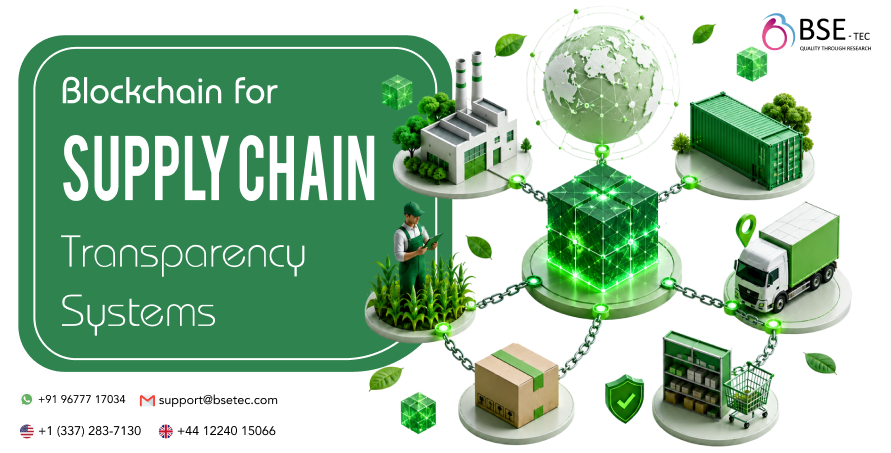
However, that’s changing rapidly. In 2026, blockchain is transforming supply chains from opaque, paper-based systems into transparent, real-time digital ecosystems. Instead of relying on multiple disconnected databases, companies can now record every transaction on an immutable blockchain ledger, making products traceable from origin to destination.
Moreover, governments are tightening regulations around sustainability, counterfeit prevention, ESG reporting, and Digital Product Passports (DPPs). Consequently, enterprises are investing heavily in blockchain-powered supply chain platforms that deliver trust, compliance, and operational efficiency.
According to recent market research, the global Blockchain Supply Chain Market is valued at USD 5.23 billion in 2026 and is projected to reach USD 33.96 billion by 2030, growing at an impressive 59.6% CAGR.
At BSEtec, we help businesses modernize supply chain operations with enterprise-grade blockchain solutions that improve transparency, reduce fraud, automate workflows, and build customer trust.
Why Traditional Supply Chains Still Struggle
Even today, many supply chains operate through disconnected systems.
As a result:
- Product information gets lost between suppliers.
- Counterfeit goods enter the market.
- Manual verification delays shipments.
- Compliance reporting becomes expensive.
- Customers lack confidence in product authenticity.
Furthermore, global supply chains now involve manufacturers, suppliers, logistics providers, warehouses, customs agencies, retailers, and customers across multiple countries. Without a shared source of truth, disputes become inevitable. This is precisely where blockchain changes everything.
Why 2026 Is the Breakthrough Year
Several global trends are accelerating blockchain adoption.
1. Digital Product Passports (DPP) — The EU is pushing Digital Product Passport initiatives, encouraging manufacturers to provide verified lifecycle information for products, especially in sectors such as electronics, batteries, and textiles.
2. ESG Compliance — Companies must now prove sustainable sourcing instead of simply claiming it. Blockchain creates verifiable ESG records.
3. AI + Blockchain Integration — Artificial Intelligence predicts supply chain disruptions. Blockchain verifies every decision using trusted data. Together, they create intelligent supply chains.
4. Consumer Demand— Modern customers want to scan a QR code and instantly know:
- Where was it made?
- Who manufactured it?
- Is it genuine?
- Is it sustainable?
Blockchain makes this possible.
How Blockchain Improves Supply Chain Transparency
End-to-End Product Traceability
Every product receives a unique blockchain identity.
For example: Farm → Processing Plant → Warehouse → Shipping → Retail Store → Customer
Every step is permanently recorded. Therefore, if contamination or defects occur, companies can immediately identify affected batches.
Eliminating Counterfeit Products
Counterfeit goods cost global businesses billions annually. Luxury goods, Pharmaceuticals, Electronics, Automotive parts, and Food products are particularly vulnerable. Blockchain allows customers to verify authenticity simply by scanning a QR code. If the blockchain record doesn’t exist, the product is likely counterfeit.
Real-Time Shipment Tracking
Unlike traditional tracking systems, blockchain stores verified logistics updates. Businesses can monitor Shipping status, Warehouse transfers, Delivery confirmation, Customs clearance, and Environmental conditions. As a result, delays become easier to identify and resolve.
Smart Contract Automation
Smart contracts execute business rules automatically.
For example:
Supplier delivers products → Warehouse verifies quantity → IoT sensor confirms quality → Blockchain validates data → Payment is automatically released →
No paperwork, delays, and manual approvals.
Better collaboration
Supply chains involve many organizations. Instead of sharing spreadsheets through emails, blockchain provides one trusted platform where every participant accesses the same information. Consequently, disputes decrease while collaboration improves.
Real-World Industries Using Blockchain
Food Supply Chains: Food companies use blockchain to trace Fresh produce, Seafood, Meat, and Dairy products. If contamination occurs, affected batches can be identified within minutes instead of days.
Pharmaceutical Industry: Medicine authenticity has become a global priority. Blockchain tracks Manufacturing, Packaging, Distribution, and Pharmacy delivery. This helps reduce fake medicines entering the market.
Manufacturing: Manufacturers monitor Raw materials, Components, Suppliers, Production batches, and Warranty history. This significantly improves quality control.
Automotive: Vehicle manufacturers trace Engine parts, Batteries, Tires, and Electronic components. As EV adoption grows, blockchain is also helping verify battery origin and recycling compliance.
Luxury Brands: Luxury companies protect products using blockchain certificates. Customers can verify Authenticity, Ownership history, Manufacturing origin, and Warranty.
Latest Blockchain Supply Chain Trends in 2026
AI + Blockchain Analytics: AI identifies disruptions before they happen. Blockchain ensures the underlying data is trustworthy.
IoT-Powered Verification: Sensors automatically record Temperature, Humidity, GPS location, and Storage conditions. Every reading is securely written to the blockchain.
Tokenized Logistics Assets: Shipping containers, warehouse inventory, and freight documents are increasingly being tokenized to improve tracking, financing, and ownership management.
Digital Twins: Companies now create digital twins of physical supply chains. Blockchain synchronizes every physical movement with its digital counterpart.
Privacy-Enabled Enterprise Blockchains: Modern enterprise blockchains increasingly combine transparency with privacy technologies, allowing organizations to share verifiable data while protecting sensitive business information.
Benefits of Blockchain Supply Chain Systems
Businesses adopting blockchain experience Greater transparency, Faster auditing, reduced paperwork, Lower fraud risk, Improved supplier trust, Better compliance, Faster recalls, Enhanced customer confidence, Real-time visibility, Automated payments, Stronger ESG reporting, and improved operational efficiency
Challenges Businesses Must Address
Although blockchain offers significant benefits, organizations should also plan for Legacy ERP integration, Data standardization, User adoption, Scalability, Cross-border regulations, and Interoperability between blockchain networks. An experienced blockchain partner can simplify these challenges with the right architecture and implementation strategy.
Why Businesses Choose BSEtec for Blockchain Supply Chain Development
Implementing blockchain is about much more than deploying a ledger. It requires deep expertise in supply chain workflows, smart contracts, enterprise integration, security, and scalable infrastructure.
BSEtec delivers an end-to-end blockchain development company tailored to modern supply chain needs. From manufacturers and logistics providers to retailers and exporters, BSEtec builds secure, enterprise-ready solutions that help organizations achieve transparency, compliance, and operational excellence.
BSEtec’s blockchain supply chain capabilities include:
- Custom blockchain platform development
- Supply chain traceability solutions
- Smart contract development
- Private and consortium blockchain implementation
- ERP and CRM integration
- IoT-enabled asset tracking
- QR code and Digital Product Passport solutions
- Multi-party supplier management
- AI-powered supply chain analytics
- Blockchain consulting and deployment
- Ongoing maintenance and technical support
Whether you’re modernizing an existing supply chain or launching a new blockchain initiative, BSEtec provides scalable solutions that grow with your business while ensuring security, efficiency, and trust.
Conclusion
Supply chain transparency has become a competitive necessity in 2026. Businesses can no longer rely on fragmented systems and manual processes if they want to maintain customer trust and comply with global regulations.
Blockchain delivers a secure, immutable, and collaborative platform that enables real-time product traceability, fraud prevention, automated workflows, and data integrity across every stage of the supply chain.
At BSEtec, we empower enterprises to harness blockchain technology for smarter, more transparent supply chains. By combining blockchain with AI, IoT, and enterprise integrations, BSEtec helps businesses build future-ready supply chain ecosystems that drive efficiency, accountability, and long-term growth.
If you’re ready to transform your supply chain with blockchain, BSEtec has the expertise to turn your vision into reality.