Artificial intelligence(AI) is no longer just a supportive tool. In 2026, AI systems have evolved into autonomous agents capable of making decisions, interacting with APIs, executing workflows, and even handling financial transactions. This shift is transforming AI from a passive assistant into an active digital participant in business ecosystems.
But with this evolution comes a critical challenge: trust and identity.
When multiple AI agents begin interacting with each other, negotiating, transacting, and collaborating, how do we verify who they are, what they are allowed to do, and whether their past actions are reliable?
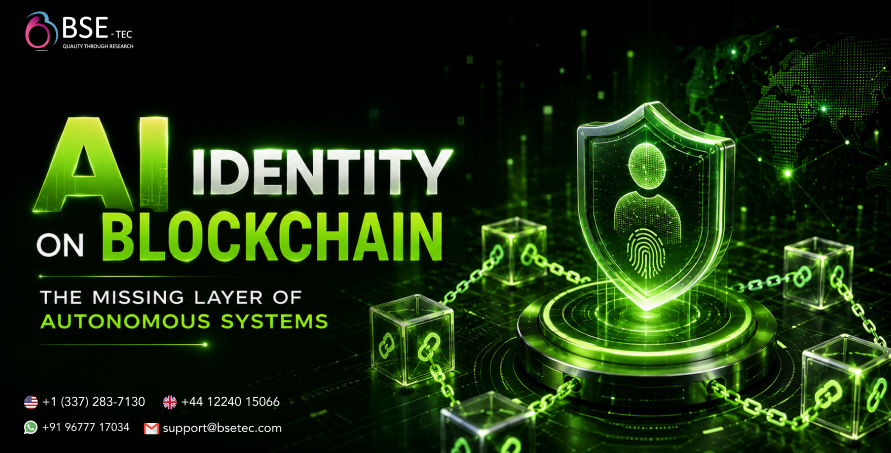
This is where AI identity on blockchain emerges as a foundational solution. It introduces a verifiable, persistent, and decentralized identity layer for autonomous systems, enabling trust in a machine-driven economy.
The Core Problem: Trust in Autonomous AI Systems
Imagine an AI agent managing procurement for a global company. It can search suppliers, negotiate pricing, Place orders, execute payments, and coordinate logistics
This level of automation is powerful—but also risky. Before allowing such an agent to operate freely, businesses must answer key questions:
- Who created this AI agent?
- What permissions does it have?
- Can it be trusted with financial operations?
- Has it performed similar tasks successfully before?
- Can its actions be audited or verified?
Traditional authentication systems only confirm access credentials. They do not provide reputation, history, or accountability. This creates a major trust gap in autonomous systems.
Why Blockchain Becomes the Natural Solution
Blockchain technology introduces properties that directly address these challenges:
- Persistence of Identity: An AI agent’s identity can exist independently of any single platform or company.
- Verifiability: All identity and activity records can be independently verified on-chain.
- Transparency: Actions and reputation signals can be audited by multiple stakeholders.
- Portability: An AI agent can operate across different ecosystems while retaining its identity.
- Programmability: Smart contracts can define permissions, access rules, and financial limits.
Together, these features make blockchain a strong foundation for AI trust infrastructure.
The Rise of the AI Agent Economy
The world is shifting from chatbot-based AI to agentic AI systems.
Instead of responding to single prompts, AI agents now plan multi-step workflows, interact with other agents, use external tools and APIs, make autonomous decisions, and execute real-world actions
A typical AI-driven workflow in 2026 might look like this:
- Identify business requirement
- Discover suppliers or services
- Communicate with other AI agents
- Compare pricing and quality
- Validate trust and reputation
- Request approval if needed
- Execute blockchain-based payment
- Record transaction history
This is no longer human-centric automation—it is machine-to-machine economy formation.
Real-Time 2026 Industry Signals
Recent ecosystem data and research in 2026 show clear adoption trends:
- Over 120,000 AI agent identities have been registered across the Ethereum, Base, and BNB Chain ecosystems (via ERC-8004-compatible registries).
- More than 65% of new Web3 automation tools now include an agent-based execution layer.
- Early enterprise pilots show a 30–40% reduction in operational workflow time using autonomous AI agents in procurement and customer support systems.
- However, only ~18–22% of agents currently maintain active reputation or validation records, showing that trust infrastructure is still immature.
This confirms a key insight:
Identity adoption is growing faster than trust and validation systems.
What Is AI Identity on Blockchain?
AI identity gives each AI agent a verifiable blockchain-based identity, including its unique ID, ownership, and capabilities. This allows agents to operate as trusted digital entities across decentralized ecosystems.
ERC-8004: Trust Infrastructure
Identity Registry: Records each AI agent’s on-chain identity.
Reputation Registry: Tracks performance, feedback, and trust signals.
Validation Registry: Verifies whether an agent completed tasks correctly.
Key Benefit: ERC-8004 enables flexible, application-specific trust models instead of one global reputation score.
The Three Pillars of AI Trust
AI identity systems rely on three interconnected layers:
1. Identity: “Who is the agent?”
A blockchain-based identity ensures that every AI agent has a verifiable origin, ownership, and capability profile.
2. Reputation: “How has the agent performed?”
Reputation systems track historical performance, feedback, and reliability.
2026 real-world observation:
- High-performing enterprise agents show up to 92% task success consistency
- New agents without history are typically restricted to low-risk operations
3. Validation: “Did the agent actually do the work correctly?”
Validation ensures correctness using:
- Independent validators
- Zero-knowledge proofs
- Trusted execution environments
- Staking-based verification systems
Together, these form a trust stack for autonomous AI systems.
Why AI Identity Is a Security Layer
AI agents access APIs, financial systems, and smart contracts. Therefore, blockchain identity can enforce permissions, spending limits, approvals, audit trails, and revocation, making AI identity a critical security layer.
Identity Does Not Equal Trust
A valid blockchain identity does not guarantee trustworthy behavior. True trust requires identity, reputation, validation, permissions, and risk controls.
Verifiable AI & Zero-Knowledge Proofs
ZKML helps verify whether AI follows rules and processes data correctly without exposing sensitive information, making it valuable for finance and enterprise systems.
AI Agents as Economic Participants
AI agents are becoming active Web3 participants, capable of managing wallets, making payments, negotiating contracts, and handling digital assets.
Industry Applications of AI Identity
Finance: Autonomous trading, portfolio management, and DeFi interactions with controlled risk.
Supply chain AI agents managing procurement, logistics, and supplier verification.
Healthcare: Verified AI systems assisting in diagnostics and data exchange under strict compliance.
Gaming: AI-driven characters owning assets and participating in digital economies.
DePIN Networks: AI agents coordinating decentralized physical infrastructure.
AI Marketplaces: Discovery and evaluation of AI services based on identity and reputation.
The Role of Companies Like BSEtec
For Blockchain development companies like BSEtec, AI identity represents a major opportunity.
With expertise in:
- Blockchain development
- Smart contracts
- Web3 applications
- AI integration
- Wallet systems
BSEtec can help businesses build:
- AI agent identity frameworks
- Permission-controlled autonomous systems
- Blockchain-based reputation systems
- Secure AI payment integrations
- Enterprise-grade agent ecosystems
This shifts AI from being a feature to becoming a controlled digital workforce inside blockchain ecosystems.
Conclusion: The Future Is About Trust, Not Just Intelligence
The future of AI is not only about making systems smarter, it is about making them trustworthy enough to act independently.
As AI agents become more autonomous, the need for identity, reputation, and validation becomes critical. Blockchain provides the infrastructure to support this transformation.
With standards like ERC-8004, the world is moving toward a new digital architecture where:
- AI agents are identifiable
- Their actions are verifiable
- Their reputation is trackable
- Their permissions are controllable
This creates the foundation for a truly autonomous digital economy.