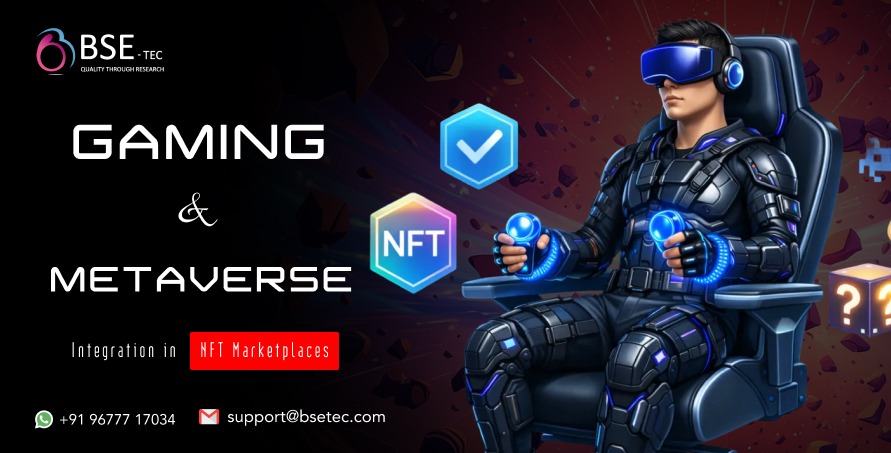
In a digital era powered by immersive experiences and decentralized technologies, gaming and the metaverse are transforming how users interact, own, and trade virtual assets. NFT marketplaces are no longer limited to collectibles—they are evolving into dynamic ecosystems that fuel in-game economies and virtual worlds.
Let’s explore how gaming and metaverse integration are reshaping NFT marketplaces, unlocking new monetization models, enhancing player ownership, and enabling businesses to build scalable, future-ready virtual economies.
The Evolution of NFTs in Gaming
Since NFTs were introduced, the gaming industry has seen a significant upheaval. What started as digital collectibles has now become a powerful system of real in-game ownership and utility. These days, NFTs are valuable assets that power entire gaming economies rather than just objects to be shown.
From collectibles to utility assets: NFTs have evolved from simple trading goods to in-game assets players can actively use and enhance, including virtual land, characters, weapons, and skins.
Play-to-Earn (P2E) and Move-to-Earn models: These contemporary blockchain games establish genuine income potential through gameplay and engagement by rewarding players with tokens and NFTs for their participation.
Digital assets that are interoperable: NFTs may now be made to function on a variety of platforms, allowing users to move their identities and assets between games and metaverse settings.
Leading gaming ecosystems: Platforms such as Axie Infinity and The Sandbox have shown how NFT-powered economics can foster strong communities and long-lasting virtual marketplaces.
This progression demonstrates that NFTs are more than just digital treasures; they form the foundation of next-generation gaming and metaverse experiences.
Metaverse’s role in NFT marketplaces
The metaverse improves NFT marketplaces by transforming digital assets into interactive aspects within virtual worlds, hence promoting actual economic activity and immersive user experiences.
Virtual assets can be owned and traded as NFTs, including land, avatars, skins, and wearables.
Metaverse integration enables seamless asset trading on platforms such as Decentraland.
Digital identity ownership allows gamers to manage their avatars and exert control over their virtual presence.
Traditional web-based markets are being replaced by virtual world 3D shopfronts.
Here are the key Features of Gaming-Integrated NFT Marketplaces:
Gaming-integrated NFT marketplaces make safe asset ownership and trade easier by incorporating marketplace elements right into the gaming experience.
In-game minting and trading: Players can create and exchange NFTs directly within the game for a more seamless experience.
Multi-chain support: Works with Ethereum, Polygon, and the BNB Chain to reduce fees and increase reach.
Smart contract automation: securely manages transactions and royalties.
Secure wallet integration: Enables secure storage and simple NFT management.
Royalty system: Developers profit from each secondary resale.
These features make gaming NFT marketplaces more powerful, user-friendly, and future-proof.
Trending Technologies Powering Integration:
Blockchain scalability solutions improve performance and reduce congestion.
Layer-2 networks on Ethereum reduce gas fees and accelerate NFT trading.
AR/VR integration allows for immersive 3D experiences.
AI-driven personalisation increases engagement with clever NFT features.
NFTs are cross-platform compatible, which means they can function with a variety of games and devices.
Now we see the Business advantages for game developers and enterprises.
Integrating NFTs into gaming platforms opens up new monetisation opportunities via asset sales and royalties, while also increasing user engagement through true digital ownership.
It promotes community-driven economies in which players create actual value. At the same time, blockchain assures transparency in ownership while reducing fraud and duplication, resulting in a safe and scalable ecosystem.
Challenges in Gaming and Metaverse NFT Integration: Regulatory uncertainty
Regulatory uncertainty among geographies.
Scalability concerns and high petrol prices during peak hours.
Security threats include flaws in smart contracts.
Non-crypto players must navigate a complex user onboarding process.
Future Trends for 2026 and Beyond
By 2026, NFT marketplaces will prioritise interoperable assets between metaverses, AI-powered virtual economies, DAO-based governance, decentralised gaming guilds, and more enterprise adoption of metaverse commerce.
How BSEtec Facilitates Gaming and Metaverse NFT Marketplace Development
BSEtec provides comprehensive end-to-end development support to firms seeking to create robust gaming and metaverse-driven NFT marketplaces. To ensure long-term success in the rapidly growing Web3 ecosystem, we prioritise scalability, security, and an immersive user experience.
Such as,
Customised NFT platforms for gaming environments.
Metaverse-ready and immersive architecture.
Smart contracts are both secure and automated.
Multi-chain blockchain support.
Scalable cloud infrastructure.
Continuous support and upgrades.
With extensive knowledge of blockchain, gaming, and metaverse technologies, BSEtec enables organisations to develop safe, scalable, and immersive NFT marketplace solutions.
Transform your vision into the future of digital ownership with BSEtec and build secure, scalable, immersive NFT marketplaces that lead the gaming and metaverse revolution
BSEtec Metaverse-Focused Products:
Mint Trades – A ready-made NFT marketplace built on the Ethereum ERC-721 standard.
World 360 Plus – An immersive virtual commerce platform for digital showrooms and interactive shopping.
StreamBiz – A live streaming solution designed for immersive virtual events.
By integrating VR, AR, and AI technologies, BSEtec creates interactive environments that seamlessly support gaming, commerce, and digital engagement in the metaverse space.Curious how your game can thrive in the metaverse? BSEtec, a Blockchain development company, makes immersive NFT platforms possible.
Greate article. Keep writing such kind of information on your page.
Im really impressed by it.
Hey there, You have done an excellent job. I will certainly digg it and in my opinion recommend to my friends.
I’m sure they’ll be benefited from this web site.
Thank you so much for your kind words! I’m really glad you liked the article. I truly appreciate you recommending it to your friends.
Thanks for finally writing about > Gaming & Metaverse Integration in NFT Marketplaces | BSEtec < Liked it!
Appreciate you checking it out and sharing your feedback, it means a lot.
I have read so many articles or reviews about the blogger lovers except this article is truly a good article, keep it
up.
Thank you so much! I’m glad you enjoyed the article. Your support means a lot—I’ll keep it up!
Appreciation to my father who informed me about this blog, this blog
is really remarkable.
That’s wonderful to hear—please extend my sincere thanks to your father. I’m glad you’re finding the site increasingly useful and informative. Keep reading !
Good post! We will be linking to this great content on our site.
Keep up the great writing.
Thank you! I’m glad you enjoyed the post. I appreciate you linking to it and your support
Great article, exactly what I was looking for.
Thank you! I’m glad you found it helpful
Keep this going please, great job!
Thank you! I’ll keep sharing more.
Way cool! Some very valid points! I appreciate you writing
this post plus the rest of the website is also really good.
Thanks a lot! Really glad you liked the post and the site — appreciate the support!
Appreciation to my father who informed me on the topic of this webpage, this website is actually
awesome.
That’s great to hear! Big thanks to your father for pointing you in the right direction—glad you’re enjoying the site. Hope you keep finding it helpful and interesting!
I’m truly glad you’re enjoying the website — and a big thanks to your father for recommending it. That really means a lot!
Hello there, I discovered your website by the use of Google while looking
for a comparable matter, your website got here up, it appears to be like great.
I’ve bookmarked it in my google bookmarks.
Hi there, simply became aware of your weblog through Google,
and found that it’s really informative. I am going to watch out
for brussels. I will appreciate in case you continue this in future.
Lots of other folks will likely be benefited from your writing.
Cheers!
Thank you so much for your kind words and for bookmarking the site — that truly means a lot. I’m glad you found it helpful, and I’ll definitely keep sharing more useful content in the future.
My brother recommended I might like this blog. He was totally right.
This post truly made my day. You cann’t imagine just how much time I
had spent for this information! Thanks!
That really means a lot — thank you so much! I’m glad the post was helpful and made your day. Appreciate you taking the time to share this.
Wonderful site. Lots of useful information here.
I am sending it to some pals ans additionally sharing in delicious.
And obviously, thanks on your effort!
Thank you Really appreciate your kind words! Your support truly means a lot.