The conversation around Real-World Asset RWA tokenization has changed dramatically in 2026.
A few years ago, most discussions focused on Can we tokenize assets? Today, institutional players are asking a very different question:
How do we scale tokenized assets while staying compliant?
That shift is exactly why permissioned sidechains have become one of the hottest infrastructure trends in institutional finance.
Banks, asset managers, private credit firms, real estate investment groups, and regulated funds are entering the tokenization market at a speed few expected. In fact, the tokenized RWA market has already surpassed $1 billion in on-chain value in 2026, with several reports estimating the market at between $19 billion and $27 billion by Q1 2026 alone.
However, there is a problem. Institutions cannot simply move trillion-dollar assets onto public blockchains and hope compliance works itself out.
They need privacy, regulatory controls, predictable transaction costs, and they need infrastructure that regulators can actually approve. This is where permissioned sidechains are becoming the preferred choice.
Why Public Chains Are Not Enough for Institutional RWAs
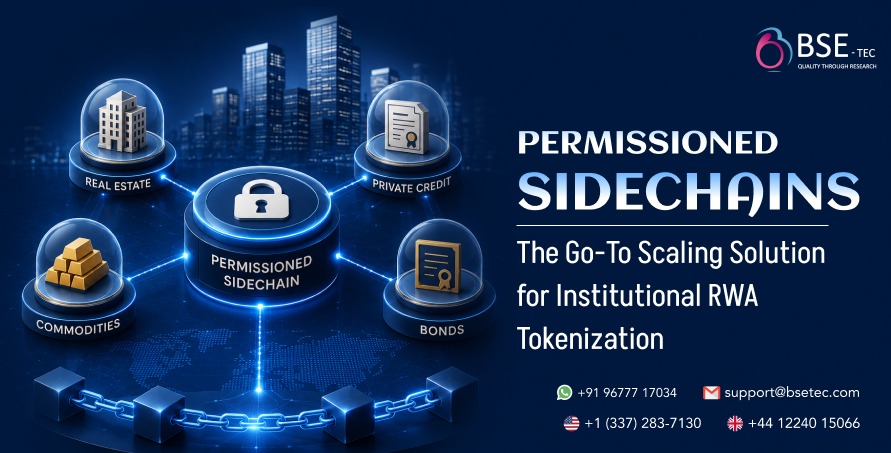
Imagine a global asset management company tokenizing Commercial real estate, Government bonds, Private credit funds, Treasury products, Infrastructure investments
Now imagine every transaction being visible to everyone. For crypto-native users, transparency sounds great. For institutions handling sensitive financial data, it becomes a compliance nightmare.
Moreover, public chains often introduce challenges such as Data exposure, Compliance complexity, Identity verification issues, Network congestion, and variable transaction fees As institutional adoption grows, these limitations become impossible to ignore.
Interestingly, analysts now view RWA tokenisation less as a blockchain experiment and more as a financial infrastructure transformation. Major financial institutions are actively building blockchain-based settlement systems because they provide faster settlement and programmable compliance capabilities.
Enter Permissioned Sidechains
Permissioned sidechains offer something institutions have been searching for the efficiency of blockchain without sacrificing control.
Unlike public networks, permissioned sidechains allow organizations to decide:
- Who can join the network
- Who can validate transactions
- Which jurisdictions are allowed
- What compliance checks must be completed
- How assets can move across the ecosystem
As a result, institutions gain blockchain benefits while maintaining governance standards expected by regulators.
Think of it this way: Public blockchains are like public highways.
Permissioned sidechains are like dedicated financial express lanes built specifically for regulated asset movement.
Why Institutions Prefer Permissioned Sidechains in 2026
The reason goes beyond scalability. Institutions are increasingly prioritizing four critical requirements.
1. Built-In Compliance: Compliance is no longer an afterthought. Every tokenized asset must satisfy KYC requirements, AML regulations, Investor eligibility checks, and jurisdiction restrictions Permissioned sidechains can enforce these rules directly at the infrastructure level. This significantly reduces operational risks.
2. Confidential Transactions: Institutional investors rarely want competitors to see every movement they make. Permissioned environments allow sensitive trading information to remain private while still maintaining auditability. That balance is becoming essential for large-scale RWA deployments.
3. Faster Settlement: Traditional financial systems still rely heavily on T+1 or T+2 settlement models. Tokenized assets operating on permissioned blockchain networks can settle within seconds or minutes. This is one reason institutional interest continues to accelerate across treasury products and private credit markets.
4. Predictable Costs: When dealing with millions or billions of dollars in transactions, fee predictability matters. Permissioned sidechains provide controlled transaction environments, helping institutions forecast operational costs more accurately.
The Biggest Trend: Tokenized Private Credit
One trend that deserves attention in 2026 is the rise of tokenized private credit.
While real estate often receives the spotlight, private credit is becoming one of the fastest-growing RWA categories. Several market reports indicate that private credit and tokenized treasury products now account for a significant share of tokenized asset value globally.
Why?
Because institutional investors care less about hype and more about yield-generating assets. Permissioned sidechains are enabling these products to operate efficiently while meeting regulatory requirements.
The Liquidity Question Everyone Is Asking
Here is something many blogs avoid discussing. Tokenization alone does not guarantee liquidity.
An asset can be tokenized and still experience limited trading activity.
Recent research highlights that many tokenized assets face challenges related to liquidity, ownership concentration, and secondary market participation. This is why leading institutions are not simply launching tokens.
They are building complete ecosystems that include Secondary trading mechanisms, Compliance layers, Custody solutions, Investor onboarding systems, and cross-chain interoperability Permissioned sidechains play a central role in making that ecosystem work.
Where BSEtec Fits Into This Transformation
This is exactly where many businesses struggle.
They understand the potential of RWA Tokenisation.
They understand the value of Blockchain Technology.
But they are unsure how to build an institutional-grade platform that regulators, investors, and asset issuers can trust.
At BSEtec, we help businesses move beyond proof-of-concept discussions and into real-world deployment.
Through our Blockchain development services, our blockchain specialists work on:
- RWA tokenization platforms
- Asset-backed token ecosystems
- Permissioned blockchain networks
- Smart contract architecture
- Compliance-integrated tokenization solutions
- Multi-chain and sidechain infrastructure
- Digital asset marketplaces
- Investor onboarding systems
- Custody and security integrations
More importantly, we focus on building platforms that can scale when institutional participation increases.
Because in 2026, launching a token is easy. Building an ecosystem that can support thousands of investors, regulatory requirements, and large-scale asset movement is where the real challenge begins.
That’s where BSEtec delivers value.
What Happens Next?
The next phase of tokenization will not be driven by retail speculation. It will be driven by infrastructure.
As tokenized RWA markets continue expanding beyond $19 billion and push toward much larger institutional adoption milestones, scalable blockchain architecture becomes critical.
Permissioned sidechains are rapidly emerging as the bridge between traditional finance and blockchain-powered markets.
And as more institutions bring real estate, private credit, treasury products, and investment funds on-chain, the organizations that invest in compliant, scalable infrastructure today will be the ones leading tomorrow’s tokenized economy.
Final Thoughts
The biggest misconception in tokenisation is that blockchain adoption is simply about moving assets on-chain. In reality, success depends on creating a secure, compliant, and scalable environment where institutions feel confident operating. Permissioned sidechains are solving that challenge.
And as institutional RWA tokenisation accelerates throughout 2026, they are quickly becoming the go-to scaling solution for serious financial players.
If your organization is exploring RWA tokenisation, permissioned blockchain infrastructure, or institutional asset digitization, BSEtec can help you build a future-ready platform designed for real-world adoption—not just experimentation.