Blockchain has entered a new phase. For years, enterprises viewed it mainly as a distributed ledger for recording transactions without relying on a central authority. In 2026, that definition is no longer enough.
Blockchain is becoming a programmable infrastructure layer for financial systems, AI agents, tokenized assets, digital identity, automated payments, and enterprise applications. Businesses are no longer asking whether blockchain has potential. They are asking how it can be integrated into their existing technology ecosystem.
This shift is supported by growing institutional interest. Coinbase and EY-Parthenon’s 2026 Institutional Investor Survey reported that 64% of asset managers were interested in tokenizing assets, while 85% of surveyed institutional investors were using or interested in using stablecoins for money movement and cash management.
The important question is now:
What should an enterprise blockchain technology stack look like?
From Blockchain Projects to Blockchain Infrastructure
Early enterprise blockchain initiatives were usually designed around one specific use case. A company might build a supply-chain ledger, a financial institution might test digital assets, or a business might create a token-based loyalty platform.
Today, enterprises want more flexible infrastructure. They need blockchain systems capable of supporting multiple applications, assets, users, networks, and business processes at the same time.
This is similar to the evolution of cloud computing. Businesses do not create a completely separate cloud environment for every application. Instead, multiple applications use shared infrastructure, security, data, and integration services.
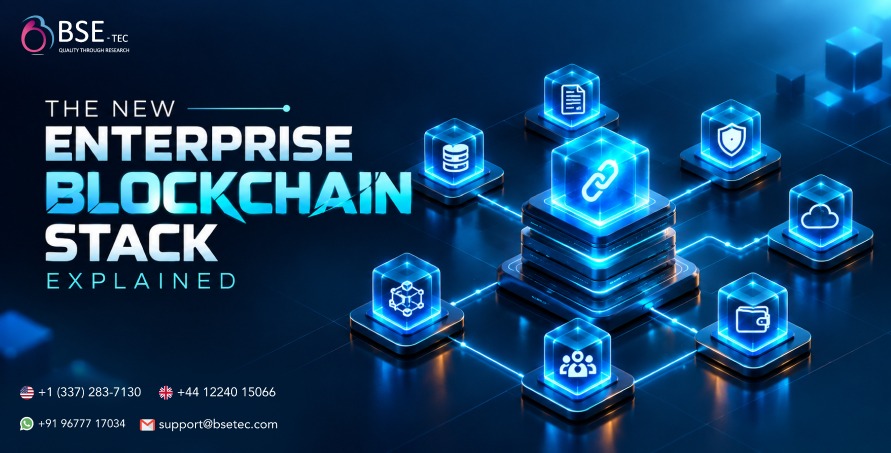
The enterprise blockchain stack is developing in the same direction. It combines blockchain networks with smart contracts, tokenization, stablecoins, identity, artificial intelligence, interoperability, data infrastructure, security, and compliance.
Together, these layers allow business processes to become programmable, verifiable, and increasingly automated.
The New Stack Is More Than a Blockchain
A modern enterprise blockchain architecture should be viewed as a connected technology ecosystem rather than a single network.
The blockchain provides the trust foundation. Smart contracts provide programmable business logic. Tokenization represents assets digitally. Identity determines who can act. AI agents support decision-making. Stablecoins and digital payment rails enable settlement. Interoperability connects different networks, while security and compliance protect the entire environment.
Consider a multinational company purchasing equipment from an overseas supplier. An AI agent could identify the requirement, verify the supplier, check internal purchasing policies, access an approved treasury asset, execute a smart contract, settle the payment using a stablecoin, record the transaction, and update the company’s enterprise resource planning system.
A process that once required several disconnected systems and manual approvals could become a coordinated digital workflow.
Blockchain as the Trust Foundation
The underlying blockchain remains essential, but enterprises are becoming more selective about how they use it. Public blockchains, Layer 2 networks, appchains, permissioned networks, and modular architectures can serve different business requirements.
Rather than forcing every transaction onto one network, companies can create multi-chain architectures. One network may provide settlement liquidity, while another handles high-volume application transactions. Sensitive business information can remain off-chain, while cryptographic proofs are recorded on-chain.
This hybrid approach gives enterprises blockchain-level verification without requiring every piece of confidential data to be publicly visible.
Smart Contracts Become Business Logic
Smart contracts are also becoming more useful in enterprise environments. They are no longer limited to token transfers or decentralized finance applications. They can function as programmable business rules.
For example, in an international trade transaction, a smart contract could release payment only after the shipment reaches its destination, an IoT device confirms delivery, compliance requirements meet the necessary standards, and all required documents pass verification.
The smart contract is not merely transferring money. It is executing the terms of a business agreement.
This makes smart-contract development increasingly important for companies seeking to automate complex workflows while reducing delays, disputes, and administrative costs.
Tokenization Changes How Assets Move
Tokenization is one of the most significant developments in the enterprise blockchain stack. Traditionally, ownership of financial assets has depended on centralized databases, intermediaries, paperwork, reconciliation systems, and lengthy settlement processes.
Tokenization makes it possible to represent assets as programmable digital tokens. These assets may include government securities, private credit, real estate, investment funds, commodities, deposits, loyalty points, or other forms of value.
The opportunity is not simply to create another digital token. It is to build new financial infrastructure around programmable ownership, automated compliance, fractional access, and faster settlement.
Stablecoins Become Payment Infrastructure
Stablecoins are also moving beyond cryptocurrency trading. Businesses are exploring them for cross-border payments, treasury management, supplier payments, merchant settlement, and digital commerce.
This trend is becoming increasingly institutional. In September 2026, Reuters reported that Goldman Sachs, Bank of America, Citi, and Deutsche Bank were planning a joint U.S.-dollar stablecoin initiative targeted for 2027.
For global enterprises, stablecoins could reduce settlement friction, speed up payments, and support more efficient movement of money across jurisdictions. Their future role will depend on regulation, custody, compliance, and integration with existing banking systems.
AI Agents Add Intelligence
AI agents are becoming another important layer of blockchain infrastructure. Unlike traditional software, which waits for a human to initiate an action, AI agents can understand objectives, evaluate information, interact with applications, and execute workflows.
However, giving an AI agent unrestricted access to financial systems would create serious risks. Enterprises need programmable controls, spending limits, identity verification, approval policies, and auditability.
Blockchain can support these requirements. An AI agent could have a verifiable identity, limited permissions, access to approved smart contracts, and a complete record of its actions.
The workflow could be:
AI decides → policy engine validates → smart contract executes → blockchain records → enterprise system reconciles.
This separates AI intelligence from financial authority. The AI can recommend or initiate an action, while blockchain-based controls enforce the boundaries.
Identity, Privacy, and Interoperability
A wallet address alone is not sufficient for enterprise use. Businesses need to know who is acting, what that entity is authorized to do, what limits apply, and whether the action satisfies regulatory requirements.
Verifiable credentials, decentralized identity, programmable permissions, and reputation systems are therefore becoming important components of the enterprise stack. These tools can support both human users and autonomous AI agents.
Privacy is equally important. Enterprises want transactions to be verifiable without exposing sensitive commercial information. Zero-knowledge technology can help by proving that a condition is satisfied without revealing the underlying data.
Interoperability is another business requirement. Companies do not want digital assets trapped on one network. Cross-chain messaging, unified wallets, chain abstraction, and multi-chain settlement can allow applications to work across different blockchain ecosystems without forcing users to understand the technical details.
Security Becomes Central
Enterprise blockchain cannot succeed without strong security. Smart contracts require audits, wallets need secure key management, AI agents need permission controls, cross-chain systems require monitoring, and tokenized assets need reliable custody.
Security must be designed into the architecture from the beginning. Enterprises must also consider long-term cryptographic risks, including the potential impact of quantum computing on digital assets and identities.
Where BSEtec fits
Building this infrastructure requires more than basic blockchain development. It requires knowledge of smart contracts, AI integration, digital assets, enterprise systems, security, payments, and compliance.
As a blockchain development company, BSEtec helps businesses design blockchain solutions aligned with practical business objectives. Its capabilities include enterprise blockchain development, smart contract development, RWA and tokenization platforms, stablecoin and payment infrastructure, AI and blockchain solutions, crypto wallet development, DeFi applications, and multi-chain systems.
The goal is not simply to place data on a blockchain. The goal is to identify where blockchain can create measurable value through better trust, ownership, automation, settlement, and transparency.
Final thoughts
The enterprise blockchain stack of 2026 is much broader than a blockchain network with smart contracts. It connects tokenization, AI agents, stablecoins, identity, zero-knowledge proofs, interoperability, security, compliance, and enterprise applications.
Blockchain is becoming less visible as a product and more important as infrastructure.
Businesses should stop asking, “What blockchain should we build?”
The better question is:
“What business infrastructure can blockchain help us redesign?”
That change in thinking marks the real beginning of enterprise blockchain.