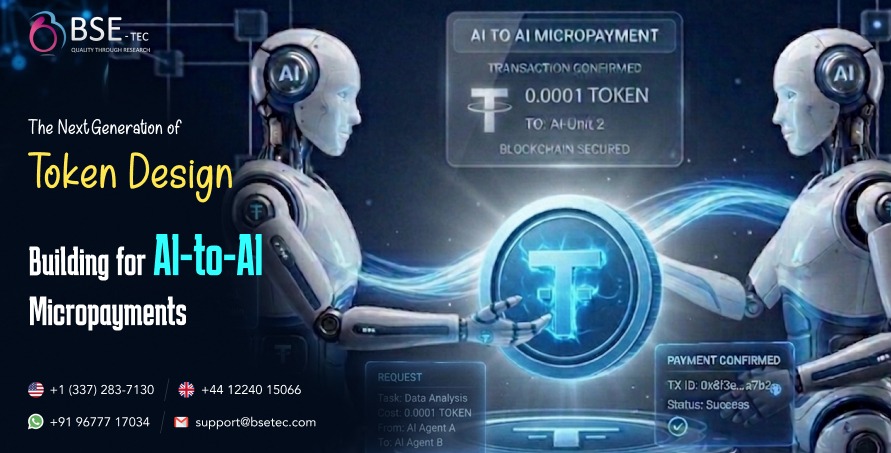
At first, digital transactions were built for humans, then automation made them faster. Now, we’re entering a phase where AI systems actively engage in AI-to-AI Micropayments, driving demand for instant, low-cost, autonomous transfers. However, traditional token models weren’t designed for this machine-speed economy.
So, what comes next is a new generation of token design built for AI-to-AI interactions, where speed, scalability, and intelligence are essential.
What Are AI-to-AI Micropayments and Why They Matter?
AI-to-AI micropayments are instant, automated transactions of tiny monetary values, often fractions of a cent, that allow autonomous agents to trade resources without human intervention. Essentially, they serve as the financial nervous system for the machine economy, enabling software to buy and sell data or compute power on the fly.
How AI-to-AI Micropayments Work
To begin with, the process relies on decentralized technology to bypass traditional banking friction.
Wallet Integration: AI agents have digital wallets with unique cryptographic identities.
Blockchain Rails: Transactions run on fast, low-cost Layer 2 or Lightning networks.
Smart Contracts: Payments trigger automatically once tasks are completed.
Account Abstraction: Paymasters handle complexity for seamless transactions.
Why They Matter
Ultimately, these payments enable true digital autonomy by removing human approvals. As a result, AI agents can scale into an independent workforce. Furthermore, this shifts the internet to a precise pay-as-you-go model, unlocking a more efficient and automated future.
Why Traditional Token Models Don’t Fit
However, traditional token models create volatility and friction; as a result, they can’t match the speed of the machine economy.
The following points outline the core reasons why these human-centric models are becoming obsolete:
Inflationary schedules and gas fees make costs unpredictable and require intervention. In addition, traditional tokens lack the flexibility for micro-scale AI services.
Inflation: First, constant minting dilutes value, making long-term budgeting for machines unreliable.
Friction: Next, the requirement of a separate asset for transaction fees creates a technical bottleneck for autonomous workflows.
Rigidity: In addition, static models fail to account for the pay-as-you-go precision that agentic systems demand.
Ultimately, the shift toward deflationary burn mechanisms and automated payment rails is essential for digital sovereignty. As a result, AI agents can manage their own budgets and scale independently.
Rethinking Token Design for Machine Economies
Rethinking token design is a vital shift toward prioritizing machine utility and predictable costs over human speculation. To start, these new frameworks ensure that autonomous agents can budget for resources with millisecond precision and zero manual intervention.
First, we must replace inflationary rewards with deflationary burn mechanisms to tie token value directly to network demand.
Next, account abstraction must be integrated so agents can settle all fees in a single currency without needing to manage separate gas tokens.
Furthermore, tokens should evolve into modular, programmable keys that grant agents specific, temporary access to data or hardware resources on a pay-per-use basis.
Predictable Stability: Ultimately, removing price volatility ensures agents can finish complex tasks without running out of funds.
Seamless Execution: Consequently, the use of paymasters allows for seamless experiences that keep the machine economy moving.
Digital Sovereignty: Finally, modular designs give agents the ability to own and trade assets independently.
How These Tokens Will Be Used in the Real World
These tokens act as the currency of the machine economy, enabling autonomous agents to trade without human intervention. To start, they let software manage budgets for key tasks like compute and real-time data.
Tokens power machine work:
Autonomous Procurement: Machines independently negotiate and pay for APIs, enabling 24/7 operations without human approvals.
Granular Utility: Shifts from subscriptions to pay-per-inference, reducing waste and cost.
Decentralized Logistics: Agents auto-detect shortages and trigger smart contract-based restocking.
Direct Settlement: Blockchain wallets enable millisecond transactions for global commerce.
The Infrastructure Behind It
The infrastructure supporting AI-to-AI micropayments must be fast, automated, and secure to handle the high-speed demands of the machine economy. To start, these layers ensure that agents can trade resources at a scale and frequency that traditional banking systems simply cannot reach.
First, scalable blockchain networks or Layer 2 solutions provide the high-throughput, low-fee rails needed for millions of tiny, rapid-fire transactions. Next, smart contracts act as the autonomous legal layer, executing payments automatically based on pre-defined code without any human oversight. Furthermore, secure execution environments and cryptographic wallets allow AI agents to manage funds and transact safely within a protected digital sandbox.
Challenges That Still Need Solving
Despite progress toward a machine-driven economy, key challenges still block full autonomy:
Regulatory Ambiguity: Legal systems can’t yet assign liability for AI financial errors or flawed contracts.
Network Fragmentation: Lack of blockchain interoperability limits seamless asset and data movement.
Security Risks: Adversarial attacks require stronger encrypted protection for autonomous wallets.
Data Integrity: Agents need accurate, real-time data to prevent costly automated market errors.
Where BSEtec comes in
BSEtec bridges the gap between raw technological potential and functional enterprise applications by providing the essential automation and decentralization layers.
To start, their high-performance systems enable businesses to deploy autonomous digital agents that independently manage budgets, trade resources, and settle debts in real-time.
First, they build high-throughput infrastructure for millions of micro-transactions with millisecond precision. Next, modular, high-performance systems ensure a seamless, future-proof transition for the machine economy. Furthermore, they create secure environments where software can operate autonomously without constant human oversight.
Strategic innovation drives autonomous success:
Scalable Architecture: Initially, they deploy specialized scaling solutions that process high-frequency transactions with minimal latency and near-zero fees, perfectly suited for machine-speed trade.
Tamper-Proof Automation: Consequently, their engineers develop sophisticated smart contracts that independently manage inventory, payments, and service-level agreements.
Secure Digital Sovereignty: Moreover, they facilitate the shift toward private, sovereign infrastructures, ensuring that sensitive corporate data remains protected from centralized cloud vulnerabilities.
Precision Tokenomics: Finally, they design modular token frameworks that prioritize functional utility, allowing agents to pay for exactly what they use, whether it’s compute power or data.
The End of Gas Friction: Autonomous workflows shouldn’t stop because an agent ran out of a specific gas token. By integrating Account Abstraction (ERC-4337) and Paymasters, we allow agents to settle all fees in a single currency with zero friction and maximum speed.
Acting as a leading AI development company, BSEtec integrates agentic capabilities into these networks to allow software to make real-time, data-driven financial decisions. Ultimately, this specialized approach ensures that enterprises don’t just adopt new tools but gain a self-sustaining competitive edge in the global digital market.
What the Future Looks Like
The machine economy is evolving into a frictionless system where AI acts as an economic participant. To start, the internet is shifting toward automated value exchange. First, self-sovereign agents will manage wallets and contracts independently. Next, pay-per-use models will replace traditional subscriptions. Furthermore, DePIN enables devices to autonomously fund their own operations. Ultimately, this creates a 24/7 global digital marketplace.
Closing Thoughts
We’re clearly moving into a new phase where AI isn’t just part of the system; it is the system. And as that shift happens, token design has to keep pace, becoming faster, smarter, and built for nonstop machine-to-machine interaction.
In this evolving landscape, it’s not about adapting old models anymore; it’s about creating what comes next.
That’s exactly the direction BSEtec is moving in—quietly shaping the backbone of AI-driven economies with token systems built for real-time, autonomous value exchange.