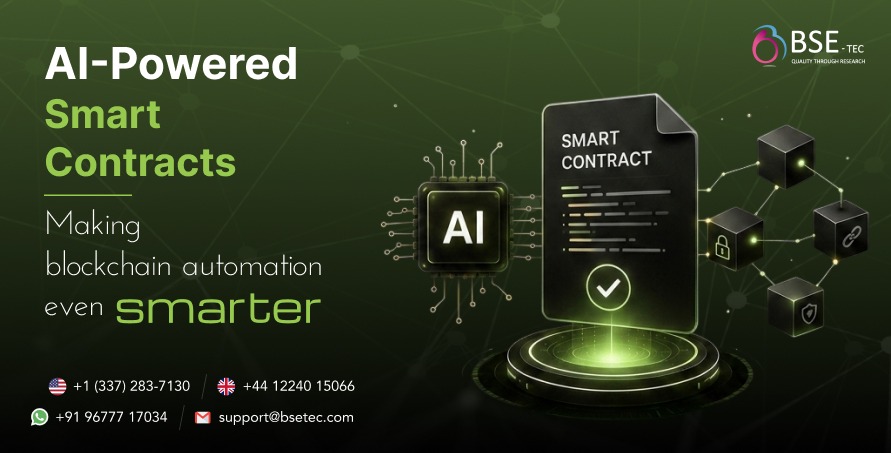
In 2026, smart contracts are evolving beyond simple automation. Instead of following only fixed rules, businesses now need intelligent systems that can analyze data, adapt in real time, and make smarter decisions automatically. As a result, the combination of AI and blockchain is transforming Web3 with faster, smarter, and more efficient automation.
So, What Makes AI-Powered Smart Contracts Different?
Traditional smart contracts are built on fixed logic.
For example: If Condition A happens, execute Action B.
That model works well for simple automation. However, the problem is that traditional smart contracts cannot adapt beyond their programming.
They cannot:
- Evaluate shifting market variables
- Anticipate network security risks
- Assess real-time user behavior
- Optimize performance based on historical data
- Mitigate fraudulent transactions proactively
AI transforms smart contracts by enabling them to analyze data, learn patterns, and automate intelligent decisions in real time. As a result, blockchain systems become smarter, faster, and more efficient. Moreover, AI-powered automation improves accuracy, reduces manual effort, and enhances overall performance.
Why Businesses Are Moving Toward Intelligent Automation
Traditional automation works with fixed logic for repetitive tasks, but it struggles to adapt to real-world complexity and unexpected changes.
To overcome this, companies are upgrading to intelligent automation. By embedding AI into their workflows, businesses achieve capabilities that static systems cannot match:
Processing Chaotic Data: Instantly analyzing unstructured info like emails and PDFs.
Predictive Operations: Forecasting bottlenecks and market shifts before they occur.
Continuous Learning: Improving accuracy over time by learning from past data.
Autonomous Decisions: Resolving unexpected workflow issues without human intervention.
How AI and Blockchain Work Together
Traditional blockchain systems are excellent at recording data securely, but they are inherently rigid and data-blind.
Conversely, pairing blockchain with AI creates a synergistic system where blockchain provides the trust, security, and data integrity, while AI delivers the intelligence, analysis, and automation.
The Core Synergy
Blockchain Trust for AI Data: Blockchain provides an immutable, tamper-proof ledger to store the training data, logs, and decisions of AI models. This ensures the data hasn’t been altered and creates an auditable trail for AI governance (AgentOps).
AI Intelligence for Blockchain Networks: AI algorithms can analyze massive amounts of on-chain data in real time to optimize smart contracts, detect fraudulent transactions, and manage network resources.
How They Connect in Practice
Secure Data Marketplaces: Blockchain acts as a decentralized repository where users can safely monetize their data. AI models can then purchase and train on this high-quality, verified data without relying on centralized tech giants.
Autonomous Agent-to-Agent Economies: AI agents can operate independently on the blockchain, using smart contracts to execute micro-transactions, pay for decentralized cloud computing (DePIN), or trade assets without human intervention.
Decentralized AI Infrastructure: Instead of running AI on centralized servers, blockchain-based networks allow developers to crowd-source computing power from a global, distributed network of machines to train and deploy models securely.
Ultimately, this powerful combination solves the core flaws of both technologies. Blockchain makes AI transparent, verifiable, and secure, while AI makes blockchain intelligent, adaptive, and highly efficient.
Where AI-Powered Smart Contracts Are Being Used in 2026
Traditional smart contract deployments rely on rigid, pre-programmed automation.
Currently, in 2026, the integration of machine learning and agentic logic has moved AI-powered smart contracts out of the experimental phase and into live production across several high-utility sectors.
They are primarily being used to solve real-world complexity in the following areas:
Next-Gen Decentralized Finance (DeFi)
Traditional DeFi protocols use static rules that can be vulnerable to sudden market crashes. AI-powered contracts actively protect capital by:
- Dynamic Risk Scoring: Continuously analyzes on-chain volatility to automatically adjust liquidation thresholds and loan-to-value ratios before a market dip occurs.
- Predictive Portfolio Rebalancing: Executing automated hedging strategies and moving liquidity across different pools based on predictive price signals.
Decentralized Physical Infrastructure Networks (DePIN)
Managing physical hardware through a blockchain requires real-time adaptability. AI smart contracts are utilized for:
- Predictive Maintenance: Analyzing data feeds from physical nodes or hardware sensors to forecast equipment failures and automatically allocate treasury funds for repairs.
- Dynamic Resource Allocation: Adjusting bandwidth, storage distribution, or power grids automatically based on shifting demand metrics.
Automated Protocol Security
Manual code audits cannot keep up with the speed of live protocol deployments. AI contracts are embedded to handle:
- Real-Time Exploit Mitigation: Scanning incoming transaction queues to identify and block novel exploit patterns or reentrancy flaws before they are permanently written to the ledger.
- Continuous Anomaly Detection: Monitoring user behavior and wallet patterns to halt contract execution if suspicious, non-standard activity is detected.
Supply Chain Document Reconciliation
Global logistics involves a chaotic influx of unstructured data that traditional contracts cannot read. AI-powered systems bridge this gap by:
- Processing Chaotic Data: Using machine learning to read, verify, and extract information from messy PDFs, emails, and customs data.
- Autonomous Exception Handling: Dynamically rerouting supply pathways or adjusting automated milestone payments when weather delays or port bottlenecks are detected.
Consequently, businesses are using AI-powered smart contracts to create more adaptive, resilient, and self-optimizing blockchain ecosystems.
Real-Time Adoption & Impact (2026)
In 2026, AI-powered smart contracts are no longer experimental — they are already being used in real business environments. More than 500+ Web3 and blockchain companies are actively building or testing AI-integrated smart contract systems across DeFi, supply chain, and enterprise automation.
Around 30%–45% of advanced blockchain projects are now exploring AI-driven automation to improve decision-making, fraud detection, and real-time risk management. Early implementations have already shown up to 60% reduction in manual processing time and nearly 40% improvement in operational efficiency in pilot enterprise systems.
Industries like finance, logistics, and decentralized infrastructure are seeing the biggest impact, where AI helps smart contracts react instantly to real-world data instead of relying only on fixed logic.
This clearly shows that AI-powered smart contracts are becoming a practical, real-world solution — not just a concept, helping businesses build faster, smarter, and more autonomous blockchain ecosystems.
The Biggest Advantage Businesses Are Seeing
The single biggest advantage businesses are seeing from intelligent automation is unprecedented operational resilience through autonomous decision-making.
Traditional automation handles repetitive tasks efficiently, but it struggles with unexpected changes and often requires manual intervention to fix workflow issues. Consequently, AI-powered systems can analyze situations, adapt to changes, and make intelligent decisions in real time without constant human intervention.
Businesses capture this core advantage through four major shifts:
- Zero-Delay Problem Solving: Instantly rerouting workflows when encountering unexpected variables or missing data.
- True Scalability: Expanding operations exponentially because workflows are no longer bottlenecked by human exception handling.
- Proactive Asset Protection: Predicting market volatility or hardware failures and adjusting parameters beforehand to mitigate risk.
- Continuous Self-Optimization: Learning from daily operational data to systematically reduce errors over time.
Ultimately, intelligent automation helps businesses become more proactive and resilient by enabling systems to make autonomous decisions and operate efficiently 24/7.
Of Course, There Are Still Challenges
Even though the technology is advancing rapidly, businesses still face some challenges when implementing AI-powered blockchain systems.
For example:
- AI integration can be technically complex
- High-quality data is essential
- Scalability remains a concern
- Regulatory frameworks are still evolving
- AI transparency is still improving
However, despite these obstacles, the long-term potential remains extremely strong. In fact, many businesses now see intelligent blockchain systems as a major part of their future digital strategy.
Why Businesses Trust BSEtec for AI-Powered Blockchain Development
As businesses move toward intelligent digital ecosystems, they need technology partners capable of combining innovation, scalability, and security.
That’s where BSEtec continues to lead strongly in 2026.
With extensive expertise in blockchain infrastructure, Web3 ecosystems, and enterprise automation, BSEtec helps businesses build scalable and future-ready digital solutions.
Consequently, as a leading AI development company, we deliver complete end-to-end development services tailored to modern business needs, from AI-powered smart contracts and decentralized applications to next-generation Web3 platforms and enterprise blockchain ecosystems.
What makes BSEtec stand out is its focus on building ecosystems that combine:
Intelligence: Embedding machine learning, predictive analytics, and autonomous agentic workflows (AgentOps) directly into business architecture.
Automation: Replacing rigid, step-by-step processes with self-optimizing and context-aware systems.
Security: Integrating real-time AI anomaly detection and Zero-Knowledge Proofs (ZKPs) to identify and block security exploits proactively.
Scalability: Leveraging high-throughput modular blockchains, Layer 2 scaling solutions, and Account Abstraction for friction-free enterprise growth.
Long-Term Performance: Designing future-focused infrastructure that adapts, learns, and protects itself as market variables shift.
Ultimately, whether businesses want to automate operations, build intelligent blockchain applications, or launch next-generation Web3 platforms, BSEtec provides future-focused solutions designed for sustainable digital growth.
Final thoughts
AI-powered smart contracts are transforming blockchain automation by making systems smarter, faster, and more efficient. As AI-driven digital transformation grows, businesses need scalable and future-ready blockchain solutions to stay ahead.
With strong expertise in AI-powered automation, Web3 infrastructure, decentralized applications, and enterprise blockchain systems, BSEtec continues to help businesses lead the next generation of intelligent blockchain innovation.
–