Let’s be honest. You may have an innovative blockchain idea, a powerful smart contract, and even a strong token ecosystem. However, if your mobile dApp takes a few extra seconds to load, users won’t stay around to appreciate it. Instead, they’ll move to a competitor.
That’s exactly what’s happening across the Web3 market in 2026.
Today, decentralized applications are competing not only with other blockchain platforms but also with highly optimized Web2 apps. Therefore, performance, responsiveness, and seamless user experience have become critical success factors.
According to recent Web3 analytics reports, mobile devices now contribute over 65% of decentralized application traffic globally, while active blockchain wallet users have surpassed 25 million daily users. As a result, businesses are prioritizing frameworks that can deliver speed, scalability, and frictionless blockchain interactions.
So, which frameworks are helping businesses build the next generation of mobile dApps?
Let’s dive in.
What Makes a Mobile dApp Successful in 2026?
Before choosing a framework, it’s important to understand what users actually expect.
Today’s mobile dApp users demand Instant wallet connectivity, Faster transaction confirmations, Real-time blockchain updates, Smooth UI interactions, Cross-chain compatibility, and AI-powered automation features. Consequently, developers are moving beyond traditional mobile development approaches and focusing on frameworks that can support modern Web3 ecosystems.
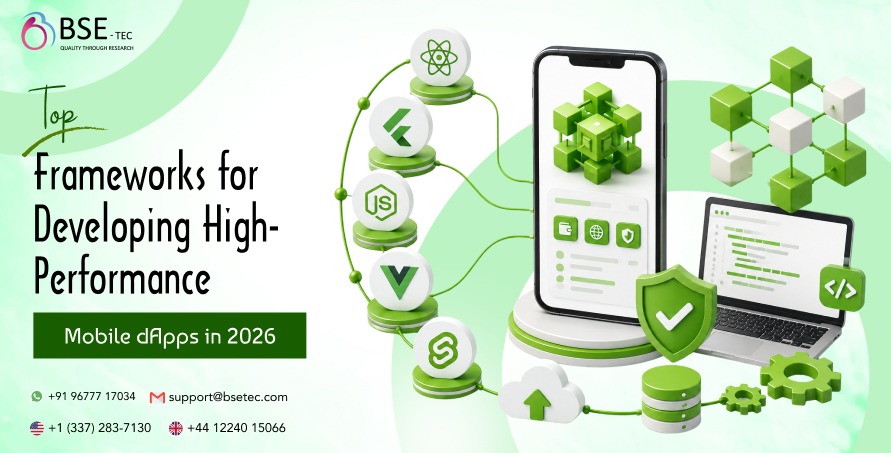
React Native: The Preferred Choice for Scalable Web3 Applications
Even with newer technologies entering the market, React Native continues to dominate blockchain mobile development.
The reason is simple.
Businesses want to launch on both Android and iOS without maintaining separate codebases. At the same time, they need reliable performance and strong blockchain integration capabilities.
Why React Native Continues to Lead
Single codebase for multiple platforms, Faster development cycles, Strong Web3 ecosystem support, Easy integration with MetaMask and WalletConnect, and Lower maintenance costs
Moreover, React Native works exceptionally well for DeFi platforms, crypto wallets, NFT marketplaces, and tokenized asset applications. Interestingly, many blockchain projects developed by leading Web3 companies continue to rely on React Native because it effectively balances performance and cost efficiency.
Flutter: Delivering Premium User Experiences for Web3
While React Native focuses on flexibility, Flutter focuses heavily on user experience. In fact, Flutter has become one of the fastest-growing frameworks for blockchain applications in 2026.
Why?
Because users expect visually rich and highly responsive interfaces.
Where Flutter excels: near-native performance, Smooth animations, Real-time rendering, Consistent UI across devices, and Enhanced user engagement
As blockchain gaming, metaverse applications, and NFT ecosystems continue expanding, Flutter is becoming a preferred choice for businesses that prioritize design and user retention. Furthermore, Flutter’s rendering engine helps maintain performance even during complex blockchain interactions.
Kotlin Multiplatform: The Enterprise Blockchain Favorite
Not every blockchain project targets retail users. Many enterprises are building tokenization platforms, digital asset management systems, and blockchain-based financial products. This is where Kotlin Multiplatform shines. Instead of duplicating development efforts, businesses can share core logic while maintaining native experiences.
Why Enterprises Are Choosing Kotlin Multiplatform
Native-level performance, Better security architecture, Shared business logic, reduced development complexity, and Easier long-term maintenance
Consequently, banks, fintech companies, and enterprise blockchain providers are increasingly adopting Kotlin Multiplatform for mission-critical applications.
Ionic with Capacitor: Fast Launches for Emerging Web3 Startups
Sometimes speed matters more than perfection. For startups entering the blockchain market, validating an idea quickly can be more important than building a complex infrastructure from day one. Therefore, Ionic with Capacitor remains a practical solution.
Key Benefits
Rapid MVP development
Lower development costs
Easy deployment
Faster market entry
Simplified blockchain integrations
As a result, many early-stage Web3 startups use Ionic to test concepts before scaling into larger ecosystems.
Solana Mobile Stack: Built Specifically for Blockchain-Native Experiences
Unlike traditional frameworks that later integrate blockchain functionality, Solana Mobile Stack was designed with Web3 at its core. This makes it particularly attractive for blockchain-first applications.
Why Solana Mobile Stack Is Gaining Attention
Native wallet integration, Secure transaction signing, Optimized blockchain interactions, Enhanced mobile security, and Better on-chain performance
Meanwhile, as consumer adoption of crypto applications continues growing, blockchain-native frameworks are becoming increasingly relevant.
The Biggest Shift in 2026: AI and Blockchain Are Now Working Together
Here’s where things get really interesting. The conversation is no longer just about blockchain. Instead, businesses are now combining AI with decentralized technologies. AI agents are executing trades, managing portfolios, automating DeFi strategies, analyzing blockchain data, and interacting with smart contracts in real time.
However, this creates a new challenge.
Your framework must support: AI-driven automation, Real-time blockchain processing, Instant user interactions, Secure wallet communication, and High-volume transaction handling
Therefore, selecting a framework based solely on popularity is no longer enough. You need an architecture that can support future innovations as well.
Choosing the Right Framework Is Important—But Execution Matters More
Here’s something many businesses realize too late. A framework alone doesn’t guarantee success.
You can choose React Native, Flutter, Kotlin, or Solana Mobile Stack. However, without proper blockchain architecture, smart contract optimization, wallet integration, security implementation, and scalability planning, performance issues will eventually appear.
This is exactly where experienced blockchain development partners become valuable.
For example, when businesses approach BSEtec for mobile dApp development, the discussion rarely starts with “Which framework should we use?”
Instead, it starts with:
- What problem are you solving?
- How many users do you expect?
- Which blockchain ecosystem fits your goals?
- Will AI integration be required?
- How should the platform scale over the next five years?
Because of this strategic approach, BSEtec helps businesses build mobile dApps that are not only fast today but also prepared for future Web3 demands.
Whether it’s a DeFi platform, NFT marketplace, tokenization solution, crypto wallet, or AI-powered blockchain ecosystem, the focus remains on creating high-performance applications that users genuinely enjoy using.
And honestly, that’s what separates successful dApps from forgotten ones.
Which Framework Fits Your Business Goals?
Rather than asking which framework is the best, ask which framework is best for your specific project.
Choose React Native If:
You need cross-platform efficiency,
Want a faster development
You require strong Web3 integrations
Choose Flutter If:
User experience is your priority
You need visually rich interfaces
Performance consistency matters
Choose Kotlin Multiplatform If:
You’re building enterprise-grade solutions
Security and scalability are critical
Choose Ionic If:
You need a rapid MVP launch
Budget optimization is important
Choose Solana Mobile Stack If:
You’re building blockchain-native applications
Deep Web3 integration is required
Ultimately, the right framework depends on your business objectives, user expectations, and long-term growth strategy.
Final Thoughts: The Framework You Choose Today Shapes Your Web3 Future
The mobile dApp market in 2026 is moving faster than ever. Meanwhile, user expectations continue rising.
People no longer compare your decentralized application with another blockchain platform. Instead, they compare it with the fastest apps on their phones. That’s a tough benchmark. So before launching your next blockchain project, ask yourself:
Will your mobile dApp simply function, or will it deliver an experience users actually love?
The answer often comes down to choosing the right framework, architecture, and development partner. If you’re planning to build a high-performance mobile dApp that stands out in the competitive Web3 landscape, now is the perfect time to take the next step.
Ready to transform your blockchain idea into a powerful mobile dApp? Connect with BSEtec today and discover how the right technology strategy can turn your vision into the next big Web3 success story.