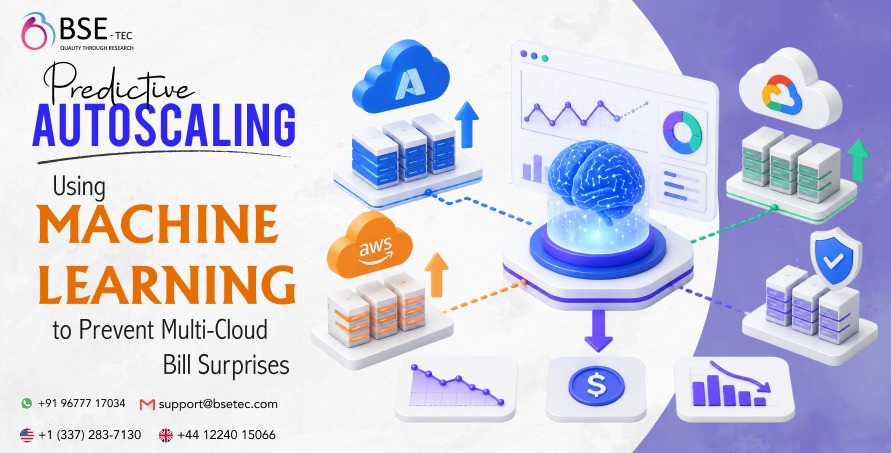
Have you ever opened a cloud invoice and wondered: “Where did all these charges come from?” You’re not alone. In 2026, businesses are scaling faster than ever. AI applications, Kubernetes clusters, real-time analytics, and multi-cloud deployments are driving innovation. However, they are also creating a new problem, unpredictable cloud spending. The reality is simple: traditional autoscaling is no longer enough. Today, leading enterprises are turning to Machine Learning-powered predictive autoscaling to forecast demand, optimize resources, and prevent costly cloud bill surprises before they occur.
So, how does it work, and why are organizations making it a key part of their cloud strategy?
Let’s dive in.
The Multi-Cloud Reality: More Flexibility, More Cost Complexity
A few years ago, most businesses relied on a single cloud provider. Today, that’s changed dramatically. Many organizations now run workloads across AWS for application hosting, Microsoft Azure for enterprise systems, Google Cloud for AI and data analytics, and Edge environments for low-latency services
While this multi-cloud approach improves resilience and flexibility, it also introduces a major challenge. Every cloud provider has Different pricing structures, scaling mechanisms, resource allocation models, and billing complexities. As a result, cloud costs become harder to predict.
According to recent cloud optimization reports, organizations continue to waste between 22% and 50% of their cloud spending due to idle resources, overprovisioning, and inefficient scaling practices.
Meanwhile, AI workloads are accelerating the problem. In 2026, GPU-intensive AI applications have become one of the fastest-growing contributors to cloud expenses, forcing organizations to rethink how infrastructure scales. This is exactly where predictive autoscaling comes into play.
Reactive Scaling vs Predictive Scaling: What’s the Difference?
Think about traditional autoscaling for a moment. It behaves like a firefighter. It responds after the fire starts.
For example:
- CPU usage spikes
- Memory reaches a threshold
- Traffic suddenly increases
Only then does the infrastructure begin scaling.
Unfortunately, by that time:
- Users may already experience delays
- Applications may slow down
- Additional resources may be overallocated
Consequently, businesses often pay more while delivering a poorer user experience.
Now compare that with predictive autoscaling. Instead of reacting, it predicts. Rather than waiting for traffic spikes, machine learning models analyze patterns and prepare infrastructure before demand arrives. It’s the difference between reacting to a storm and checking the weather forecast beforehand.
How Machine Learning Predicts Infrastructure Demand
This is where things get interesting. Modern predictive autoscaling platforms continuously learn from multiple data sources. Instead of relying on simple CPU thresholds, they evaluate:
Historical Traffic Trends: If your platform experiences recurring traffic increases every Monday morning, the system recognizes the pattern automatically. As a result, resources are provisioned before users log in.
User Behavior Analytics: Machine learning can identify how customers interact with applications and predict future demand based on behavioral trends.
Seasonal and Business Events
Product launches.
Marketing campaigns.
Holiday sales.
Subscription renewals.
These events often generate predictable traffic spikes. Predictive models incorporate these signals into scaling decisions.
Real-Time Infrastructure Monitoring
The latest AI-powered scaling engines combine forecasting with live telemetry. Therefore, if conditions suddenly change, the system adjusts instantly.
This hybrid approach helps organizations avoid both:
- Under-provisioning
- Over-provisioning
Industry studies show that AI-driven resource optimization can reduce cloud infrastructure costs by approximately 30% to 40%, while simultaneously improving application performance.
That’s a significant competitive advantage.
Why AI-Native FinOps Is Becoming Essential
Interestingly, predictive autoscaling is closely connected to another major trend in 2026:
AI-Native FinOps
Cloud cost management is evolving rapidly. Previously, FinOps teams spent hours reviewing reports after expenses occurred. Today, AI-powered FinOps platforms can forecast future cloud spending, detect anomalies automatically, predict budget overruns, recommend optimization actions, and identify inefficient workloads. In other words, organizations are moving from reactive cost analysis to proactive cost prevention. This shift is becoming increasingly important because AI workloads themselves now consume a substantial portion of enterprise cloud budgets.
Recent industry data indicates that AI and machine learning workloads account for approximately 30% to 40% of total cloud spending in many AI-driven organizations.
Consequently, predictive autoscaling and AI-powered FinOps are becoming inseparable technologies. One predicts infrastructure demand. The other predicts financial impact. Together, they create a smarter cloud ecosystem.
Beyond Autoscaling: The New Era of Intelligent Cloud Optimization
Although predictive autoscaling delivers impressive results, leading organizations are taking optimization even further.
Intelligent Workload Placement
Not every workload should run on the same cloud provider.
Machine learning can evaluate:
- Cost efficiency
- Performance requirements
- Geographic location
- Resource availability
Then it automatically recommends the most economical deployment option.
Cost-Aware Kubernetes Operations
Kubernetes remains the backbone of modern cloud-native applications. However, Kubernetes clusters can become expensive when scaling decisions focus only on performance.
In 2026, organizations are increasingly adopting cost-aware Kubernetes scheduling that balances both performance and spending.
GPU Forecasting for AI Workloads
AI applications require expensive GPU resources.
Therefore, enterprises are using predictive analytics to determine:
- When GPUs are actually needed
- Which workloads require premium accelerators
- How AI inference workloads should be distributed
Studies suggest that organizations implementing AI-focused FinOps strategies can reduce GPU-related cloud expenses by up to 40%.
Why Businesses Are Connecting Predictive Autoscaling with Digital Transformation
Here’s something many organizations overlook. Predictive autoscaling isn’t just a cloud optimization feature. It’s part of a much larger digital transformation strategy.
When businesses invest in AI-powered applications, Cloud-native development, Multi-cloud infrastructure, Kubernetes modernization, and Enterprise automation, they need intelligent infrastructure capable of scaling efficiently.
This is where BSEtec plays a critical role.
Rather than treating cloud optimization as an isolated project, BSEtec helps organizations build complete digital ecosystems where cloud infrastructure, AI solutions, automation, analytics, and business applications work together seamlessly.
For example:
A company implementing AI-powered customer platforms may also require Predictive autoscaling, Cloud cost optimization, Kubernetes management, AI monitoring systems, and Real-time analytics. Instead of solving these challenges separately, BSEtec creates integrated solutions that connect every layer of the technology stack.
As a result, businesses gain better performance, stronger scalability, and greater control over cloud spending.
The Future Is Predictive, Not Reactive
Imagine a cloud environment that knows demand is coming before users arrive, Imagine an infrastructure that scales automatically without wasting resources, Imagine receiving your monthly cloud bill and finding exactly what you expected.
No surprise GPU charges, No unexpected Kubernetes costs, No unexplained multi-cloud spending spikes.
That’s the future predictive autoscaling is creating.
And as machine learning continues to evolve throughout 2026 and beyond, organizations that embrace predictive cloud management will gain a significant advantage in both performance and profitability.
Ready to Take Control of Your Multi-Cloud Costs?
If you’re planning to modernize your cloud infrastructure, optimize Kubernetes environments, implement AI-powered cloud management, or build scalable digital platforms, now is the perfect time to explore predictive autoscaling.
BSEtec helps businesses transform cloud complexity into intelligent, cost-efficient growth.
Don’t wait for your next cloud bill to reveal a problem.
Connect with BSEtec today for a customized consultation and discover how predictive autoscaling, AI-driven cloud optimization, and intelligent infrastructure management can help your business stay ahead in 2026.