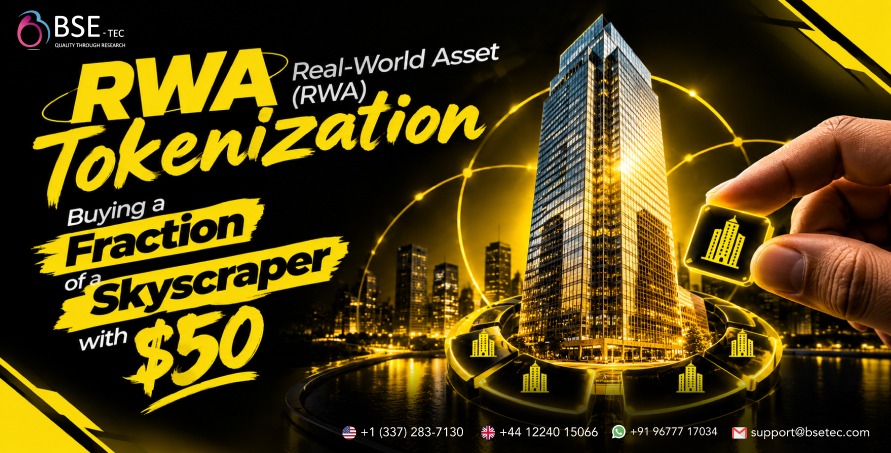
Imagine looking at a $10 million skyscraper and owning a small fraction of it without purchasing the entire building. It sounds unusual. However, Real-World Asset (RWA) tokenization is making this type of fractional ownership increasingly possible through blockchain technology.
Instead of keeping a physical asset locked inside traditional ownership structures, tokenization can represent ownership rights or economic interests through digital tokens. As a result, assets such as real estate, fine art, private credit, commodities, and other investments can become easier to divide and manage digitally.
In some models, the minimum participation amount could be as low as $50. However, that figure is only an example. The actual minimum depends on the asset, platform, legal structure, investor requirements, and applicable regulations.
For businesses across the United States, Belgium, and other global markets, this creates a new connection between traditional finance and blockchain infrastructure.
What Is RWA Tokenization?
RWA tokenization means representing ownership, economic rights, or claims connected to a real-world asset through blockchain-based tokens.
The underlying asset can include:
- Commercial and residential real estate
- Fine art and collectibles
- Private credit and investment funds
- Bonds and other financial instruments
- Gold and other commodities
- Business assets and receivables
Rather than transferring the physical asset itself onto a blockchain, businesses can digitally represent the legal and economic rights associated with that asset.
Consequently, blockchain can provide a programmable layer for recording ownership, managing transfers, and automating certain transactions.
BSEtec’s own research describes RWA tokenization as a way to bring assets such as real estate, art, and financial instruments into blockchain-based systems while enabling fractional ownership. BSEtec: RWA Tokenization – The $10 Trillion Opportunity
How Could $50 Represent a Fraction of a Skyscraper?
Consider a commercial property valued at $10 million.
Traditionally, purchasing the building would require enormous capital, along with legal work, due diligence, financing, and other processes.
With tokenization, the economic interest in that property could instead be divided into a large number of digital units.
Now imagine an offering where a small portion is represented by tokens worth $50.
The investor would not own the entire skyscraper. Instead, the tokens could represent a defined fractional interest or economic right, depending on how the investment has been legally structured.
That distinction matters.
Tokenization does not magically turn $50 into ownership of a $10 million building. Instead, it creates a digital mechanism through which a larger asset can potentially be divided into smaller participation units.
This is the foundation of fractional ownership.
Why Are Businesses Putting Assets On-Chain?
Traditional assets can be difficult to divide, transfer, and manage.
Paperwork, intermediaries, settlement procedures, investor verification, and geographical restrictions can add complexity. By contrast, blockchain can digitize parts of the ownership and transaction process.
As a result, businesses are exploring tokenization for several reasons:
1. Fractional Ownership: High-value assets can potentially be divided into smaller units, lowering the capital required to participate in certain offerings.
2. Greater Accessibility: Investors may gain access to asset classes that traditionally required significantly higher capital, subject to eligibility and regulation.
3. Faster Settlement: Smart contracts can automate parts of the transaction and settlement process, reducing manual steps.
4. Transparent Records: Blockchain provides a shared transaction record, which can improve visibility into token ownership and transfers.
5. Programmable Rules: Transfer restrictions, investor eligibility, and other conditions can be incorporated into the digital asset infrastructure.
BSEtec also highlights these advantages in its research on asset tokenization and blockchain-based fractional ownership. BSEtec: Tokenization Through Blockchain Innovation
RWA Tokenization Is Bigger Than Real Estate
Real estate may be the easiest example to understand. Nevertheless, tokenization is moving into several other asset categories.
Private credit, bonds, commodities, invoices, investment funds, intellectual property, and even alternative assets are being explored for blockchain-based representation.
That expansion is important because the real opportunity is not simply creating digital property tokens.
Instead, the bigger goal is building a digital infrastructure for ownership, settlement, compliance, and asset management.
BSEtec’s 2026 research also highlights enterprise asset tokenization across areas such as real estate, private credit, corporate bonds, commodities, invoices, intellectual property, and infrastructure assets. BSEtec: Enterprise Asset Tokenization
What Happens Behind a Tokenized Property?
Tokenizing a skyscraper involves much more than creating a token.
A typical ecosystem could look like:
Real-World Asset → Legal Structure → Smart Contract → Digital Tokens → Investor Platform → Compliance → Secondary Market
First, the underlying asset needs a suitable legal and ownership structure.
Next, smart contracts can define how tokens are issued, transferred, and managed. After that, an investor platform can provide access to holdings, transactions, distributions, and other information.
Meanwhile, compliance systems can handle requirements such as KYC and AML, particularly when the asset involves regulated investors or financial products.
BSEtec’s dedicated RWA tokenization offering covers areas including custom tokenization platforms, smart contract architecture, compliance integration, and fractionalization. BSEtec: RWA Tokenization Development
What About US and Belgian Investors?
This is where the technology needs to meet regulation.
A token representing an investment interest may fall under securities or other financial regulations depending on its structure and jurisdiction. Therefore, businesses cannot treat tokenization as simply a technical blockchain project.
For US and European markets, investor eligibility, KYC/AML, custody, transfer restrictions, reporting, and applicable securities requirements can all become important.
Belgium also sits within the broader European regulatory environment, so businesses targeting Belgian investors need to consider the relevant EU and local requirements.
In short:
Blockchain provides the infrastructure, while legal and compliance frameworks determine how that infrastructure can be used.
BSEtec’s token development services include security token development, smart contract development, tokenomics, wallet integration, and compliance-focused token solutions. BSEtec: Token Development Services
A Practical Example of Fractionalized Real Estate
BSEtec has published a real-estate tokenization case study based on a hypothetical $45 million office building in Berlin.
In that example, the property is represented through 100,000 tokens, with each token representing a $450 fractional share. The proposed platform also includes KYC/AML onboarding, investor dashboards, rental-income distribution, and custody integration.
The example shows why RWA tokenization is more than a token-creation exercise.
The surrounding platform is what makes the digital asset useful.
BSEtec: Real Estate Tokenization Case Study
How BSEtec Helps Build RWA Tokenization Platforms
For businesses planning an RWA project, the technology stack can include several connected components.
BSEtec can support areas such as:
1. RWA Tokenization Platforms: Build customized infrastructure for real estate, private credit, commodities, and other assets.
2. Security Token Development: Create token structures designed around fractional ownership and regulated asset models.
3. Smart Contract Development: Automate issuance, ownership, transfers, and other asset-related functions.
4. Compliance Integration: Incorporate KYC, AML, investor verification, and jurisdiction-specific requirements.
5. Investor Dashboards: Provide portfolio tracking, transaction history, distributions, and reporting.
6. Liquidity Infrastructure: Support future trading and secondary-market functionality where applicable.
BSEtec’s broader blockchain development capabilities also cover smart contracts, token development, Layer-2/Layer-3 scaling, and cross-chain interoperability. BSEtec Blockchain & Web3 Solutions
The Bigger Opportunity
The most interesting part of RWA tokenization is not simply the idea of buying a piece of a skyscraper for $50.
The bigger change is happening in the way assets can be structured.
A commercial building could potentially be divided into digital units. Similarly, an investment fund could use tokens to represent economic interests, while smart contracts manage predefined transactions.
For asset owners, this model could create new approaches to capital formation and distribution.
At the same time, investors may gain access to fractional opportunities that were previously difficult to reach.
However, tokenization alone does not guarantee liquidity, value appreciation, or investment success. The underlying asset, legal structure, market demand, platform design, and regulatory framework still matter.
Final Thoughts
RWA tokenization is changing how businesses can create, manage, and distribute ownership of real-world assets.
For example, the idea of owning a fraction of a skyscraper for $50 is just one possibility. However, behind that opportunity lies a complete technology ecosystem involving blockchain, smart contracts, token development, compliance, digital identity, investor platforms, custody, and liquidity infrastructure. As a result, RWA tokenization can create new ways for businesses and investors to access and manage real-world assets.
This is where BSEtec brings its blockchain and Web3 expertise into the picture. From designing RWA tokenization platforms and developing security tokens to building smart contracts, compliance integrations, investor dashboards, and supporting blockchain infrastructure, BSEtec helps businesses turn real-world assets into practical digital solutions.
For businesses across the US, Belgium, and global markets, BSEtec can support the development of secure and scalable RWA tokenization solutions tailored to different asset classes and business requirements.
The future of asset ownership may not always require buying the whole asset.
With the right technology and infrastructure, owning a fraction could become the new starting point.