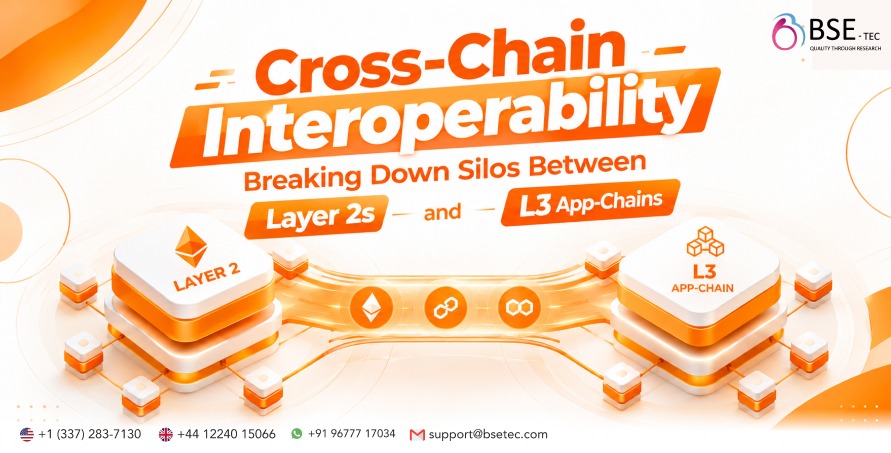
BSEtec is building the infrastructure needed for a multichain enterprise world, combining Layer 2 and Layer 3 scaling, cross-chain interoperability, smart contracts, and Web3 infrastructure. As businesses deploy applications across specialised blockchain networks, the next challenge is no longer simply making each chain faster. It is making those chains work together.
The rise of L2s and L3 app-chains has created more room for specialised applications, lower-cost transactions, and customised blockchain environments. However, every new execution layer can also create another silo for liquidity, assets, users, data, and applications.
That creates a critical infrastructure question for 2026:
What happens when an application needs to operate across several L2s and L3 app-chains without forcing users to understand the underlying networks?
The answer is moving toward cross-chain interoperability, shared liquidity, cross-chain messaging, chain abstraction, and secure multi-network infrastructure.
More Chains Solved Scaling. Now They Need to Talk.
Ethereum’s ecosystem is no longer built around one execution environment.
L2s now serve different purposes, while app-specific chains can optimise infrastructure around particular applications or industries. Consequently, businesses gain flexibility but face a new integration problem.
A user may hold an asset on one network, interact with an application on another, and need liquidity from a third ecosystem.
Ethereum’s 2026 roadmap explicitly places greater emphasis on interoperability and reducing fragmentation across L2s. The Ethereum Foundation describes a future with independent but interoperable L2s that can share access to liquidity, users, and applications.
So, scalability created more blockchain environments. Interoperability now has to connect them.
The Real Problem Is Bigger Than Moving Tokens
Cross-chain interoperability often gets reduced to one simple use case: moving assets from Chain A to Chain B.
Enterprise applications need much more.
A financial platform may need to send instructions across networks. A tokenized asset platform could require coordinated transactions across multiple environments. Meanwhile, an AI-powered application may need to select the right chain based on liquidity, cost, speed, or application requirements.
Therefore, modern interoperability needs to support more than token transfers.
It can involve:
- Cross-chain messaging for communicating instructions and data.
- Asset movement across different blockchain environments.
- Shared liquidity for reducing fragmented capital.
- Cross-chain smart-contract interactions for coordinated workflows.
- Chain abstraction for hiding network complexity from users.
This distinction matters because connectivity alone does not guarantee useful integration. Recent research into cross-chain infrastructure found that structural connectivity and actual cross-chain usage can diverge significantly.
L2s and L3s Are Becoming Specialized — Interoperability Must Become Smarter
The next blockchain architecture will not necessarily depend on one universal chain.
Instead, different networks can specialise in different workloads.
An L2 might prioritise high-volume transactions. An L3 app-chain could focus on gaming, financial applications, enterprise workflows, or AI-driven execution. Another network may optimise privacy or compliance.
That specialisation creates value. At the same time, isolated ecosystems limit that value.
Imagine an enterprise application that uses an L3 for execution but depends on liquidity sitting on an L2. Without efficient interoperability, users may face manual bridging, multiple wallets, network switching, and fragmented liquidity.
A connected architecture removes much of that friction:
Application → Intent → Routing → Cross-Chain Messaging → Execution → Settlement
As a result, developers can choose specialised infrastructure without forcing customers to manage every underlying chain.
Bridges Were the Beginning. Chain Abstraction Is the Bigger Shift.
Bridges created the first major connection between isolated blockchain ecosystems.
However, the user experience still exposed the underlying complexity. Users had to identify networks, select bridges, manage gas, move assets, and wait for transactions to complete.
The next phase focuses on making those decisions increasingly invisible.
Ethereum’s interoperability research now includes intent-based transfers, standardised cross-chain addressing, general message passing, and wallet-level chain abstraction.
That shift changes the experience from:
“Which chain should I use?”
to:
“What do I want to accomplish?”
The infrastructure can then determine how to route the transaction.
BSEtec is already exploring this direction through its work around chain abstraction and enterprise blockchain infrastructure, where unified wallets, smart transaction routing, cross-chain asset management, and multi-network applications reduce blockchain complexity for users.
Security Becomes the Price of Interoperability
Connecting more networks also increases the security surface.
A weak interoperability layer can expose assets, messages, or applications to serious risks. That is why cross-chain architecture needs security at every stage rather than treating it as an afterthought.
A robust design can combine:
- Message verification to validate cross-chain instructions.
- Smart-contract controls to restrict execution.
- Multi-layer validation to reduce single points of failure.
- Transaction monitoring to detect abnormal behaviour.
- Emergency controls to contain suspicious activity.
Ethereum’s own interoperability research highlights security as a central concern because bridges have historically represented a significant source of ecosystem losses.
Consequently, enterprise interoperability must balance connectivity, security, performance, and control.
2026: Interoperability Is Becoming Enterprise Infrastructure
Cross-chain capability is moving beyond crypto-native applications.
Businesses increasingly need blockchain infrastructure that can support multiple networks, digital assets, smart contracts, and enterprise systems at the same time. BSEtec’s 2026 infrastructure work specifically identifies cross-chain messaging, secure bridge architecture, shared liquidity, chain abstraction, unified wallets, and multi-network asset management as important components of modern blockchain infrastructure.
For global enterprises, this matters because blockchain adoption rarely happens inside one isolated network.
A financial institution may connect tokenized assets with multiple settlement environments. A multinational platform could need several blockchain ecosystems for different business functions. Likewise, Web3 applications may need to reach users regardless of which network holds their assets.
Interoperability therefore becomes less of an optional feature and more of an integration layer between blockchain ecosystems.
BSEtec: Connecting the Infrastructure Behind Multichain Applications
Building a cross-chain application requires more than adding a bridge.
BSEtec can design blockchain infrastructure around cross-chain interoperability, Layer 2 and Layer 3 scaling, smart contracts, blockchain messaging, asset transfers, chain abstraction, and multi-network application architecture.
The company’s current technology stack explicitly includes Layer-2 / Layer-3 Rollup Scaling as well as Cross-Chain Interoperability Protocols, alongside broader blockchain and enterprise infrastructure capabilities.
That capability is particularly relevant for enterprises that want to avoid locking an application, asset, or user base into a single network.
BSEtec also has direct experience and published work around cross-chain Web3 applications, blockchain interoperability, and token bridges, providing useful context for businesses evaluating multichain architectures.
For a deeper internal link, BSEtec’s Cross-Chain Web3 App content can support this article, while its Chain Abstraction article fits naturally alongside the user-experience discussion.
What Comes Next: One Application, Many Chains, Zero Confusion
The future of blockchain infrastructure may not belong to a single dominant execution layer.
Instead, specialised L2s and L3 app-chains can coexist while interoperability connects their users, assets, liquidity, and applications.
The winning experience will not ask users to understand which chain executes every transaction. Instead, they will interact with an application while the infrastructure handles routing, messaging, liquidity, and settlement underneath.
That is the real promise of cross-chain interoperability: specialisation without fragmentation.
Final Thoughts
Layer 2s and L3 app-chains are solving the scalability and customisation problem. Cross-chain interoperability now has to solve the fragmentation problem.
As blockchain ecosystems multiply, enterprises need infrastructure that can connect networks without sacrificing security, performance, or user experience.
BSEtec helps businesses move toward that multichain future through Layer 2 and Layer 3 development, cross-chain interoperability, smart contracts, chain abstraction, and enterprise blockchain infrastructure.
The next generation of Web3 applications will not simply live on one chain. They will operate across ecosystems while making the complexity invisible to the end user.