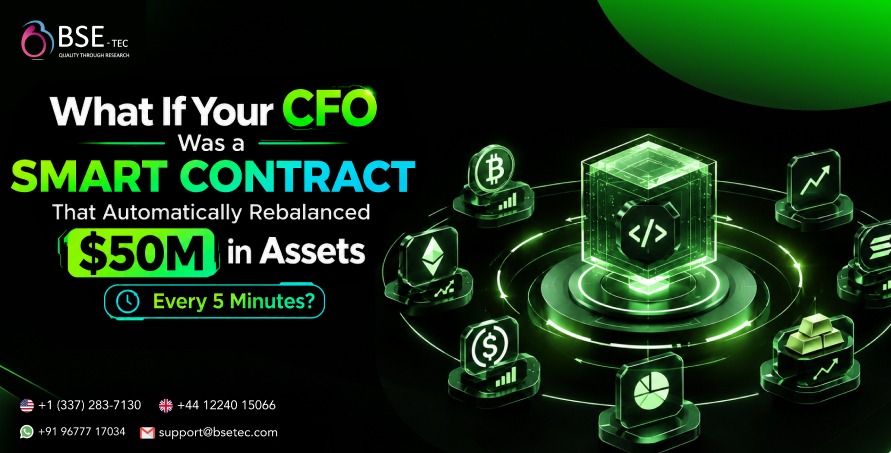
Imagine managing a $50 million portfolio without waiting for a meeting, a spreadsheet update, or a manual trade approval. That is the possibility emerging at the intersection of smart contracts, AI-driven market analysis, and tokenized financial assets. BSEtec works across blockchain development, AI-powered trading infrastructure, and asset tokenizationto help businesses explore this next generation of programmable finance.
However, the real opportunity is not simply making financial decisions faster. It is building a system that executes predefined investment rules, responds to changing market conditions, and keeps every movement accountable.
Your Financial Strategy Could Run While Everyone Else Sleeps
Traditional portfolio management often depends on analysts, operational teams, market data providers, and approval workflows. Even when firms use automated trading systems, separate tools may handle monitoring, decision-making, execution, and reporting.
A smart-contract-based portfolio can connect these processes through programmable rules.
For example, imagine a portfolio that targets 40% tokenized government securities, 30% digital assets, and 30% other eligible investments. When market movements push the portfolio away from its approved allocation, a rebalancing engine can identify the difference and propose or execute adjustments.
Every five minutes, the system could reassess portfolio conditions. Nevertheless, it should trade only when the expected benefit outweighs transaction costs, liquidity constraints, and risk.
That distinction matters: frequent monitoring does not require frequent trading.
The $50M Rebalancing Engine: From Market Signals to Execution
A programmable portfolio needs more than a smart contract. It requires a coordinated architecture that connects reliable information with controlled financial actions.
A typical workflow looks like this:
- Collect: Market data feeds and approved sources provide asset prices, liquidity information, and portfolio valuations.
- Evaluate: A strategy engine checks allocation drift, exposure limits, volatility, and portfolio objectives.
- Validate: Risk controls determine whether the proposed transaction meets predefined rules.
- Execute: Smart contracts or connected execution systems process eligible transactions.
- Record: The system records transaction details and updates portfolio reporting.
Consequently, the portfolio can respond to changing conditions without requiring a human to approve every routine action. Meanwhile, finance teams retain oversight of strategy, risk limits, exceptions, and major allocation changes.
For implementation, BSEtec’s AI algorithmic trading and predictive DeFi oracle solutions are relevant to the market-analysis, data-validation, and execution components of this architecture.
The Institutional Signal: JPMorgan and Apollo Tested Automated Portfolio Management
The idea of programmable portfolio management already has an institutional precedent.
Under Project Guardian, JPMorgan and Apollo explored how permissioned blockchain infrastructure and smart contracts could support portfolio construction across traditional and alternative funds. The proof-of-concept included automated portfolio rebalancing, standardized subscription and redemption processes, and cross-chain interoperability.
This example matters because it moves the conversation beyond crypto trading bots. Institutional portfolio management involves different asset types, operational rules, investor requirements, and infrastructure. Therefore, automation must coordinate those requirements rather than simply react to price changes.
The project demonstrates an important direction for financial technology. However, it was a proof of concept, not evidence that a smart contract can manage a $50 million portfolio by rebalancing every five minutes.
Why Tokenized Assets Make Programmable Finance More Practical
Automation becomes more useful when the assets themselves can interact with digital infrastructure.
Tokenization represents ownership or economic rights in assets through blockchain-based tokens. Depending on the legal structure and platform, these assets may include fund interests, real estate investments, government securities, or other eligible instruments.
With suitable infrastructure, tokenized assets can interact with smart contracts for transfers, settlement, and selected portfolio operations.
For instance, a portfolio engine could detect that one holding has exceeded its target allocation. It could then evaluate an eligible transaction, check compliance restrictions, and route the trade through an approved execution venue.
Still, tokenization alone does not guarantee liquidity or instant settlement. Asset restrictions, market depth, custody arrangements, and legal requirements continue to shape what the system can actually execute.
Businesses exploring this model can connect the portfolio layer with BSEtec’s RWA tokenization development solutions, which cover smart-contract architecture, compliance integration, investor dashboards, and tokenized asset platforms.
Five-Minute Decisions Need More Than Fast Code
A system that manages $50 million cannot treat every market signal as an instruction to trade.
Frequent rebalancing can increase transaction costs, create unnecessary turnover, and expose the portfolio to slippage. In volatile markets, poor data or a delayed price feed could also trigger an inappropriate decision.
A production-ready system therefore needs several safeguards:
- Allocation boundaries: Define the permitted exposure to each asset and asset class.
- Trade thresholds: Ignore small allocation changes that do not justify transaction costs.
- Reliable data: Validate prices across suitable sources and detect abnormal readings.
- Liquidity controls: Estimate execution impact before submitting large orders.
- Emergency controls: Pause automated execution when data, protocols, or market conditions behave unexpectedly.
Moreover, high-value portfolios may need multisignature approvals, role-based permissions, transaction caps, and human authorization for exceptional actions.
The smart contract should enforce approved rules—not invent investment policy on its own. AI can help interpret data or recommend adjustments, while deterministic controls decide whether the system may execute them.
The New CFO Stack: AI Intelligence Meets Smart Contract Enforcement
The next generation of financial automation will likely combine several specialised components rather than rely on one all-powerful contract.
An AI analysis layer can identify changing market conditions and assess possible strategies. A portfolio engine translates those findings into proposed allocations. Meanwhile, smart contracts enforce permitted actions, and monitoring tools record outcomes and flag unusual activity.
This division of responsibility is essential. AI models can produce inaccurate recommendations, while smart contracts can execute flawed instructions exactly as programmed. Combining both without independent validation would simply automate mistakes faster.
BSEtec’s work across AI, blockchain, and smart-contract infrastructure aligns with this broader development direction. Businesses can explore its AI and blockchain capabilities when designing systems that connect market intelligence with programmable execution.
What Comes Next: From Automated Portfolios to Programmable Treasury
The same architecture could eventually support corporate treasury operations, collateral management, tokenized fund allocation, and other financial workflows. Instead of waiting for separate teams to reconcile every change, organisations could use programmable rules to coordinate eligible actions and maintain an auditable record.
Even so, not every financial decision belongs on-chain. Illiquid assets, legal approvals, off-chain obligations, and exceptional market events still require specialist judgement and operational oversight.
The practical goal is therefore not to remove the CFO. It is to give finance teams better tools for implementing policy consistently, identifying risk earlier, and understanding what changed across a portfolio.
Final Thoughts
A smart contract that manages a $50 million portfolio every five minutes is a compelling vision of programmable finance. Yet its real value would come from disciplined execution, reliable data, transparent controls, and a clear boundary between automated actions and human decisions.
As tokenization and AI-driven financial systems evolve, BSEtec can help businesses explore the blockchain, smart-contract, and AI infrastructure needed to build these solutions. The future CFO may not be a single contract—but a coordinated financial system that makes routine execution more efficient while keeping accountability firmly in place.