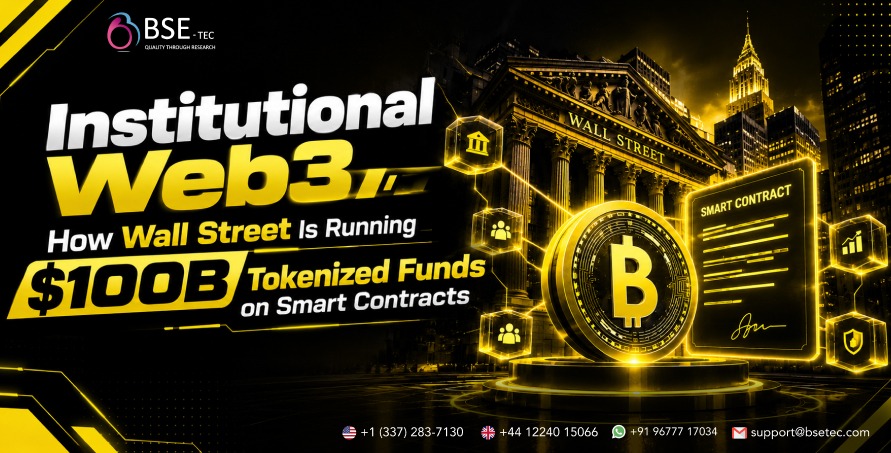
Wall Street is no longer asking whether blockchain belongs in institutional finance. The bigger question is how much of the financial system can move on-chain.
In 2026, that shift is becoming visible through tokenized funds, tokenized securities, smart contracts, digital assets, and blockchain-based settlement infrastructure.
For global financial institutions, the attraction is not crypto speculation. Instead, the focus is operational: faster settlement, programmable ownership, automated compliance, 24/7 transferability, and better integration between traditional finance and digital markets.
BSEtec works in this emerging space by combining blockchain development, asset tokenization, smart contracts, Web3 infrastructure, and enterprise-grade architecture. Consequently, businesses can explore institutional blockchain solutions without treating tokenization as simply a process of putting an asset on-chain.
The real opportunity is much bigger.
Financial infrastructure itself is becoming programmable.
Wall Street Has Moved Beyond the Blockchain Experiment
Institutional Web3 is entering a different phase.
Previously, financial institutions mostly explored blockchain through pilots and proof-of-concepts. Now, however, major players are putting tokenized financial products into production environments.
BlackRock, for example, launched tokenized access to selected Institutional Cash Series money-market funds in Europe in August 2026. The initiative provides tokenized functionality across funds representing a combined $311 billion in AUM across 15 markets, with the digital tokens issued on Ethereum through J.P. Morgan’s Kinexys platform.
That figure matters because it shows the scale of the underlying financial products being connected to blockchain infrastructure.
At the same time, J.P. Morgan reports that its Kinexys Digital Assets platform has facilitated more than $1.5 trillion in trading and settlement activity, involving tokenized Treasuries, money-market funds, and fixed-income instruments.
Therefore, the institutional Web3 conversation is moving from “Can blockchain work?” toward “How should financial markets use it?”
The Token Is Only the Beginning
A tokenized fund is not simply a traditional fund with a blockchain-based label.
Instead, tokenization can connect ownership, transfer rules, investor eligibility, settlement, and financial workflows through programmable infrastructure.
Consider a simplified structure:
Traditional Fund → Digital Representation → Smart Contract Rules → Approved Investor → On-Chain Transfer → Settlement
Each stage can potentially become more automated.
For instance, transfer restrictions can be encoded into smart contracts. Likewise, approved wallets can be whitelisted, ownership records can be updated digitally, and certain fund operations can be triggered automatically.
However, blockchain does not eliminate the legal or regulatory framework surrounding the underlying asset.
The SEC has clarified that tokenized securities remain subject to existing securities laws, while the legal rights, custody arrangements, and authoritative records remain important to the regulatory analysis.
That distinction is critical for institutional investors.
Smart Contracts Are Becoming the New Financial Workflow
The most interesting part of tokenized funds may not be the token itself.
It is the logic surrounding the token.
Smart contracts can encode rules that previously required multiple systems, intermediaries, reconciliations, and manual processes.
For example, an institutional fund platform could use programmable logic for:
- Investor eligibility — restricting ownership to approved participants.
- Transfer controls — checking whether a token can move between wallets.
- Distribution logic — automating eligible payments or fund distributions.
- Settlement workflows — coordinating asset and cash movements.
- Collateral management — using tokenized assets within financial workflows.
- Compliance rules — applying predefined restrictions before transactions execute.
As a result, smart contract automation can become part of the financial operating layer rather than simply a feature of a blockchain application.
PwC similarly identifies smart contracts as an important component of institutional tokenization, including programmable rules for distributions, capital calls, NAV calculations, transfer restrictions, and compliance logic.
Why Tokenized Funds Are Attractive to Institutions
Institutional finance operates across complex systems.
Custodians, transfer agents, administrators, banks, brokers, investors, and regulators may all interact with the same financial product. Consequently, reconciliation and settlement can become expensive and time-consuming.
Tokenization offers another architecture.
A blockchain-based representation can create a shared digital layer where authorized participants interact with the same programmable asset.
That can support:
Faster settlement: transactions can move closer to real time.
24/7 transferability: certain tokenized products can operate outside traditional market hours.
Programmable compliance: eligibility and transfer conditions can be embedded into transaction logic.
Improved transparency: authorized participants can access on-chain transaction records.
Automated workflows: smart contracts can reduce repetitive manual processes.
BlackRock’s tokenized money-market fund structure, for example, supports 24/7 peer-to-peer transferability between approved wallets while retaining the traditional fund structure and transfer-agent shareholder register.
So, institutional tokenization is not necessarily about replacing traditional finance overnight.
Rather, it can add a programmable digital layer around existing financial infrastructure.
From Tokenized Funds to a Programmable Capital Market
The bigger story starts when tokenized funds connect with other digital assets.
Imagine an institutional investor holding a tokenized money-market fund.
That asset could potentially become collateral within another financial workflow. Meanwhile, smart contracts could manage eligibility, settlement, and movement automatically.
Similarly, tokenized Treasury products could connect with:
- Digital collateral systems.
- Institutional lending platforms.
- Stablecoin settlement.
- Automated treasury management.
- Tokenized private-credit markets.
- Digital asset marketplaces.
This creates a broader concept:
Tokenized assets → Programmable finance → Connected financial markets
That is why institutional Web3 is becoming more interesting than isolated tokenization projects.
2026: The Institutional Tokenization Stack Is Taking Shape
The market is also expanding beyond money-market funds.
Tokenization is now being explored across Treasuries, equities, ETFs, private credit, real estate, commodities, and other financial instruments. Franklin Templeton notes that programmable tokens are increasingly being considered as wrappers for a broad range of investible assets.
Meanwhile, the SEC approved a temporary conditional exemption in September 2026 for limited trading of tokenized NMS stocks on certain on-chain venues.
These developments do not mean every security will immediately move to a public blockchain.
Instead, the market is developing several models involving public networks, permissioned environments, custodians, transfer agents, and hybrid infrastructure.
Consequently, institutional blockchain development now requires much more than smart-contract coding.
It requires architecture that connects blockchain with legal, financial, compliance, custody, and operational systems.
The Real Challenge: Scaling Trust Alongside Technology
Institutional adoption creates a different set of requirements.
Financial institutions need strong identity controls, investor verification, custody processes, compliance monitoring, cybersecurity, and clear ownership records.
Moreover, tokenized assets must maintain a reliable connection between the digital token and the underlying legal or economic rights.
The SEC’s 2026 institutional tokenization analysis emphasizes that digital representation does not automatically change the legal rights or accountability attached to the underlying security.
Therefore, successful RWA tokenization requires coordination between technology and financial infrastructure.
That is where architecture becomes as important as the blockchain itself.
BSEtec: Building Infrastructure for Institutional Tokenization
For financial institutions exploring this transition, BSEtec can help design blockchain infrastructure around real business and regulatory requirements.
Its capabilities can support:
- Asset Tokenization — representing real-world assets and financial interests through programmable digital tokens.
- Smart Contract Development — automating transfers, distributions, permissions, and transaction rules.
- Institutional Blockchain Architecture — designing scalable and secure blockchain environments.
- Permissioned Blockchain Solutions — supporting controlled access for regulated financial workflows.
- RWA Tokenization Platforms — connecting real-world assets with digital ownership infrastructure.
- Cross-Chain Integration — enabling tokenized assets to interact across blockchain ecosystems.
BSEtec has also published work specifically around permissioned sidechains for institutional RWA tokenization, covering compliance, confidentiality, scalability, and controlled asset movement.
Its tokenization platform case study further demonstrates how smart contracts can support fractional ownership, compliance controls, and automated dividend distribution for tokenized real-world assets.
These capabilities are relevant for enterprises exploring tokenized funds, institutional RWA platforms, digital securities, private credit, and programmable financial infrastructure.
What Comes Next for Institutional Web3?
The next stage may not be about creating more tokens.
Instead, it could be about connecting those tokens to the broader financial system.
Tokenized funds may interact with digital collateral. Smart contracts may automate corporate actions. Stablecoins may support settlement. AI agents may eventually interact with tokenized financial products under predefined permissions.
Furthermore, tokenized assets could become components inside automated treasury and investment workflows.
PwC projects global tokenized fund AUM could reach $715 billion by 2030, based on a 41% CAGR assumption from its research.
That projection is not a guarantee. Nevertheless, it illustrates why asset managers, banks, exchanges, custodians, and technology providers are investing in the infrastructure now.
Final Thoughts
Institutional Web3 is moving beyond experimentation.
Tokenized funds are showing how traditional financial products can connect with blockchain-based infrastructure, while smart contracts can introduce programmable rules around ownership, transfers, compliance, settlement, and distributions.
The important shift is therefore not simply “Wall Street is using blockchain.”
It is that financial infrastructure itself is becoming programmable.
For institutions, the next challenge will be connecting this technology with regulatory requirements, custody, identity, liquidity, interoperability, and existing financial systems.
That is where BSEtec can help.
With capabilities across RWA tokenization, smart contracts, blockchain development, permissioned infrastructure, and Web3 solutions, BSEtec can help financial businesses move from tokenization concepts toward scalable institutional platforms.
The future of finance may not replace every traditional system.
Instead, it may connect traditional financial assets to programmable infrastructure—creating markets that can move, settle, and operate in fundamentally new ways.