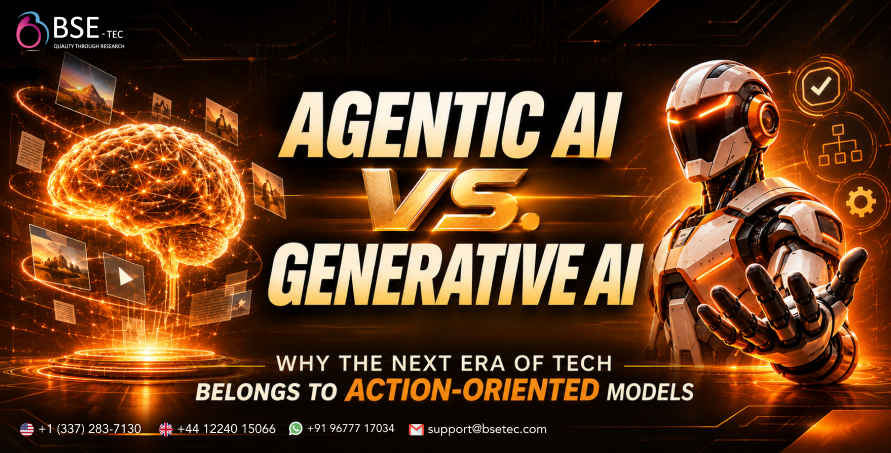
BSEtec is helping businesses explore the next stage of artificial intelligence through AI agents, multi-agent platforms, workflow automation, and AI-powered application development. Generative AI has already changed how companies create content, write code, analyse information, and communicate with customers. However, businesses now want something more than answers. They want AI systems that can understand a goal, make decisions, use tools, and complete tasks across connected applications.
That shift brings Agentic AI vs. Generative AI into the spotlight. While generative models help people create and understand information, agentic systems take the next step by using AI capabilities to perform multi-step work.
Imagine asking an AI system to prepare a sales report. A generative AI tool can write the report when you provide the necessary information. An agentic system can go further: retrieve relevant data, analyse sales performance, prepare the report, and send it for approval through an authorised workflow.
The difference matters because businesses no longer measure AI only by the quality of its responses. Increasingly, they also measure how effectively it helps teams complete real work.
Generative AI Creates the Answer. Agentic AI Moves the Task Forward.
Generative AI and Agentic AI share an important foundation: AI models that interpret information and generate useful outputs. However, they serve different roles in a business workflow.
Generative AI focuses on creating new content based on user instructions and available context. It can generate text, images, code, summaries, reports, and other outputs.
Agentic AI focuses on achieving a goal through a sequence of actions. It can interpret a request, plan steps, select tools, retrieve information, perform authorised actions, and evaluate results.
Consider a customer who requests a refund.
- A generative AI chatbot can explain the refund policy and draft a response.
- An agentic AI workflow can verify the order, check refund eligibility, create a request in the support system, and route it for approval.
Therefore, the two technologies do not compete in every situation. In fact, agentic systems often use generative models as their reasoning and language foundation. The real difference lies in how the system uses that intelligence.
5 Reasons Businesses Are Moving Beyond AI Chatbots
1. From Answering Questions to Completing Work
A chatbot can answer questions quickly. However, many business problems require several connected steps.
For example, a customer support request may require order verification, account checks, policy validation, and a refund action. An agentic workflow can coordinate these steps through connected systems.
As a result, employees spend less time moving information between applications and more time handling complex customer needs.
2. From Manual Processes to Connected Workflows
Businesses often use separate tools for sales, finance, customer support, recruitment, and project management. Consequently, employees lose time switching between platforms and repeating the same information.
Agentic AI can connect these systems through APIs and approved tools. For instance, a sales agent can identify a new lead, research the company, prepare a personalised email, and add the lead to a CRM for review.
Moreover, specialised agents can handle different stages of the same workflow. One agent can gather information, another can analyse it, and a third can prepare the next action.
3. From One-Time Prompts to Goal-Based Execution
Generative AI usually responds to a prompt and produces an output. In contrast, agentic systems can work towards a larger objective.
Consider the instruction: “Prepare a competitor analysis for our new product.”
An agentic workflow could:
- Identify relevant competitors.
- Collect information from approved sources.
- Compare features, positioning, and pricing.
- Organise findings into a report.
- Highlight gaps and opportunities.
- Present the report for human review.
This approach helps teams move from individual prompts to structured business execution.
4. From Individual AI Tools to Multi-Agent Collaboration
One AI system does not need to handle every task. Instead, businesses can build a multi-agent system in which specialised agents collaborate.
For example, an e-commerce company could use:
- A product research agent to analyse product information.
- A customer support agent to handle common questions.
- An inventory agent to check stock levels.
- A marketing agent to prepare campaign suggestions.
- A reporting agent to summarise performance.
Together, these agents can coordinate different parts of a business process. Nevertheless, developers must define clear responsibilities, communication rules, and approval points to prevent errors from spreading across the workflow.
5. From AI Experiments to Measurable Business Outcomes
Businesses need to understand whether AI improves productivity, reduces delays, or enhances customer experience.
Generative AI can help employees create content faster. Meanwhile, agentic systems can target larger operational outcomes, such as reducing manual ticket handling or speeding up information retrieval.
However, autonomy alone does not guarantee better results. Companies should measure task completion rates, error rates, escalation frequency, processing time, and operating costs before expanding an agentic deployment.
Real-World Case Study: How Air India Uses AI.g to Handle Customer Service at Scale
Air India provides a strong example of how businesses can move beyond basic chatbot interactions.
The airline developed AI.g, a generative AI-powered customer-service solution with agentic capabilities, to manage a large volume of customer queries. The system supports questions across areas such as booking changes and refund requests.
According to Microsoft’s February 2026 customer story, AI.g handles around 40,000 customer queries daily across more than 1,300 question types. Microsoft also reports that the system has resolved more than 13 million conversations, with a 97% success rate.
What makes this example relevant is the operational approach. Air India did not focus only on generating helpful answers. Its team developed an agentic solution that could support customer-service processes at scale and improve the experience over time.
The business lessons are clear:
- Connect AI with real operations: Customer service requires more than answering questions; it also involves handling requests and moving processes forward.
- Start with high-volume workflows: Repetitive customer queries offer a practical starting point for AI deployment.
- Measure outcomes: Resolution rates and escalation levels help businesses understand whether the system delivers value.
- Keep human support available: Complex, sensitive, or unusual requests still need appropriate human attention.
Air India’s deployment demonstrates how generative AI and agentic capabilities can work together. It does not suggest that every customer interaction should run without human oversight.
2026 Trends: What Comes Next for Agentic AI?
Agentic AI continues to move from experimental projects towards practical business applications. Several developments are shaping this transition.
1. Multi-Agent Systems Will Handle Larger Workflows
Businesses are exploring systems that coordinate multiple specialised agents instead of relying on one general-purpose assistant. Frameworks and orchestration approaches such as LangGraph and CrewAI support the development of structured agent workflows.
Consequently, companies can divide complex tasks into smaller responsibilities and introduce checkpoints where necessary.
2. AI Agents Will Work Across Business Applications
Agents increasingly connect with CRMs, ERP platforms, internal databases, communication tools, and cloud services. In addition, standards and protocols such as the Model Context Protocol (MCP) help AI applications connect with external tools and data sources.
This development can reduce the gap between an AI assistant and the applications employees already use.
3. Voice Agents Will Expand Customer Interactions
Voice-based AI agents are gaining attention in customer support, appointment scheduling, sales assistance, and service enquiries. Rather than relying only on text conversations, businesses can use voice interfaces to support more natural interactions.
However, companies must design clear escalation paths for complex conversations and sensitive requests.
4. Governance Will Become Essential for Autonomous Work
As agents gain access to business systems, companies must manage permissions, data access, audit trails, and approval requirements.
For example, an AI agent may prepare a payment request, but a human finance manager should approve the transaction before execution. Similarly, an agent may draft a customer email without receiving permission to send it automatically.
Therefore, responsible autonomy will depend on clear boundaries, not simply more powerful models.
5. AI and Blockchain Will Explore New Forms of Automation
AI agents can analyse information and coordinate tasks, while blockchain systems can provide programmable transactions and verifiable records. Together, these technologies create opportunities for on-chain agents, smart-wallet automation, and AI-assisted decentralized applications.
Nevertheless, developers must protect private keys, restrict transaction permissions, and test smart-contract interactions carefully before enabling autonomous execution.
What Should Businesses Automate First?
Agentic AI does not need to begin with a fully autonomous digital workforce. Instead, companies should identify repetitive processes that consume employee time and follow predictable rules.
Good starting points include:
- Customer support ticket classification and routing.
- Lead research and CRM updates.
- Internal document search and information retrieval.
- Invoice data extraction and approval preparation.
- Meeting summaries and task tracking.
- IT incident triage and knowledge recommendations.
Once a workflow demonstrates reliable results, businesses can gradually introduce additional actions. Furthermore, they should establish human approval for financial transactions, sensitive customer decisions, and other high-impact operations.
This phased approach helps companies understand the technology before they expand its responsibilities.
Build Action-Oriented AI Solutions With BSEtec
The next era of AI will not depend only on models that generate impressive answers. It will also depend on systems that connect intelligence with useful, measurable action.
At BSEtec, we help businesses explore this opportunity through AI agent development, custom multi-agent platforms, AI workflow automation, conversational AI, voice AI, intelligent document processing, and AI-enhanced application development.
Our Artificial Intelligence solutions include AI agents for customer support, sales, executive assistance, recruiting, and operational intelligence. We also work across AI and blockchain applications, including on-chain autonomous agents and smart-wallet solutions.
Whether your business wants to improve customer support, connect existing applications, automate internal operations, or develop an AI-powered product, BSEtec can help shape a solution around your business requirements.
Generative AI helps businesses create more. Agentic AI helps them move more work forward. The competitive advantage will come from knowing where to combine both—and building them responsibly.