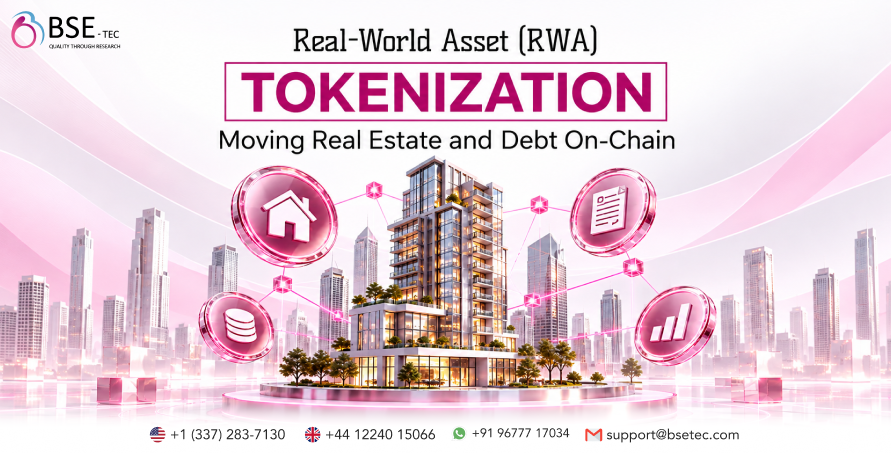
BSEtec is helping shape the next phase of blockchain innovation through Real-World Asset (RWA) tokenization, smart contract development, and institutional fintech solutions. As businesses explore new ways to raise capital and manage investments, blockchain offers an opportunity to connect traditional assets with digital financial infrastructure.
Real estate, government bonds, private loans, and other financial instruments can now enter blockchain ecosystems through tokenization. Instead of depending entirely on traditional paperwork and fragmented financial processes, businesses can represent asset-related rights through digital tokens and manage transactions using smart contracts.
This shift creates new possibilities for fractional investment, transparent ownership records, and more efficient asset management. RWA tokenization is no longer just a blockchain experiment; it is becoming an important part of the evolving financial technology landscape.
Why Are Traditional Assets Moving On-Chain?
Real estate and debt markets involve valuable assets, yet their investment processes often create significant barriers.
For example, purchasing commercial property usually requires substantial capital, legal documentation, property verification, and multiple intermediaries. Similarly, traditional debt markets involve complex loan agreements, lengthy settlement processes, and limited access to investment opportunities.
These challenges can slow transactions and restrict participation.
However, blockchain introduces a different approach. Through RWA tokenization, businesses can create digital tokens that represent defined ownership interests, financial claims, or other legally structured rights connected to physical or financial assets.
Consequently, investors can interact with these assets through digital platforms while issuers maintain records and manage transactions through blockchain infrastructure.
The biggest opportunity lies in connecting traditional financial rights with programmable digital systems.
What Exactly Happens When a Real-World Asset Becomes a Token?
Consider a commercial property valued at $10 million. Instead of requiring one investor to purchase the entire property, a properly structured investment vehicle could divide the investment into smaller units.
For example, the issuer could create 100,000 tokens, each representing a defined share of the investment structure. Investors could purchase eligible units according to the offering terms.
However, the token does not automatically become a property title. The legal structure must clearly explain whether it represents shares in a company, beneficial interests, debt claims, or another recognised right.
A typical tokenization process involves:
- Asset verification: Confirm the asset’s ownership, valuation, legal status, and supporting documents.
- Legal structuring: Establish the ownership vehicle, investor rights, and applicable regulatory requirements.
- Token creation: Develop smart contracts that define token supply, transfer conditions, and permissions.
- Investor onboarding: Complete identity verification, eligibility checks, and required compliance procedures.
- Asset management: Track ownership records, distributions, and relevant asset information.
- Secondary transfers: Enable eligible investors to transfer or trade tokens through authorised platforms.
As a result, tokenization connects the physical asset, legal framework, investors, and blockchain infrastructure within one coordinated system.
Real Estate Tokenization: Making Property Investment More Accessible
Real estate offers a strong use case for RWA tokenization because property investments often require significant upfront capital.
Through fractional tokenization, developers and asset managers can create investment opportunities with smaller participation amounts, depending on the legal structure and offering requirements.
For instance, a commercial building could support a tokenized investment model where eligible investors hold defined interests through digital tokens. Meanwhile, smart contracts can automate approved activities such as investor distributions, transfer restrictions, and ownership-record updates.
Furthermore, a digital investor portal can provide access to property information, investment documents, transaction history, and portfolio details.
Where Can Businesses Apply Real Estate Tokenization?
- Commercial properties: Represent eligible investment interests in office buildings, shopping centres, and business parks.
- Residential developments: Structure fractional investment opportunities around residential projects.
- Rental properties: Track eligible investor interests and automate rental-income distributions.
- Infrastructure projects: Connect investment structures with long-term infrastructure assets.
- Real estate funds: Digitise fund interests and simplify investor administration.
Nevertheless, tokenization does not automatically create liquidity. Investors still need eligible buyers, compliant trading platforms, reliable valuations, and clear exit conditions.
Debt Tokenization: Bringing Loans and Credit Markets On-Chain
Real estate is only one part of the RWA opportunity. Debt tokenization can also change how financial institutions manage and distribute credit-related investments.
Traditional debt instruments include government bonds, corporate bonds, private loans, and other credit products. These instruments often involve multiple financial intermediaries and complex recordkeeping.
Through tokenization, issuers can represent eligible debt interests as digital tokens. Smart contracts can then support defined payment schedules, interest calculations, transfer restrictions, and investor records.
Imagine a business that issues a $5 million private credit instrument. Instead of managing every investor record through disconnected systems, the issuer could use a tokenization platform to represent eligible investment interests and maintain transaction records on-chain.
Moreover, authorised systems could automate coupon distributions and provide investors with clearer access to relevant financial information.
Why Are Financial Institutions Exploring Debt Tokenization?
- Faster settlement: Blockchain infrastructure can reduce certain transaction and reconciliation delays.
- Transparent records: Participants can verify authorised transactions through shared ledger records.
- Programmable payments: Smart contracts can support predefined payment and distribution rules.
- Broader distribution: Digital platforms can connect eligible investors across different markets.
- Improved reporting: Issuers can provide more structured information about debt instruments and their performance.
However, credit risk does not disappear when a loan enters a blockchain. Borrower defaults, collateral valuation, repayment delays, and legal enforcement still require proper financial and operational management.
Real-World Case Studies: RWA Tokenization in Action
The financial industry already offers practical examples of businesses connecting traditional assets with blockchain technology.
1. Dubai Land Department: Bringing Property Ownership On-Chain
Dubai has taken a significant step towards real estate tokenization through its Real Estate Tokenization Project.
In May 2025, the Dubai Land Department launched its first tokenized real estate investment project through the PRYPCO Mint platform. The initial offering attracted 224 investors from 44 nationalities, and the department reported that the average investment amounted to AED 10,714.
More importantly, the project introduced a digital property ownership framework that connects tokenization with the official property registration process.
In February 2026, the project entered its second phase and introduced controlled secondary-market trading. According to Ctrl Alt, the pilot had tokenized ten properties worth more than $5 million, with approximately 7.8 million tokens eligible for resale within the controlled framework.
This development demonstrates how blockchain can support property investment while maintaining connections with recognised land-registration and regulatory systems.
2. BlackRock BUIDL: Institutional Financial Assets Meet Blockchain
BlackRock introduced its USD Institutional Digital Liquidity Fund (BUIDL) in March 2024, marking an important development in institutional asset tokenization.
The fund represents shares in a portfolio of short-term U.S. dollar-denominated assets, including cash, U.S. Treasury bills, and repurchase agreements. Securitize provides the tokenization infrastructure, while traditional financial institutions support custody and fund administration.
Instead of relying exclusively on conventional fund-record systems, eligible investors can hold digital tokens representing fund shares.
Furthermore, in April 2026, BlackRock, OKX, and Standard Chartered announced a framework that allows BUIDL to serve as collateral within specified trading workflows, with Standard Chartered providing off-exchange custody.
This development highlights an important evolution: tokenized financial assets can support more than digital ownership records. They can also connect with institutional trading and collateral-management systems.
RWA Tokenization Trends Businesses Should Watch in 2026
The RWA market continues to expand beyond early blockchain experiments. Several developments indicate where businesses and financial institutions may focus next.
1. Institutional Adoption of Tokenized Debt
Government securities, money market funds, and private credit products continue to attract institutional interest. As a result, financial institutions increasingly explore blockchain-based issuance, settlement, and asset-management infrastructure.
2. Real Estate Platforms With Secondary Markets
Property tokenization is moving beyond initial digital offerings. Projects such as Dubai’s initiative demonstrate growing interest in controlled secondary trading, which can give eligible investors additional transfer opportunities.
3. Multi-Chain Tokenization Infrastructure
Businesses increasingly evaluate different blockchain networks based on transaction costs, scalability, ecosystem support, and compliance requirements. Therefore, cross-chain interoperability can become an important part of future RWA platforms.
4. Smart Contract Automation
Smart contracts can support investor onboarding rules, payment distributions, transfer restrictions, and asset-related workflows. Consequently, businesses can reduce certain manual processes while improving transaction traceability.
5. Stronger Compliance and Institutional Controls
As more financial institutions explore tokenized products, identity verification, custody, transfer permissions, investor eligibility, and regulatory reporting become essential infrastructure components.
According to Coinbase Research’s January 2026 analysis, distributed tokenized RWAs had reached approximately $18 billion, excluding stablecoins. Meanwhile, a June 2026 Castle Labs report placed the broader tokenized RWA market at $28.2 billion in its snapshot, with tokenized public debt representing more than $17 billion.
Build Your RWA Tokenization Platform With BSEtec
Real-world asset tokenization creates new opportunities for property developers, financial institutions, investment platforms, and businesses exploring digital asset infrastructure.
However, launching a reliable RWA platform requires the right combination of blockchain architecture, smart contracts, token standards, investor management, and compliance-focused workflows.
BSEtec supports businesses exploring this opportunity through Real-World Asset (RWA) Tokenization for real estate, equity, and debt, along with institutional fintech, token development, smart contract engineering, and multi-chain blockchain solutions.
These capabilities can help businesses plan platforms that connect traditional asset structures with secure digital investment infrastructure.
Explore BSEtec’s blockchain and RWA tokenization capabilities to discover how blockchain technology can support your next financial innovation.
Conclusion
RWA tokenization is creating a new connection between traditional financial assets and blockchain infrastructure. From fractional real estate investment to tokenized debt instruments, businesses can explore more transparent, programmable, and digitally accessible ways to manage asset-related rights.
Nevertheless, long-term success depends on legal clarity, reliable asset verification, investor protection, secure smart contracts, and practical liquidity solutions.
With BSEtec’s blockchain development and RWA tokenization capabilities, businesses can take the next step towards building secure, scalable, and future-ready digital asset platforms. The opportunity goes beyond putting assets on-chain; it lies in creating a trusted financial ecosystem around them.