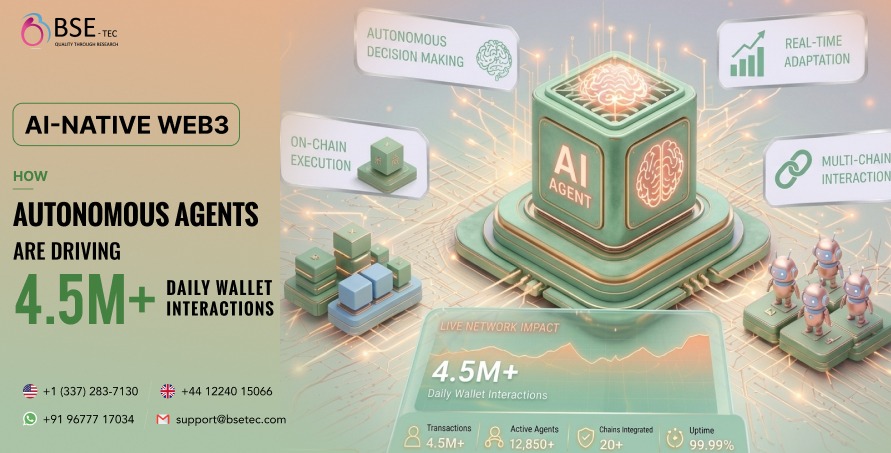
AI-Native Web3: How Autonomous Agents are Driving 4.5M Daily Wallet Interactions
What if your wallet could think, decide, and act on its own? AI-Native Web3 is shifting the space from manual interactions to AI-driven automation, with millions of wallet activities happening daily.
In this blog, let’s explore how autonomous agents are making it possible.
What is AI-Native Web3?
AI-Native Web3 is the evolution where Artificial Intelligence moves from being a tool used by humans to becoming the primary operator of the blockchain.
The core pillars:
- Autonomous Agents: Instead of humans manually signing transactions, AI agents manage intent-based workflows and execute smart contracts independently.
- Decentralized Brains: Using DePIN (Decentralized Physical Infrastructure Networks), AI models run on distributed GPU networks rather than centralized servers.
- Verifiable Logic: On-chain proofs ensure that an AI’s decision-making process is transparent and hasn’t been tampered with.
The shift is a glance:
- Human-Centric — Agent-Centric
- Manual Execution — Autonomous Logic
- Cloud-Dependent — Sovereign Infrastructure
In short, it is an ecosystem where AI doesn’t just help users; it functions as a sovereign entity capable of owning assets and performing complex tasks on-chain.
Why Traditional Wallets Are Falling Behind
Traditional wallets are falling behind, as they rely on manual control and single-key risk. Moreover, gas fee complexity makes them even harder to use in an increasingly automated world.
The primary limitations are:
- Fragile Security: No recovery options if a seed phrase is lost or stolen.
- High Friction: Mandatory native tokens for every transaction fee.
- No Automation: Inability to handle scheduled tasks or if-this-then-that logic.
- Manual Barriers: Every action requires a human signature, blocking AI-driven workflows.
Consequently, manual wallets are becoming obsolete, as Smart Accounts take over, making blockchain seamless and invisible to users.
How Autonomous Agents Are Changing Everything
Autonomous agents are transforming the digital economy by shifting from manual actions to automated outcomes. Initially, users handled every step; however, agents now execute tasks based on intent. Moreover, they enable 24/7 activity, while removing friction like gas fees and bridging. In addition, agents can interact with each other, creating a machine-driven on-chain economy.
Ultimately, this marks a shift from using software to delegating to intelligence, turning the internet into a self-executing system.
Why the 4.5M Daily Wallet Interactions?
The 4.5 million daily wallet interactions signal a shift from a speculative market to a true machine-driven economy, where activity is now powered more by autonomous agents than human traders.
1. The Rise of the Silent Operator (AI Agents)
The most significant driver behind this volume is the explosion of Autonomous AI Agents. Specifically, there are now over 17,000 AI agents operating on-chain, managing everything from DeFi yield strategies to automated supply chain payments.
- Continuous Execution: Unlike humans, these agents do not sleep. They interact with wallets thousands of times per day to rebalance portfolios and hunt for micro-arbitrage opportunities.
- Agentic Volume: Consequently, a single AI agent can generate the same daily interaction volume as hundreds of traditional human users.
2. The Death of the Manual Click (Account Abstraction)
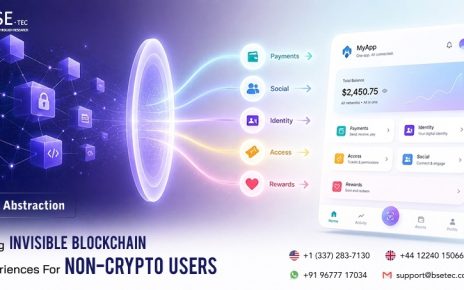
Furthermore, the implementation of ERC-4337 (Account Abstraction) has effectively made the wallet invisible. In the past, every interaction required a manual signature and a gas fee payment in a native token.
- Session Keys: Users can now authorize sessions where the wallet signs transactions in the background—common in Web3 gaming and social apps.
- Gasless UX: By removing the native token trap, dApps are sponsoring fees, which encourages users to interact with the blockchain far more frequently without worrying about cost.
3. Institutional Utility and Stablecoin Velocity
In addition to retail and AI activity, institutional adoption has reached a tipping point. As a result, traditional finance (TradFi) giants are now using Web3 wallets for real-time gross settlement (RTGS) and cross-border remittances.
- Stablecoin Dominance: With over 570 million people using Tether (USDT) and other MiCA-compliant stablecoins globally, the wallet has moved from an investment vault to a daily salary account.
- Velocity of Money: In other words, money is moving faster. Frequent micro-transactions for gig-economy payments and digital services are replacing slow, weekly bank batches.
4. Gaming and DePIN Expansion
Finally, high-performance Layer 3 scaling solutions and Decentralized Physical Infrastructure Networks (DePIN) have moved on-chain.
- Micro-Rewards: Devices like decentralized weather stations or GPU providers are constantly talking to the blockchain to claim rewards or update status.
- High-Frequency Gaming: In contrast to older blockchain games, 2026 titles utilize high-speed app-chains where every in-game action (crafting, trading, leveling) is a verified wallet interaction.
Ultimately, we have reached a stage where the blockchain is no longer a destination you visit, but a background layer that constantly settles value. Instead of humans logging in to do crypto, 4.5 million automated interactions are now happening every day to keep the global decentralized economy running.
What Can AI Agents Actually Do?
AI agents have evolved from chatting to doing by acting as autonomous operators. Initially, AI provided information; however, agents now execute multi-step tasks independently.
Here is what they can do:
- Financial Agency: They manage non-custodial wallets and sign transactions. Consequently, they can trade or rebalance assets 24/7.
- Workflow Automation: Rather than just planning, they use APIs to book services, send emails, or manage calendars.
- Proactive Security: They monitor live data feeds. As a result, they can move funds or block attacks before a human even notices.
- Machine Commerce: Agents can hire and pay other agents for specialized services. Furthermore, this creates a fully autonomous machine-to-machine economy.
Ultimately, agents turn the web into a self-executing layer. In short, you provide the goal, and they handle the technical execution.
The Infrastructure Behind AI-Native Web3
Building intelligent, autonomous systems in Web3 requires more than just AI; it demands a robust blockchain foundation, secure smart contracts, and seamless integration layers powered by advanced Web3 technologies.
This is where BSEtec stands out.
BSEtec is not just adapting to this shift; it is actively driving it. With deep expertise in blockchain development, AI integration, and decentralized infrastructure, BSEtec enables businesses to build AI-native Web3 platforms that are scalable, secure, and future-ready.
Why BSEtec is the Premier Choice for AI-Native Web3 Development
BSEtec leads the AI-native Web3 space as a leading Blockchain development company, seamlessly integrating intelligence with decentralization while delivering advanced web3 services and pioneering an agent-driven approach where AI actively operates within blockchain networks.
The core reasons why BSEtec is the premier choice include:
Expertise in Agentic Workflows: Rather than building simple chatbots, BSEtec develops autonomous agents that can manage their own non-custodial wallets and sign transactions. Consequently, they enable businesses to deploy self-executing systems that operate 24/7 without human intervention.
Mastery of Account Abstraction: BSEtec eliminates the native token trap by utilizing ERC-4337. In this way, they provide a gasless user experience where technical hurdles like seed phrases and gas fees become invisible to the end-user.
Modular Infrastructure Design: Furthermore, they specialize in moving projects from rigid monolithic blockchains to modular, high-performance Layer 3 scaling solutions. As a result, their applications can handle high transaction volumes while maintaining peak efficiency.
Digital Sovereignty focus: Ultimately, their development philosophy prioritizes data ownership and private infrastructure. Instead of relying on centralized cloud providers, they build decentralized environments that give businesses full control over their digital assets.
BSEtec stands out by connecting intelligent AI with real Web3 execution, turning autonomous concepts into practical, business-ready solutions.
Where AI-Native Web3 is Making a Real-World Impact
AI-Native Web3 is already transforming major industries:
- DeFi Platforms: AI agents act as fund managers, automating trades, rebalancing liquidity, and optimizing yields 24/7.
- Gaming: Intelligent agents manage in-game assets, creating dynamic and self-sustaining virtual economies.
- NFT Ecosystems: Agents curate digital assets, track trends, and execute buy/sell decisions in real time.
- Enterprise Solutions: Autonomous workflows trigger smart contracts for payments, supply chains, and business agreements.
What’s Next: The Shift to Intent-Driven Web3
Web3 is becoming intent-driven, meaning you define the goal while AI handles the work. Initially, users had to click every button manually; however, agents now execute complex tasks like rebalancing my portfolio automatically. Consequently, the blockchain becomes an invisible background layer. Ultimately, this shift turns Web3 into a seamless, goal-oriented experience.
Final thought
AI-native Web3 is not a trend, it’s a transformation. Autonomous agents are turning wallets into intelligent systems, driving millions of daily interactions and unlocking unprecedented efficiency.
Businesses that embrace this shift will lead the next wave of innovation.
With BSEtec at the forefront, organisations can seamlessly integrate AI into their Web3 strategies, build autonomous ecosystems, and stay ahead in a rapidly evolving digital landscape.
The future of Web3 is autonomous, and BSEtec is building it.