The Wallet Conversation Has Changed in 2026
If you’re building a Web3 product today, choosing a wallet is no longer a simple technical decision. Instead, it has become a security, compliance, and business continuity decision.
Just look at what’s happening across the industry. Stablecoins are being used for global payments, tokenized real-world assets (RWAs) are attracting institutional interest, and AI agents are beginning to perform financial actions on-chain. Consequently, wallets are evolving from user tools into critical financial infrastructure.
According to industry reports published in 2026, the value of tokenized real-world assets on public blockchains has already crossed tens of billions of dollars, while enterprise adoption continues to accelerate across financial markets. At the same time, institutional custody providers and fintech platforms are increasingly adopting MPC-based wallet architectures to reduce single points of failure.
That shift is creating a new question for businesses: Is a traditional wallet still enough for enterprise-grade Web3 security?
Why Traditional Wallets Are No Longer the Default Choice
For years, most crypto wallets relied on a single private key. The model was simple: whoever controlled the key controlled the assets.
However, Web3 in 2026 looks very different from the early crypto era. finally, A single platform may now manage customer funds, treasury assets, tokenized securities, stablecoin settlements, and automated AI-driven transactions.
As a result, the risk is no longer just “losing a wallet.” The bigger concern is what happens when one compromised credential can affect an entire business operation.
The Rise of MPC Wallets
This is exactly where MPC (Multi-Party Computation) wallet development is gaining momentum.
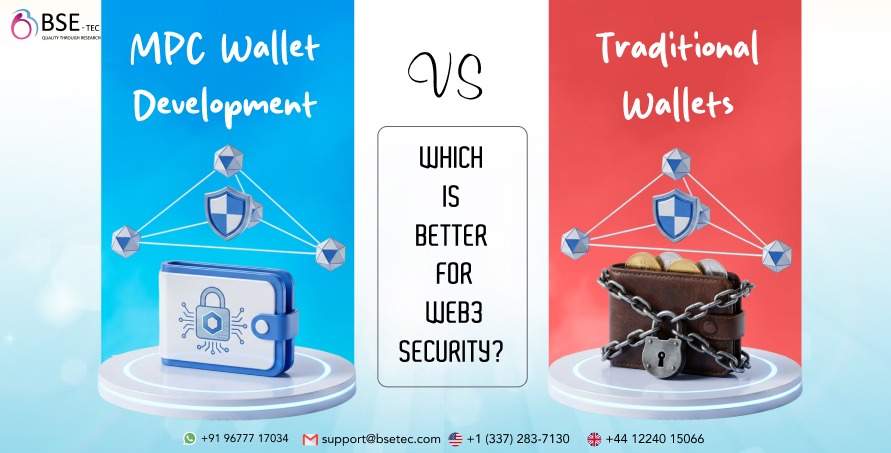
Instead of storing one complete private key in a single location, MPC distributes signing authority across multiple encrypted shares. Therefore, no single person, device, or server ever holds the full key.
For enterprises, this creates several advantages:
- Reduced single-point-of-failure risk
- Multi-user approval workflows
- Safer treasury management
- Better operational governance
- Improved recovery mechanisms
- Stronger protection against insider threats
Because of these benefits, many institutional platforms now view MPC as a long-term security architecture rather than just a wallet feature.
The AI Factor Is Accelerating Adoption
One of the biggest trends in 2026 is the convergence of AI and Web3.
Increasingly, AI agents are executing payments, interacting with smart contracts, managing treasury workflows, and automating blockchain operations. Consequently, businesses need a security model that enables automation without granting any single system unrestricted control over funds.
MPC fits naturally into this environment because transaction approvals can be distributed across policies, devices, and authorized participants. In other words, companies can automate workflows while still maintaining governance.
Traditional Wallet vs MPC Wallet: The 2026 Reality
| Feature | Traditional Wallet | MPC Wallet |
| Key storage | Single location | Distributed shares |
| Single point of value | yes | no |
| Team-Based Approvals | Limited | Advanced |
| Enterprise Governance | Basic | Strong |
| Recovery Flexibility | Lower | Higher |
| AI-Ready Workflows | Limitted | Better suited |
| Institutional Adoption | Moderate | Rapidly growing |
Where Each Wallet Still Fits
Traditional wallets work well for
- Individual investors
- Long-term personal storage
- Lower transaction volume
- Simple self-custody use cases
MPC wallets are increasingly preferred for
- Fintech platforms
- Crypto exchanges
- Tokenization projects
- Stablecoin payment systems
- Enterprise treasury management
- DAO governance
- AI-powered Web3 applications
Why This Matters for Businesses Building in Web3
Here’s the important part: wallet architecture now affects user trust, operational resilience, and future scalability.
A company launching a Web3 platform in 2026 is not just choosing a wallet UI. Instead, it is choosing how approvals, recovery, governance, automation, and security will work as the business grows.
That’s why many organizations are moving beyond basic wallet integration and investing in enterprise-grade Web3 infrastructure.
How BSEtec Approaches Modern Wallet Development
At BSEtec, wallet development is treated as part of a larger blockchain technology ecosystem, not as a standalone feature.
As a Blockchain development company, BSEtec builds secure and scalable solutions that align with modern enterprise requirements.
Its blockchain development services include:
- MPC wallet development
- Non-custodial wallet solutions
- Multi-chain wallet integration
- Smart contract development
- RWA tokenization platforms
- Stablecoin payment infrastructure
- DeFi platform development
- Enterprise blockchain applications
- AI-ready Web3 wallet APIs
- Cross-chain interoperability
In addition, BSEtec focuses on security-first architecture, governance workflows, and long-term scalability, helping businesses launch Web3 products that are prepared for the next phase of digital finance.
The Real Answer: Which Is Better for Web3 Security in 2026?
If the goal is personal self-custody, traditional wallets remain a practical option.
However, if the goal is enterprise-grade Web3 security, treasury management, tokenized assets, stablecoin payments, or AI-enabled blockchain operations, MPC wallets are increasingly becoming the stronger long-term choice.
In fact, the industry trend is clear: businesses are moving away from security models built around one secret controlled by one entity and toward architectures based on distributed trust and programmable governance.
That’s the direction modern Web3 infrastructure is heading in 2026.
Final Thoughts
The biggest shift is not “MPC vs Traditional Wallet.” Instead, the real shift is how businesses think about trust.
As blockchain technology powers payments, tokenization, AI agents, and digital finance, wallet security becomes a strategic business decision rather than a simple product feature.
Therefore, companies looking to build secure, scalable, and future-ready Web3 platforms, partnering with an experienced Blockchain development company like BSEtec can make the difference between launching a wallet and building a trusted digital asset infrastructure.