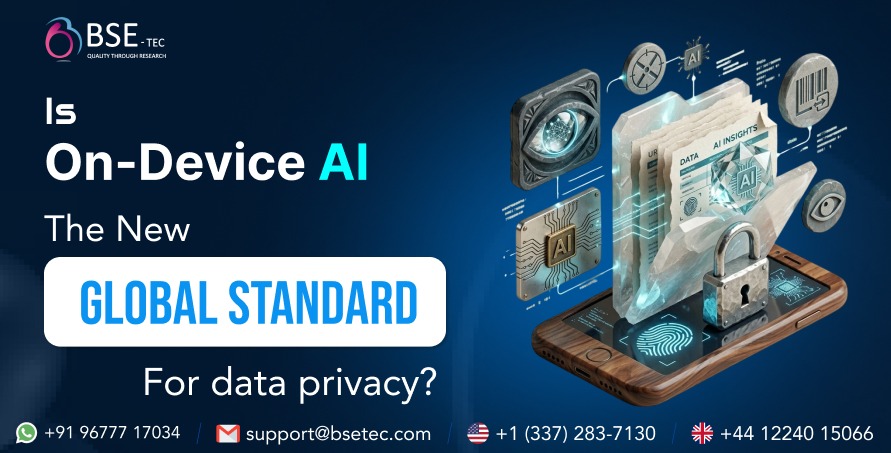
Users now demand data privacy, and meanwhile, regulations are tightening fast. As a result, businesses must rethink how they handle data. That’s where On-Device AI comes in—keeping data local, secure, and in the user’s control, while the shift is already underway.
Understanding On-Device AI?
Transition words are the connective tissue of language, and in the context of On-Device AI, they serve a critical role in making technical explanations digestible. Because On-Device AI involves complex shifts between hardware, software, and privacy, transitions help guide the reader through the logic.
Here is how transition words function within this specific topic:
- Showing Sequence and Process: First, the device captures the input. Subsequently, it processes the data locally, and finally, it delivers the output instantly.
- Contrasting On-Device vs. Cloud AI: Cloud AI depends on internet connectivity. In contrast, On-Device AI works offline, whereas processing happens directly on the device.
- Emphasizing Privacy and Security: Data stays within the device. As a result, sensitive information remains secure and protected from external risks.
- Illustrating Technical Limitations: On-Device AI delivers speed and privacy. However, it is limited by device hardware and performance constraints.
Why the World is Moving Toward Privacy-First AI?
For years, the tech industry operated under a data-grab mentality. However, we are currently witnessing a seismic shift. Consequently, the move fast and break things era is being replaced by a more disciplined, privacy-centric approach.
Furthermore, the rise of Decentralized AI and Edge Computing means that data no longer needs to travel to a central cloud to be processed. By keeping data on-device, companies can offer personalized experiences without ever seeing the user’s raw information. Ultimately, privacy-first AI is becoming the primary competitive advantage for tech giants; in a world where everyone has smart tools, the one who guarantees safety wins the consumer’s heart.
Key Benefits Driving On-Device AI Adoption
1. Enhanced Privacy
Primarily, on-device AI processes sensitive data locally on your hardware. Because information never leaves the device for a remote server, the risk of data breaches is significantly lowered. Consequently, user trust increases as personal details remain private and secure.
2. Reduced Latency
In addition, local processing eliminates the round-trip time required to send data to the cloud. As a result, features like real-time translation and AR filters feel instantaneous and fluid. Thus, the user experience becomes much more responsive and natural.
3. Offline Reliability
Furthermore, on-device models ensure that smart features work perfectly without an internet connection. While cloud-based apps fail in dead zones, these tools remain functional anywhere in the world. Therefore, the technology serves as a dependable asset for travel and remote work.
4. Cost Efficiency
From a developer’s perspective, shifting the workload to the user’s device slashes server and bandwidth costs. Moreover, this decentralized approach allows apps to scale to millions of users effortlessly. Accordingly, companies can provide high-end AI features without massive infrastructure investments.
5. Battery & Personalization
Finally, specialized hardware like NPUs handles AI tasks with extreme energy efficiency. Meanwhile, the system learns from local habits to provide highly tailored suggestions. Thereby, users enjoy a deeply personalized experience without draining their device’s battery life.
Where BSEtec Steps In: Turning Privacy into Practice
To begin with, BSEtec acts as the bridge between high-level privacy concepts and functional software. Instead of just promising security, they build the technical infrastructure that makes it physically impossible for data to leak.
1. Hardware-Level Optimization
First and foremost, BSEtec focuses on Model Quantization. Since standard AI models are too heavy for mobile phones, BSEtec shrinks them without losing accuracy. As a result, you get a powerful AI that runs locally without draining your battery.
- Edge Processing: Furthermore, they move the data processing to the edge of the network. By doing so, they eliminate the need for an internet connection for core AI tasks.
- Latency Reduction: Consequently, the AI responds instantly. Because there is no round-trip to a server, the user experience becomes much smoother and more secure.
2. Federated Learning Implementation
In addition to local processing, BSEtec utilizes Federated Learning. Essentially, this is a way for AI to learn from all users without actually seeing their private information.
- Decentralized Training: Specifically, the model learns on your device and only sends mathematical summaries to the main server. Thus, the global AI gets smarter while your personal files stay 100% private.
- Data Anonymization: Moreover, BSEtec ensures that even these summaries are encrypted. Ultimately, this creates a trustless system where the company doesn’t need to see your data to provide a great service.
3. Global Compliance Automation
Finally, BSEtec helps businesses navigate the legal landscape. By implementing on-device solutions, companies automatically align with strict laws like GDPR. Therefore, BSEtec doesn’t just provide a tool; they provide a shield that protects both the business and the consumer from legal and security risks.
BSEtec transforms On-Device AI from a concept into a competitive advantage for businesses
Real-World Applications Powered by BSEtec
On-device AI is the ultimate safeguard for privacy because it processes sensitive data locally on your hardware. Basically, it removes the middleman (the cloud) so your info is never exposed. However, turning this into a functional product requires the expert engineering that BSEtec provides.
Secure Healthcare — Initially, patient vitals were sent to external servers for analysis, risking leaks. Instead, BSEtec builds on-device systems that process medical data directly on the user’s smartphone.
BSEtec’s Role: They shrink complex medical models to run locally. As a result, health records stay private and HIPAA-compliant.
Personalized E-Commerce — Furthermore, most shopping apps track and sell your preferences to third-party advertisers. By contrast, BSEtec creates e-commerce solutions where your interest profile stays on your phone.
BSEtec’s Role: They implement localized recommendation engines. Consequently, you get smart suggestions without ever leaking your browsing history.
Smart Home Security — In addition, cloud-based cameras often upload private home footage to the web. To solve this, BSEtec develops edge-based AI that analyzes video feeds directly on the camera hardware.
BSEtec’s Role: They use edge computing for instant motion detection. Thus, your home stays secure without your private videos ever touching the internet.
Overcoming Challenges with the Right Technology Partner
While On-Device AI offers clear advantages, it also comes with practical challenges. Limited device hardware can restrict performance, and optimizing AI models for smaller environments requires deep technical expertise. Furthermore, updating models across multiple devices and ensuring scalability can become complex.
However, this is where BSEtec makes a real difference. With advanced AI engineering capabilities, BSEtec designs lightweight, high-performance models tailored for edge devices. Moreover, they implement scalable deployment strategies that ensure seamless updates and consistent performance across systems. As a result, businesses can adopt On-Device AI without compromising on efficiency, security, or growth.
Is On-Device AI Becoming the Global Standard?
The industry is clearly moving toward a new AI paradigm. As businesses seek faster and more secure solutions, the shift toward edge and hybrid AI models is accelerating. Moreover, enterprises are rapidly adopting On-Device AI to meet growing privacy expectations and strict regulations.
In this evolving landscape, BSEtec, a leading AI development company, plays a crucial role in helping businesses transition from cloud-heavy systems to privacy-first AI ecosystems. By combining on-device intelligence with scalable architectures, BSEtec enables organizations to build secure, efficient, and future-ready AI solutions.
Future Outlook: Privacy-Centric AI is Here to Stay
Privacy-centric AI is no longer a trend—it’s becoming the foundation of modern technology. As users demand more control and regulations tighten, businesses will continue shifting toward secure, on-device, and hybrid AI models for the future.
Conclusion: From Data Risk to Data Control
On-Device AI is redefining how businesses approach data—shifting from exposure to control. By keeping data local and secure, it addresses the growing demand for privacy while delivering faster and more reliable performance. As regulations tighten and user expectations rise, On-Device AI is quickly becoming the new standard for privacy-first innovation.
In this transformation, BSEtec stands as a trusted partner, enabling businesses to adopt secure, scalable, and future-ready AI solutions with confidence.
With BSEtec, businesses don’t just follow the shift to On-Device AI—they stay ahead of it, building a future where privacy and intelligence coexist seamlessly.