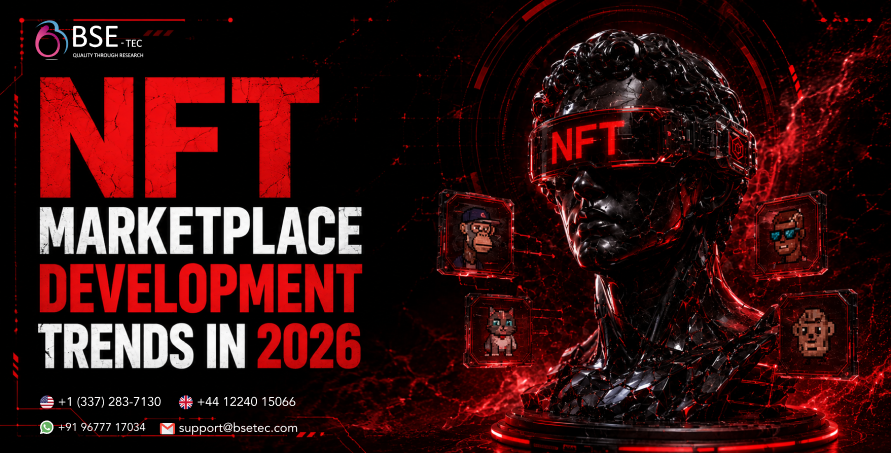
NFT marketplaces in 2026 are no longer just about digital collectibles or hype-driven trading. Instead, they have evolved into powerful ecosystems that support real-world business use cases, enterprise adoption, AI-driven automation, and tokenized ownership models.
According to DappRadar’s 2026 Q1 report, NFT trading activity has stabilized at around $4.1–$4.6 billion in monthly volume, while active wallets interacting with NFT platforms have grown by 18% year-over-year. Meanwhile, more than $24 billion in real-world assets (RWAs) are now tokenized on-chain, showing that blockchain ownership is becoming increasingly mainstream.
Today, platforms are being built not just to trade NFTs but also to solve real problems such as authentication, ownership verification, loyalty programs, gaming economies, and real-world asset tokenization. At the center of this transformation, companies like BSEtec are helping businesses design and develop next-generation NFT marketplaces that are scalable, secure, and future-ready.
NFTs in 2026: From Hype to Real Utility
The biggest shift in the NFT space is the move from speculation to utility. In fact, over 62% of new NFT projects launched in 2026 are utility-based, according to industry analytics platforms.
Instead of focusing on flipping digital art, NFTs are now being used for:
- Verifying luxury goods
- Tokenizing real estate
- Managing digital identities
- Powering event ticketing systems
- Building loyalty and reward programs
- Enabling gaming economies
According to market research, the NFT industry is expected to grow steadily, driven by enterprise adoption and real-world applications. At the same time, tokenized real-world assets are already reaching billions in on-chain value, proving that blockchain ownership is becoming mainstream.
As a result, this shift is pushing businesses to invest in custom NFT marketplace development that delivers long-term value.
Why Businesses Are Investing in NFT Marketplaces
NFTs are no longer limited to creators or collectors. Instead, they are becoming a core part of digital business infrastructure.
Moreover, enterprises are increasingly integrating NFT systems into their digital transformation strategies. For example, over 40% of Fortune 500 companies are actively exploring blockchain-based asset tracking or tokenization pilots in 2026.
Companies are building NFT marketplaces to support Digital collectibles and branded assets, Web3 gaming ecosystems, Real estate tokenization platforms, Fashion and luxury authentication systems, Music and media rights management, Event ticketing solutions, Membership and subscription models, and Educational certification systems
Governments and enterprises are also exploring blockchain-based systems because they improve transparency, reduce fraud, and eliminate manual verification processes.
Consequently, this growing demand is one of the key reasons BSEtec continues to work with startups and enterprises to build scalable NFT marketplace solutions.
Key NFT Marketplace Development Trends in 2026
Let’s explore the most important trends shaping NFT marketplace development today.
1. Utility-Driven NFTs Take Over
NFTs are now designed to offer real benefits instead of just ownership. In fact, utility NFTs account for nearly 70% of secondary-market activity in 2026, indicating a clear shift in user behavior.
Modern NFT marketplaces support use cases like Exclusive memberships, Event access passes, Gaming rewards, Subscription-based content, identity verification, and Product authentication. Therefore, this shift ensures users gain long-term value, making NFTs more practical and sustainable.
2. AI Becomes a Core Part of NFT Platforms
Artificial Intelligence is transforming how NFT marketplaces operate. Additionally, AI adoption in Web3 platforms has increased by 35% year-over-year, especially in trading and analytics systems.
AI is now used for detecting fraud and suspicious activity, generating NFT metadata automatically, offering personalized recommendations, creating AI-generated digital assets, monitoring content quality, and predicting pricing trends. As a result, NFT platforms are becoming smarter, safer, and more user-friendly.
3. Cross-Chain NFT Ecosystems Become Standard
Users no longer want to be restricted to a single blockchain. In fact, over 55% of NFT transactions in 2026 occur across multi-chain or Layer-2 networks.
Modern NFT marketplaces now support multiple networks such as Ethereum, Polygon, Solana, BNB Chain, Avalanche, Arbitrum, and Base. Moreover, cross-chain compatibility improves liquidity and allows seamless trading across ecosystems.
4. Real-World Asset Tokenization Expands Rapidly
One of the most powerful trends in 2026 is the tokenization of physical assets. According to recent financial reports, RWA tokenization has grown by over 120% since 2024, making it one of the fastest-growing sectors in blockchain.
Businesses now use NFT marketplaces to tokenize and trade real estate properties, luxury watches and jewelry, fine art collections, vehicles, intellectual property rights, and precious metals.
In addition, this trend is turning NFTs into a bridge between physical and digital ownership.
5. Phygital Experiences Become Mainstream
The boundary between physical and digital assets is disappearing. Interestingly, brands using phygital NFTs report up to 30% higher customer engagement rates compared to traditional loyalty programs.
NFTs now unlock real-world experiences such as Physical merchandise, fashion drops, VIP event access, Limited-edition collectibles, and Exclusive brand experiences. As a result, brands are increasingly using this model to engage customers in more meaningful ways.
6. NFT Ticketing Solves Fraud Issues
Traditional ticketing systems are prone to fraud and duplication, with global ticket fraud losses estimated at over $10 billion annually.
NFT-based ticketing solves this by offering verified ownership, Secure transfers, Controlled resale markets, Instant validation, and Digital collectibles as souvenirs. Therefore, sports leagues, concerts, and entertainment platforms are rapidly adopting NFT ticketing systems.
7. Enterprise NFT Marketplaces Grow Stronger
Enterprises are now building private NFT ecosystems for internal and external use. In fact, enterprise blockchain adoption has increased by 28% in 2026 alone, driven by supply chain and compliance needs.
These systems support Employee certifications, Supply chain tracking, Asset verification, Corporate documentation, Loyalty programs, and Internal reward systems. This clearly shows that NFTs are becoming part of enterprise digital infrastructure.
8. Creator Economy Gets Stronger with Royalties
NFT marketplaces now empower creators with recurring revenue opportunities. Features like automated royalty payments, smart contract licensing, and revenue-sharing models ensure creators continue earning from every eligible secondary sale while strengthening long-term community engagement.
9. Security and Compliance Become a Priority
Security is a top priority in 2026 NFT marketplaces. Advanced features such as smart contract audits, multi-signature wallets, KYC/AML verification, fraud detection, and secure escrow systems help protect users while ensuring regulatory compliance.
10. Web3 Gaming Drives NFT Adoption
Web3 gaming continues to fuel NFT growth by enabling true ownership of in-game assets such as characters, skins, weapons, virtual land, and rewards. Layer-2 networks also make NFT transactions faster, cheaper, and more scalable.
Must-Have Features in a Modern NFT Marketplace
A successful NFT marketplace in 2026 should include multi-chain support, AI-powered search, NFT minting tools, smart contract automation, wallet integration, royalty management, analytics dashboards, fractional ownership, NFT lending, fiat payments, identity verification, governance features, and advanced security monitoring.
How BSEtec Is Powering NFT Marketplace Innovation
Building a successful NFT marketplace requires more than just blockchain development. Instead, it requires strategy, scalability, security, and user experience design.
BSEtec specializes in building end-to-end NFT marketplace solutions tailored for startups, enterprises, gaming platforms, and global brands.
Their expertise includes:
- Custom NFT marketplace development
- Multi-chain blockchain architecture
- Smart contract engineering
- AI-powered marketplace integration
- Real-world asset tokenization systems
- Secure wallet and payment integration
- Scalable Web3 infrastructure
Ultimately, by combining innovation with technical expertise, BSEtec helps businesses launch NFT platforms that are ready for the future of digital ownership.
Final thoughts
NFT marketplaces in 2026 are no longer experimental platforms; they are becoming essential digital infrastructure for modern businesses.
With trends like AI integration, cross-chain ecosystems, real-world asset tokenization, and enterprise adoption, NFTs are evolving into a core part of the global digital economy.
Therefore, businesses that invest early in scalable and utility-driven NFT marketplaces will be better positioned to lead in the Web3 era.
And with experienced development partners like BSEtec, building a future-ready NFT marketplace becomes faster, more secure, and strategically aligned with long-term growth.