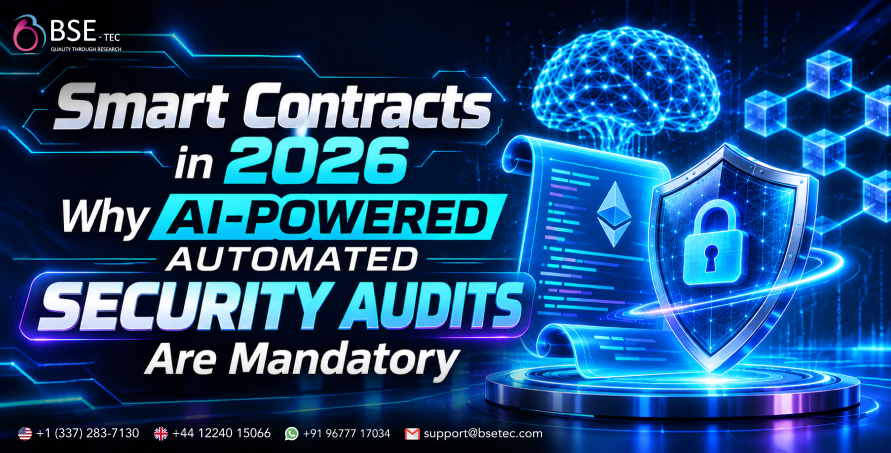
AI-powered smart contract security audits are becoming an important part of blockchain development in 2026. As businesses expand into decentralized finance(DeFi), real-world asset (RWA) tokenization, digital wallets, and Web3 platforms, they also face more complex security risks. A single smart contract vulnerability can expose digital assets, interrupt business operations, and damage customer trust. Therefore, companies need a security strategy that identifies weaknesses early and reduces risks before deployment.
At BSEtec, blockchain development involves more than building applications that function correctly. Businesses also need reliable architecture, carefully tested smart contracts, and security-focused development practices. By combining automated testing, AI-assisted code analysis, and expert review, development teams can strengthen their security processes and build blockchain solutions with greater confidence.
In 2026, security teams cannot rely on manual code reviews or a single automated scan alone. Instead, they need a continuous approach that examines smart contract code, tests different execution scenarios, and evaluates how individual components interact. AI can support this process by helping developers investigate potential vulnerabilities faster. However, qualified professionals must still validate findings and assess the business logic behind every contract.
Why Smart Contract Security Matters More in 2026
Smart contracts execute predefined rules on a blockchain. Once deployed, they may control payments, digital assets, user permissions, lending operations, and other valuable activities. Although some contracts support upgrades, developers cannot always change deployed code easily. Consequently, a security flaw can create expensive recovery work or require a carefully planned migration.
Moreover, modern blockchain platforms rarely depend on one isolated contract. A DeFi application, for example, may connect lending pools, token contracts, price oracles, governance mechanisms, and cross-chain components. Each component may pass its own basic tests; nevertheless, unexpected interactions can introduce vulnerabilities across the wider system.
Security teams must therefore examine both individual contracts and the complete application architecture. The OWASP Smart Contract Top 10 for 2026 highlights important risk categories, including access-control weaknesses, business-logic vulnerabilities, oracle manipulation, and flash-loan-related attacks. These risks demonstrate why basic code checks cannot provide sufficient protection on their own.
Furthermore, blockchain attackers continue to look for weaknesses in contract logic, permissions, integrations, and economic assumptions. A contract might behave correctly during ordinary transactions but fail under unusual conditions. For this reason, developers need to test how contracts respond to unexpected inputs, unusual transaction sequences, and interactions with external protocols.
How AI-Powered Automated Security Audits Improve Protection
AI-powered auditing can help security teams review code, identify suspicious patterns, and investigate potential attack scenarios. Rather than replacing established security practices, these tools add another layer of analysis to the development process.
1. Faster Vulnerability Detection
First, automated analysis tools can scan smart contract code for known vulnerability patterns and suspicious programming practices. Depending on the tool, language, and configuration, these checks may identify reentrancy risks, weak access controls, unsafe external calls, and certain arithmetic errors.
As a result, developers can investigate potential issues earlier instead of waiting until the final stages of development. AI-assisted tools may also explain why a code pattern appears risky, helping developers understand the problem and choose appropriate tests.
For example, an automated tool might flag a function that transfers funds before updating its internal accounting state. Developers can then investigate whether an external call could trigger an unexpected execution path. However, a warning does not automatically prove that an exploit exists. The team must examine the surrounding logic and validate the finding.
2. Better Analysis of Complex Contract Logic
Not every vulnerability comes from an obvious coding mistake. Sometimes, the risk emerges from the relationship between several functions or contracts.
For instance, a withdrawal function might work correctly under normal conditions. However, its interaction with a lending contract, price oracle, or external protocol could create an unexpected result. AI-assisted analysis can help developers trace these relationships and identify scenarios that deserve further testing.
Additionally, teams can use AI to review how permissions, transaction sequences, and state changes affect one another. This approach can help reviewers explore complex code paths that a basic scan might not fully explain.
Nevertheless, developers must define the contract’s intended behavior before they can evaluate whether the implementation follows it. AI tools cannot reliably judge every business rule without sufficient context. Therefore, a combination of technical analysis and human understanding remains essential.
3. More Comprehensive Automated Testing
Traditional testing often focuses on expected inputs and selected edge cases. Although this approach helps verify normal behavior, it may miss unusual combinations of inputs or transaction sequences.
Automated security workflows can extend testing through fuzz testing, which feeds contracts many different inputs to discover unexpected behavior. In addition, symbolic execution and other analysis techniques can help teams investigate possible execution paths under defined conditions.
AI systems may also suggest new test cases based on suspicious code patterns or potential attack scenarios. Developers can then run those tests in a controlled environment and assess the results.
Consequently, teams can explore a wider range of scenarios without depending entirely on manually written tests. Even so, they must review the test quality, reproduce important findings, and confirm that proposed fixes resolve the underlying problem.
4. Earlier Feedback During Development
Security testing works best when teams perform it throughout development rather than only before deployment. By integrating automated checks into code reviews and continuous integration pipelines, developers can examine changes whenever they update a smart contract.
For example, a team can configure its development workflow to run static analysis and selected tests whenever a developer submits new code. If a check detects a suspicious change, the team can investigate it before the update reaches production.
Moreover, continuous checks help teams detect regressions—problems that return after a code change. Therefore, AI-assisted auditing should form part of an ongoing development process instead of serving as a one-time activity.
Smart Contract Vulnerabilities AI Audits Should Detect
Smart contracts can face different security risks depending on how they handle transactions, permissions, and external data. AI-assisted audits can help developers identify potential weaknesses before deployment. Here are five common issues teams should check.
1. Reentrancy Attacks
Reentrancy happens when an external contract calls back into a function before the original operation finishes updating its state. This can sometimes allow the same operation to run repeatedly. Developers should check transaction flows, update contract states safely, and test suspicious interactions.
2. Access-Control Weaknesses
Smart contracts often include functions that only authorized users should access. If developers configure permissions incorrectly, attackers may gain control over sensitive actions. Therefore, teams should test admin functions, user roles, and ownership changes carefully.
3. Oracle Manipulation
Many blockchain applications rely on external data, especially asset prices. If attackers manipulate that data, a contract may make incorrect decisions. Developers should verify data sources, validate price updates, and test how contracts respond to unusual price changes.
4. Flash-Loan-Related Risks
Flash loans let users borrow assets and repay them within a single transaction. Attackers may exploit weaknesses in DeFi protocols by using these funds to manipulate prices or trigger unexpected outcomes. As a result, security teams should test financial logic alongside the contract code.
5. Business-Logic Vulnerabilities
Sometimes, a contract works as programmed but does not follow the business rules developers intended. For example, a token distribution system may calculate rewards incorrectly. AI tools can help flag suspicious logic, while developers must verify that the contract behaves as expected.
What AI-Powered Audits Cannot Guarantee
Although AI can improve the speed and scale of security analysis, it does not guarantee a secure smart contract. A tool may flag harmless code as dangerous, overlook a complex vulnerability, or recommend a fix that introduces another weakness. Similarly, a clean report does not prove that an application contains no exploitable flaws.
For this reason, businesses should combine several complementary security practices:
- Automated static analysis: Examine source code for suspicious patterns without executing the contract.
- AI-assisted code review: Investigate potential vulnerabilities and generate additional test ideas.
- Fuzz and dynamic testing: Run contracts with varied inputs and execution scenarios to uncover unexpected behavior.
- Manual expert review: Evaluate business logic, permissions, dependencies, and complex contract interactions.
- Formal verification where appropriate: Prove specified properties of critical contract logic under defined assumptions.
- Independent security assessment: Obtain an additional review before deploying high-risk applications.
- Post-deployment monitoring: Track contract activity and investigate unusual transactions or behavior.
Each method addresses a different part of the security challenge. For example, static analysis may flag a suspicious function, while fuzz testing explores its behavior under different inputs. Meanwhile, a human auditor can evaluate whether the contract’s financial rules create an unexpected risk.
Ultimately, businesses should use AI as a security aid rather than a substitute for professional judgment. They should also document findings, prioritize fixes according to risk, and retest contracts after every important change.
Why Businesses Should Prioritize AI-Assisted Security Audits
For businesses investing in blockchain, security directly affects financial exposure, operational reliability, and customer confidence. A vulnerable contract can disrupt a product launch, affect users, and create unexpected remediation work.
Moreover, identifying vulnerabilities late in development can increase costs and delay deployment. By introducing automated checks earlier, teams can investigate problems while the code remains easier to modify. This approach also supports more consistent reviews across projects and development teams.
AI-assisted security audits can provide value across several blockchain use cases:
- DeFi platforms: Review lending logic, liquidity mechanisms, access controls, and price dependencies.
- RWA tokenization platforms: Examine token issuance, ownership permissions, transfer restrictions, and related contract logic.
- Crypto wallets: Test transaction authorization, permission management, and contract interactions.
- NFT marketplaces: Investigate minting rules, royalty logic, transfer permissions, and marketplace operations.
- Enterprise blockchain applications: Validate business rules, user roles, and interactions between connected contracts.
However, every application requires a risk-based strategy. A contract that manages substantial financial assets may need deeper testing and independent review than a low-risk prototype. Similarly, teams should pay special attention to external dependencies, upgrade mechanisms, and privileged functions.
Therefore, businesses should evaluate security tools according to their actual needs. They should consider the programming language, supported blockchain, testing capabilities, reporting quality, and ability to fit into existing development workflows. Above all, they should verify whether a tool’s findings lead to actionable improvements.
Building a Security-First Smart Contract Development Process with BSEtec
At BSEtec, blockchain development should account for security from architecture and implementation through testing and deployment. Businesses need more than smart contracts that execute their intended functions; they also need systems that handle permissions correctly, manage dependencies carefully, and respond predictably to unusual conditions.
BSEtec supports blockchain development initiatives across areas such as DeFi platforms, tokenization solutions, NFT ecosystems, crypto wallets, and enterprise applications. Depending on the project requirements, a security-focused workflow can include automated code analysis, smart contract testing, access-control validation, integration testing, and deployment-readiness reviews.
Furthermore, AI-assisted tools can help development teams investigate suspicious code patterns and expand their test scenarios. However, qualified professionals should validate important findings, review the proposed fixes, and confirm that the updated contracts behave as intended.
Businesses should also treat security as an ongoing responsibility. After deployment, teams need to review relevant changes, monitor contract activity, and reassess risks when they introduce new integrations or features. In this way, security becomes part of the product lifecycle rather than a final checkpoint.
Explore BSEtec’s blockchain development services to learn more about developing blockchain solutions around your business requirements. For additional insight into AI-assisted smart contract security, read BSEtec’s related article on AI-audited smart contracts and pre-deployment risk detection.
Conclusion
In 2026, smart contract security must keep pace with increasingly complex blockchain applications and evolving attack techniques. AI-powered automated security audits help teams investigate vulnerabilities earlier, expand testing, and prioritize potential risks. Nevertheless, automation alone cannot guarantee protection against every exploit.
The strongest approach combines AI-assisted analysis, automated testing, expert review, and ongoing monitoring. Moreover, businesses should match their security processes to the value their contracts control and the potential consequences of failure.
With a security-first approach to blockchain engineering, BSEtec helps businesses work toward more resilient blockchain solutions designed around real-world requirements. By making security part of every development stage, businesses can identify weaknesses earlier, validate fixes carefully, and reduce avoidable risks before they reach production.