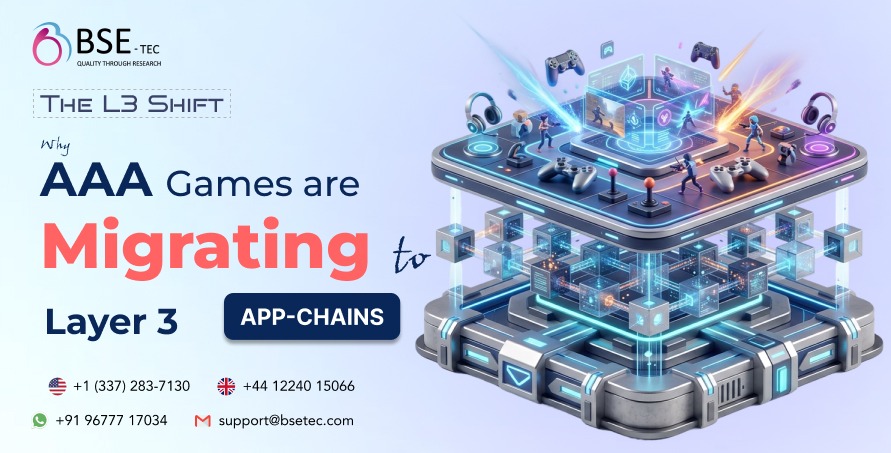
The gas war era is finally over. Consequently, to save AAA games from high fees and network lag, developers are migrating to Layer 3 app-chains. By building on these dedicated lanes, studios are ultimately delivering the seamless, high-fidelity experience players actually want.
Therefore, here is exactly why the industry is moving to the L3 stack.
From Innovation to Limitation: Where L1 and L2 Fall Short
Initially, Layer 1 and Layer 2 networks paved the way for decentralized gaming. However, as player bases grew, these shared chains became victims of their own success, plagued by high costs and congestion.
Consequently, the resulting lag and unpredictable fees proved fatal for high-performance AAA games. Ultimately, these layers fell short because they weren’t built for scale, forcing developers to look toward a more specialized future.
The Rising Expectations of AAA Games
The standard for AAA titles has reached an all-time high, as players now equate the premium price tag with total perfection.
Consequently, developers must balance several massive demands simultaneously:
- Technical Excellence: Gamers expect 4K visuals and flawless performance.
- Immense Scale: Large open worlds with rich, interactive content are essential.
- Long-Term Support: Continuous updates and live content keep players engaged.
- Cinematic Storytelling: Deep, movie-like narratives define modern AAA experiences.
Enter Layer 3: A Purpose-Built Solution
Layer 3 (L3) is a specialized application layer built on Layer 2, providing dedicated, high-performance environments for projects that need more power than general-purpose networks.
Key Benefits
- Fractional Costs: To begin with, L3s bundle transactions a second time. Consequently, gas fees drop to nearly zero, making micro-transactions finally affordable.
- Custom Sovereignty: Furthermore, developers can customize the network’s rules. Instead of following standard protocols, they can use their own gas tokens or unique privacy settings.
- Hyper-Speed: In addition, L3s provide near-instant transaction finality. Specifically, they remove the lag found on shared networks, ensuring a smooth, responsive user experience.
- Unified Ecosystems: Finally, L3s allow different apps to share data seamlessly. Ultimately, this creates a modular future where the blockchain is custom-tailored to the specific needs of the application.
Why Layer 3 Changes Everything for AAA Gaming
Layer 3 (L3) protocols are the secret sauce for bringing AAA gaming to the blockchain.
Here is a short breakdown of why they changed the game:
Hyper-Scalability: L3s are built on top of Layer 2s, acting as a dedicated lane for a single game. Consequently, they can handle the millions of micro-transactions required for real-time play without clogging up.
Zero Gas Fees: Developers can customize the fee structure. As a result, they can subsidize gas costs, allowing players to trade items or level up without paying a cent in transaction fees.
Ultra-Low Latency: Because the network is application-specific, it eliminates network noise. Therefore, players experience the millisecond responsiveness needed for fast-paced shooters or action RPGs.
Invisible Tech: L3s allow blockchain elements to run in the background. In short, it makes the crypto part of the game invisible, letting players focus on the gameplay rather than the wallet.
Ultimately, Layer 3 provides the speed and cost-efficiency required to make high-end, console-quality games viable on-chain.
Why AAA Studios Are Making the Shift Now
AAA studios are moving to Layer 3 (L3) because blockchain infrastructure has finally matured to meet their performance needs. What was once slow and costly is now fast, scalable, and ready for high-end gaming.
Here is why the shift is happening in 2026:
The Death of Gas Friction
For years, the biggest barrier for AAA studios was the transaction fee. Players shouldn’t have to pay a fee every time they open a loot box or trade a sword.
The Shift: Layer 3 protocols allow studios to gas abstract the experience. In other words, the studio can pay the network fees in the background. Consequently, the player enjoys a seamless Web2-like experience while still benefiting from Web3 ownership.
Solving the Noisy Neighbor Problem
On general blockchains like Ethereum or even Layer 2s, a sudden spike in NFT trading or a DeFi liquidation can slow down the entire network.
The Shift: Layer 3s are application-specific. As a result, a AAA game can have its own dedicated blockchain that isn’t affected by what’s happening in the rest of the crypto world. This ensures the ultra-low latency required for competitive, real-time gaming.
Proven Economic Sustainability
The era of Play-to-Earn (P2E) models that relied on infinite token inflation is over. Studios have spent the last two years observing the failures of early crypto games.
The Shift: Now, studios are focusing on Play-and-Own models. Furthermore, they are using L3 infrastructure to build sustainable economies where digital assets have actual utility and scarcity, rather than just being speculative tools.
Rapid Onboarding with Account Abstraction
In the past, making a player set up a seed phrase and a wallet was a conversion killer for mainstream gamers.
The Shift: New standards (like ERC-4337) allow for social logins. Essentially, a player can sign up using their email or PlayStation/Xbox ID, and a secure smart wallet is created automatically in the background. Therefore, the technical barrier to entry has virtually disappeared.
AAA studios are adopting Layer 3 as it enables true ownership without sacrificing performance.
Real-World Possibilities Enabled by L3
Layer 3 (L3) acts as a dedicated application layer that delivers high speed, low cost, and seamless performance—making blockchain practical for real-world use. It bridges the gap between security and usability, enabling applications to run at near-internet speed.
Key Possibilities:
- Gaming Multiverses: Instant asset movement across games
- Micro-Transactions: Fast, low-cost payments in milliseconds
- Enterprise Privacy: Secure, private business operations
- Social-Fi: Real-time rewards for user engagement
The Hidden Complexity Behind L3 Adoption
Adopting Layer 3 (L3) brings powerful performance benefits, but it also introduces deeper architectural complexity. While L3 enables dedicated speed and scalability, it can create liquidity silos, making asset movement and market integration more challenging.
At the same time, studios must handle added responsibilities like managing infrastructure, ensuring cross-layer security, and dealing with limited interoperability between networks.
Powering the Shift: How BSEtec Leads the L3 Revolution
BSEtec, a leading Blockchain development company, is driving the Layer 3 shift by building high-performance, app-specific chains that go beyond Layer 2 limitations.
Here is how BSEtec is powering this shift:
Architecting Dedicated Game-Chains — For AAA studios, sharing a network with thousands of other apps is no longer viable due to congestion and unpredictable fees.
The BSEtec Strategy: We design and deploy custom Layer 3 environments that act as dedicated lanes for a single game or ecosystem. Consequently, developers get the infinite throughput and ultra-low latency required for real-time competitive play without competing for block space.
Implementing Invisible Web3 Tech — The biggest barrier to mass adoption is technical friction. Players shouldn’t have to manage seed phrases or gas tokens to play a game.
The BSEtec Strategy: By utilizing Account Abstraction (ERC-4337) and gasless transaction models on L3, BSEtec makes the blockchain elements invisible. As a result, players can log in with their social IDs and enjoy a seamless experience while the L3 handles security and ownership in the background.
Modular & AI-Native Development — Efficiency is the core of our development philosophy. Building an L3 from scratch used to take months of manual coding.
The BSEtec Strategy: We leverage AI-native coding tools (like Cursor AI) and modular blockchain stacks to deploy L3 solutions in record time. Moreover, this allows us to offer rapid Minimum Viable Product (MVP) development for studios looking to enter the European Union and global markets quickly.
The BSEtec L3 Advantage
- Scalability: Traditional Web3 faces shared network congestion, whereas BSEtec delivers dedicated, application-specific throughput.
- User Cost: Instead of unpredictable gas fees, BSEtec enables subsidized or near-zero gas models.
- Security: Moves beyond general-purpose smart contracts to a nested security model secured by L2/L1.
- Onboarding: Replaces complex wallet setups with social logins and invisible wallets for a seamless user experience.
BSEtec provides the infrastructure of tomorrow by making decentralized technology both powerful and user-friendly. Ultimately, we lead the L3 shift so that our partners can focus on building great products rather than worrying about network limitations.
The Road Ahead: L3 as the Standard for AAA Gaming
Layer 3 is set to become the standard for AAA gaming, offering unmatched scalability, performance, and seamless user experience. As adoption grows, studios will rely on L3 to build high-performance, next-generation games without compromise.
Conclusion: The Shift is Already Happening
The journey from L1 to L2 and now L3 marks a clear evolution toward performance, scalability, and real-world usability. For AAA studios, Layer 3 is no longer optional—it’s essential to deliver seamless, high-quality gaming experiences at scale.
As innovation accelerates, the future belongs to those who build on powerful, purpose-driven infrastructure. Leading this transformation, BSEtec stands as the trusted partner empowering studios to shape the next era of AAA blockchain gaming.
L3 is redefining AAA gaming with speed, scale, and seamless performance—connect with BSEtec to lead the change.