Artificial Intelligence is no longer limited to cloud servers. In 2026, businesses are rapidly moving toward On-Device AI, where AI models run directly on smartphones, tablets, wearables, IoT devices, and enterprise applications. This shift is happening because organizations want faster responses, stronger privacy, lower cloud costs, and better user trust.
Moreover, users today are becoming increasingly concerned about how their personal data is collected, stored, and processed. As a result, companies are redesigning their applications to ensure that sensitive information never leaves the user’s device unless absolutely necessary.
The numbers clearly show this trend. Industry reports indicate that the global On-Device AI market is expected to experience significant growth throughout the decade, driven by rising demand for real-time processing, enhanced privacy, and reduced dependency on cloud infrastructure. Businesses across healthcare, fintech, retail, and enterprise software are investing heavily in edge intelligence solutions.
Consequently, Privacy First is no longer a marketing slogan, it is becoming a business requirement.
The Problem with Traditional Cloud-Based AI
For years, most AI applications followed a simple process:
User Data → Cloud Server → AI Processing → Response
While this architecture enabled powerful AI capabilities, it also introduced several challenges:
- Sensitive customer data travels across networks.
- Compliance requirements become more complex.
- Cloud inference costs continue to increase.
- Latency affects user experience.
- Internet connectivity becomes mandatory.
Furthermore, industries handling financial records, healthcare information, legal documents, and confidential business data face increasing regulatory pressure to minimize unnecessary data transfers.
Therefore, organizations are now asking an important question:
Can AI be intelligent without constantly sending data to the cloud?
The answer is increasingly becoming yes.
Enter On-Device AI: The New Privacy Standard
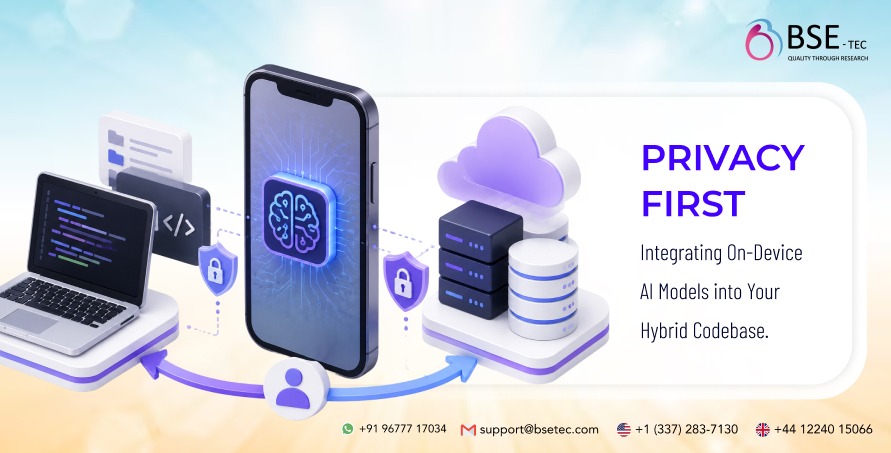
On-Device AI allows machine learning and generative AI models to perform inference directly on user devices.
Instead of uploading every interaction to cloud servers, the AI processes data locally and returns results instantly.
This approach offers several advantages:
Better Privacy: User data remains on the device, reducing exposure risks.
Lower Latency: Responses happen almost instantly without network delays.
Offline Functionality: AI continues working even without internet access.
Reduced Cloud Costs: Organizations spend less on server infrastructure and inference requests.
Improved User Trust: Customers increasingly prefer applications that protect their personal information.
As AI adoption expands globally, privacy-preserving architectures are becoming a major competitive differentiator.
Why Hybrid Codebases Need On-Device AI
Modern businesses rarely build applications for a single platform.
Instead, they rely on hybrid ecosystems consisting of Mobile applications, Web applications, Enterprise dashboards, IoT devices, Wearables, and Customer portals.
However, running AI consistently across these environments can be challenging.
This is where a Hybrid AI Architecture becomes valuable.
The model works like this:
Local Device Layer
Handles:
- Voice recognition
- Smart search
- Text summarization
- Image analysis
- Recommendation engines
Cloud AI Layer
Handles:
- Large-scale training
- Model updates
- Advanced analytics
- Enterprise intelligence
As a result, businesses achieve the best of both worlds:
Privacy + Performance + Scalability
What Is Happening Right Now in 2026?
The biggest technology companies are aggressively investing in edge intelligence.
The industry is witnessing a major shift from cloud-centric AI toward AI experiences that run closer to users. New AI-focused devices, AI PCs, intelligent smartphones, and edge computing platforms are accelerating this transition. Recent announcements across the technology sector highlight growing investments in AI hardware specifically designed for local inference and agent-based computing.
At the same time, premium smartphones are increasingly shipping with dedicated AI processors capable of running advanced AI workloads directly on the device. This trend is driving demand for specialized AI chips and edge hardware globally.
In other words, the future of AI is moving closer to the user.
The Solana Connection: Why Privacy Matters for Web3 Applications
The rise of On-Device AI is especially important for Web3 ecosystems built on blockchain networks such as Solana.
Users interacting with NFT marketplaces, DeFi platforms, and digital identity solutions, Wallet applications, and tokenized ecosystems often handle sensitive financial and behavioral data.
Traditionally, AI-powered recommendations, fraud detection systems, and user analytics depended heavily on centralized cloud processing.
However, combining On-Device AI with Solana-powered applications creates new opportunities for private wallet analysis, Local transaction categorization, Personalized NFT discovery, Secure identity verification, and real-time fraud detection without exposing unnecessary user information.
Therefore, On-Device AI and blockchain technology naturally complement each other.
Both prioritize decentralization, ownership, and user control.
How BSEtec Helps Businesses Build Privacy-First AI Solutions
As enterprises explore privacy-focused digital transformation, implementation becomes the real challenge.
This is where BSEtec plays a significant role.
BSEtec helps businesses design and develop advanced digital ecosystems that combine:
- AI-powered applications
- Blockchain infrastructure
- Web3 platforms
- Enterprise software solutions
- Hybrid mobile applications
More importantly, BSEtec focuses on architectures that balance performance, scalability, and data privacy.
For organizations building Solana-based ecosystems, NFT platforms, decentralized applications, or AI-driven enterprise products, BSEtec helps integrate intelligent features while maintaining strong privacy standards.
Instead of relying entirely on cloud processing, businesses can leverage BSEtec’s expertise to implement hybrid AI architectures that support local processing, edge intelligence, and secure data handling.
This approach enables organizations to future-proof their products while aligning with evolving privacy expectations.
The Competitive Advantage Businesses Cannot Ignore
Companies that continue using cloud-only AI strategies may eventually face Higher infrastructure costs, Increased compliance burdens, Privacy concerns, Slower user experiences
Meanwhile, organizations adopting On-Device AI can deliver Faster applications, Better customer trust, Reduced operational expenses, Enhanced security, Improved regulatory readiness
Therefore, the conversation is no longer about whether businesses should adopt AI.
The conversation is about where AI should run.
Conclusion
The AI industry is entering a new phase in 2026. Businesses are moving beyond the traditional cloud-only model and embracing privacy-first architectures powered by On-Device AI.
As edge intelligence continues to grow, organizations that integrate local AI processing into their hybrid codebases will gain a significant advantage in performance, security, and customer trust. Furthermore, for Web3 ecosystems and Solana-based applications, the combination of decentralized infrastructure and On-Device AI creates a powerful foundation for the next generation of digital experiences.
BSEtec stands at the forefront of this transformation, helping businesses build secure, scalable, and privacy-focused AI solutions that align with the future of intelligent software. Whether it’s hybrid applications, blockchain ecosystems, or AI-powered digital platforms, BSEtec enables organizations to innovate confidently while keeping user privacy at the center of every solution.
In 2026, the smartest AI isn’t just powerful, it respects privacy. And that is exactly where the future is headed.