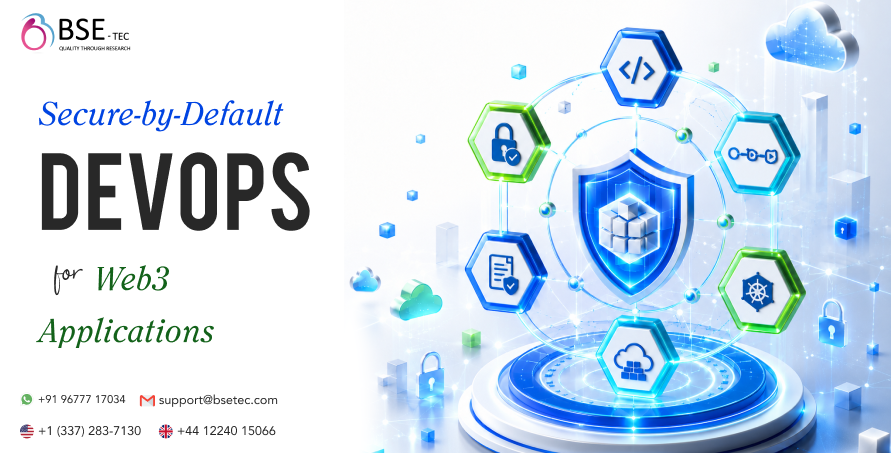
Your Web3 application is ready, but is the entire journey from code to blockchain secure? In 2026, securing only smart contracts isn’t enough. With developers, CI/CD pipelines, cloud infrastructure, wallets, APIs, and third-party tools all connected, every layer matters. That’s why Secure-by-Default DevOps focuses on building security into the development process from day one, rather than adding it later.
Why This Matters More in 2026
The current Web3 security landscape makes this approach particularly relevant. According to CertiK’s H1 2026 Hack3D report, Web3 projects experienced 344 security incidents and more than $1.31 billion in losses during the first half of 2026. Wallet compromises alone were responsible for more than $444 million across 33 incidents.
Another H1 2026 report from Immunefi recorded approximately $972 million in losses across 207 incidents. Although the two reports use different methodologies, both show the same underlying trend: attackers continue to find opportunities across the broader Web3 ecosystem.
So, what does this mean for businesses?
It means that securing a smart contract is only one part of the job. Organizations also need to think about the people writing the code, the systems building it, the dependencies being used, the infrastructure hosting it, and the wallets responsible for signing transactions.
In other words, the application may be decentralized, but its development process still needs centralized discipline around security.
Imagine Your Development Pipeline as a Security Journey
Let’s say a developer is working on a new feature for your Web3 application. They write the code and push it to the repository. From there, the CI/CD pipeline takes over, builds the application, runs tests, packages the software, and eventually prepares it for production.
That sounds straightforward.
But now imagine that the developer accidentally commits a secret. Perhaps a dependency has a known vulnerability. Maybe the build environment has excessive permissions. Or perhaps the deployment wallet is accessible from a system that shouldn’t have access to it.
If security only happens before production, these problems may already have travelled a long way through your infrastructure. Secure-by-Default DevOps changes this journey. Security checks are introduced at each important stage, so problems can be detected while they are still small and relatively easy to fix.
The workflow becomes something like:
Development → Code Review → Security Scanning → Testing → Build Verification → Deployment Approval → Production Monitoring
Because teams can automate these checks, developers can maintain their development speed. Instead, they receive security feedback earlier, while they still develop the code.
Your CI/CD Pipeline Deserves More Attention
One of the biggest mistakes businesses can make is treating CI/CD as just a deployment tool. In reality, it can connect repositories, cloud platforms, APIs, containers, blockchain services, and production environments. Therefore, if the pipeline is compromised, attackers may gain access to multiple systems.
This becomes even more important as software supply-chain attacks continue to grow in 2026. Web3 applications depend heavily on open-source packages, SDKs, blockchain libraries, and third-party services. So, teams should continuously scan dependencies, detect exposed secrets, verify packages, and monitor every component before it reaches production.
The Private-Key Problem
Web3 applications handle more than databases and API credentials—they can also control wallets and private keys that authorize blockchain transactions. Therefore, exposing these keys through CI/CD or insecure environments can create serious risks.
Instead, businesses should use dedicated wallets, role-based access, multisignature approvals, secure signing, and isolated environments. This allows teams to maintain DevOps speed while keeping sensitive blockchain operations protected.
Security Doesn’t Stop With the Smart Contract
Smart contract audits are extremely valuable, and businesses should continue using them. However, an audit should be viewed as one layer within a larger security strategy.
Think about a simple example. Your smart contract has been audited, and no major vulnerabilities have been discovered. Everything looks good. Later, however, a developer account is compromised, and an attacker gains access to the deployment environment. The contract itself hasn’t changed. But the environment around it has.
This is why modern Web3 security needs to consider the entire lifecycle: development accounts, source code, dependencies, CI/CD, infrastructure, deployment systems, signing mechanisms, and production monitoring.
The question is no longer simply “Is the smart contract secure?”
The better question is:
Can we trust every step that takes this smart contract from source code to production?
AI Is Changing the Development Process Too
AI is helping developers create code, tests, and infrastructure faster. However, speed can also introduce new security risks. A 2026 study of 4,022 AI-assisted pull requests found that 38.9% contained at least one security smell.
Therefore, AI-generated code should always go through automated security checks and human review before production. AI helps you build faster. Secure DevOps helps you build safely.
What Should a Secure Web3 Pipeline Actually Do?
A secure Web3 pipeline should automatically scan code, dependencies, secrets, smart contracts, and infrastructure before deployment. Sensitive actions, such as contract upgrades or wallet operations, should also require proper approval.
Once the application goes live, continuous monitoring should track infrastructure, transactions, smart-contract events, and administrative activity. This makes security an ongoing process rather than a one-time check.
The Goal Isn’t More Security Tools
Secure-by-Default DevOps isn’t about adding more security tools or making development complicated. Instead, the goal is to make security automatic and simple.
Dependencies should be scanned, secrets should be detected, infrastructure should be validated, and production access should be controlled automatically. This way, the secure choice becomes the default choice.
How BSEtec Can Help
For businesses entering Web3, building this type of environment requires more than simply developing a blockchain application. It requires the right combination of blockchain development, infrastructure, DevOps, security practices, and continuous monitoring.
This is where BSEtec can add value.
BSEtec works across Web3 and blockchain development requirements, helping businesses build applications with security and scalability considered from the architecture stage. Depending on the project, this can include smart contract development, blockchain application development, secure CI/CD implementation, cloud and infrastructure integration, wallet architecture, API security, automated testing, and monitoring.
The objective is not to add security after everything has already been built.
Instead, the objective is to create a development lifecycle where security becomes part of the architecture, the code, the pipeline, the deployment process, and the production environment.
That approach is particularly valuable for businesses working with DeFi platforms, tokenization solutions, crypto wallets, exchanges, enterprise blockchain applications, and other systems where security and trust directly affect the business.
What Should Web3 Businesses Do Next?
Businesses don’t need to change everything at once. First, review production access, private-key storage, dependency scanning, smart-contract testing, and deployment approvals.
From there, gradually add stronger access controls, automated security testing, secret detection, secure signing, and continuous monitoring. Most importantly, make security part of the everyday development workflow.
The Web3 Development Mindset Is Changing
Web3 is moving toward more automation, more AI-assisted development, more multi-chain applications, and more real-world business use cases. At the same time, tokenization, decentralized finance, blockchain infrastructure, and autonomous applications are creating systems that can move value with very little human intervention.
Therefore, security needs to evolve alongside the technology.
The future of Web3 development isn’t simply about building applications faster. It is about building applications that can move fast while remaining trustworthy.
That is the real value of Secure-by-Default DevOps.
When security starts at the beginning, teams can catch vulnerabilities earlier, limit access by default, and reduce the impact of compromised credentials. Moreover, controlled deployments ensure teams give sensitive changes the attention they deserve. And when monitoring continues after launch, businesses have a better chance of detecting unusual activity before it becomes a larger problem.
Ultimately, security shouldn’t feel like something standing between your team and deployment.
It should be the foundation that allows your team to deploy with confidence.
For businesses building the next generation of Web3 applications, BSEtec brings together blockchain development and security-focused DevOps practices to help turn that idea into a practical, scalable development strategy.
Because in Web3, building something that works is only the beginning. Building something people can trust is what matters next.