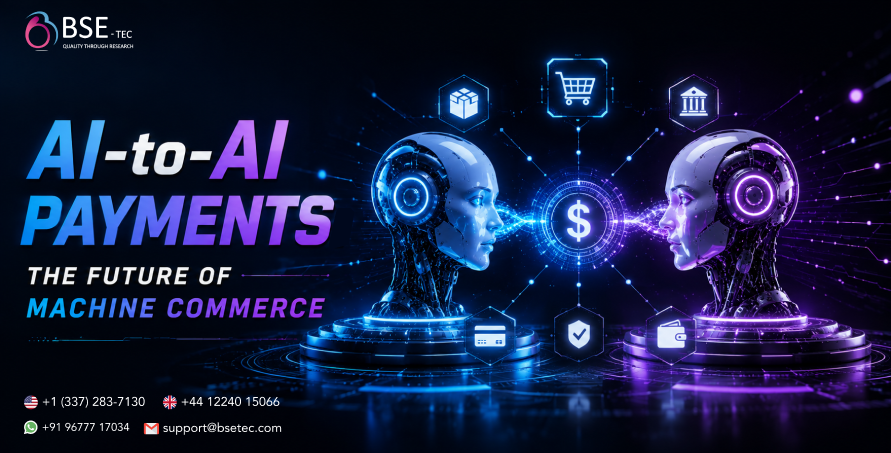
For years, digital payments were designed around one assumption: a human is making the purchase.
But 2026 is challenging that assumption.
AI agents are moving beyond answering questions and generating content. They can now search for services, compare options, trigger workflows, and increasingly participate in transactions. Visa reported in July 2026 that AI agents are already being used in activities such as booking travel, reordering inventory, querying data providers, and buying compute. At the same time, payment networks are actively building infrastructure for this new model. On June 10, 2026, Mastercard launched Agent Pay for Machines for high-frequency, low-value machine transactions, while Visa announced a collaboration with OpenAI to support secure payments in agentic commerce.
This brings us to the next stage of digital commerce:
AI does not just recommend what to buy. It can potentially buy it.
The Big Change: From Checkout to Continuous Commerce
Traditional ecommerce ends after payment. However, AI agents can continuously purchase resources as needed.
For example, a logistics agent could automatically pay for freight, warehouse services, tracking, and monitoring.
Continuous Commerce: Machines can make frequent, small payments for API Calls, Cloud Computing, AI Inference, Data Access, Storage, Bandwidth, IoT Services, DePIN Resources, and Automated Logistics
Why Microtransactions Suddenly Matter
Humans are not naturally suited to making thousands of tiny payments. An AI agent is.
Imagine an intelligent system that pays:
- $0.01 for a data request
- $0.05 for an AI inference
- $0.20 for additional compute
- $1 for a specialized digital service
A human would probably prefer a monthly subscription. An AI agent may prefer pay-per-use because it can compare the cost of every transaction in real time. Mastercard’s 2026 machine-payment infrastructure specifically targets this type of high-volume, low-value transaction environment. Consequently, AI-to-AI payments could create business models that were previously too expensive or inconvenient to operate manually.
The Rise of Payment-Enabled APIs
One of the most interesting developments in 2026 is the evolution of HTTP 402-based payment flows. Cloudflare’s current agentic-payment documentation describes an architecture where a service can return:
402 Payment Required
The response tells the requesting software what needs to be paid, including payment details. The client can then make the payment programmatically and retry the request with payment credentials. This approach is important because it turns an API into something closer to a machine-readable storefront.
For example: An AI agent requests premium market data.
The server replies:
Payment required — $0.10
The agent checks its policy. The agent pays. The server verifies the transaction. The data is delivered. There is no traditional shopping cart.
There may not even be an account or pre-shared API key. Cloudflare’s x402 documentation specifically describes this model as supporting AI agents and programmatic services without requiring traditional accounts, sessions, or API keys.
AI Agents Need Their Own Financial Rules
Giving an AI agent access to money sounds powerful. It also sounds dangerous. A production-grade AI payment system cannot simply say: “Here is a wallet. Spend whatever you need.” Instead, businesses need controlled autonomy.
For example:
- Maximum transaction: $20
- Daily spending: $500
- Allowed services: Verified APIs and compute providers
- Restricted assets: No unauthorized tokens
- Human approval: Required above $100
- Emergency action: Automatically freeze the wallet
This creates an important principle: Autonomous does not mean uncontrolled.
The AI should make decisions within a clearly defined financial boundary.
Identity Becomes as Important as Payment
A traditional payment system primarily asks:
Who is paying?
AI commerce requires additional questions:
- Which agent is paying?
- Who authorized it?
- What is the agent allowed to do?
- Which business does it represent?
- Can the receiving service trust it?
Visa’s 2026 work on agentic commerce highlights the growing importance of trust, authentication, and security as AI agents increasingly make purchases and manage transactions.
So, future machine-commerce infrastructure is likely to combine: Agent Identity + Authorization + Wallet + Payment + Verification + Monitoring
This is one reason blockchain-based identity and programmable wallet infrastructure are attracting attention in agentic commerce.
Where Stablecoins Fit
Stablecoins can provide AI agents with fast, programmable, global, and low-value payment capabilities. In 2026, Visa and Cloudflare are expanding stablecoin-based infrastructure for agentic commerce.
Key Benefits
- Fast settlement
- Programmable payments
- Global transactions
- Microtransactions
- Blockchain verification
- Machine-Commerce Flow
AI → Identity → Policy → Wallet → Payment → Settlement → Service
AI-to-AI Payment Use Cases
AI Compute: Automatically buy GPU resources.
Data: Purchase datasets on demand.
APIs: Pay per AI service request.
DePIN: Buy decentralized infrastructure.
Supply Chain: Automate service payments.
AI Marketplaces: Agents hire other AI services.
AI agents could soon buy capabilities, not just products.
What Changes for Businesses?
The rise of AI agents means businesses must prepare for AI-driven customers. Instead of serving only people, platforms will need to support machines that can discover, evaluate, and pay for services. Businesses will need AI-readable pricing, API-based services, Automated payments, Agent authentication, Real-time availability, and Smart access controls. The shift: From human-first commerce to human + AI commerce.
Where Blockchain Enters the Picture
Blockchain can provide the trust and automation layer required for machine transactions. It can handle wallets, programmable payments, smart contracts, and transparent settlement. Key areas include AI-powered wallets, Stablecoin payments, Smart contracts, tokenized services, Decentralized marketplaces, and Agent-to-agent transactions
The Bigger Opportunity: AI + Blockchain + Payments + Identity + Security = Machine Commerce Infrastructure
How BSEtec Can Help Build the AI-to-AI Payment Layer
For businesses exploring this market, the biggest challenge is connecting several technologies into one secure system.
This is where BSEtec can bring value.
BSEtec can help businesses explore solutions involving AI agents, blockchain networks, crypto wallets, smart contracts, Web3 applications, and programmable payment workflows.
For example, a future AI-commerce platform could include:
AI Agent, Identity Layer, Policy Engine, Programmable Wallet, Payment Gateway, Blockchain / Stablecoin Settlement, Smart Contract, Service Provider
BSEtec can help businesses design and develop the blockchain and Web3 components needed to support such architectures.
For organizations entering this space, partnering with an experienced blockchain development company can also help address critical areas such as security, wallet architecture, smart-contract integration, and scalable transaction infrastructure.
AI-to-AI Payments: What Comes Next?
2026: AI agents connect with payment systems.
2027: Agent-to-agent marketplaces expand.
2028: Microtransactions grow for APIs and compute.
2029: AI agents manage complex purchases.
2030: Autonomous business networks become more common.
Conclusion
AI-to-AI payments are reshaping commerce by enabling agents to discover, decide, transact, and pay automatically. As this evolves, businesses will need secure identity, wallets, payment, and blockchain infrastructure. 2026 marks the shift from AI that assists to AI that transacts.
The future
Human-to-Business → Machine-to-Machine
BSEtec helps businesses build secure, blockchain-powered solutions for this emerging machine economy.