Imagine creating a powerful AI prompt, fine-tuned model, or custom AI workflow that thousands of people use.
You helped create the intelligence behind it. But how do you continue earning when others keep using it?
That is where AI model tokenization and on-chain royalties are becoming interesting.
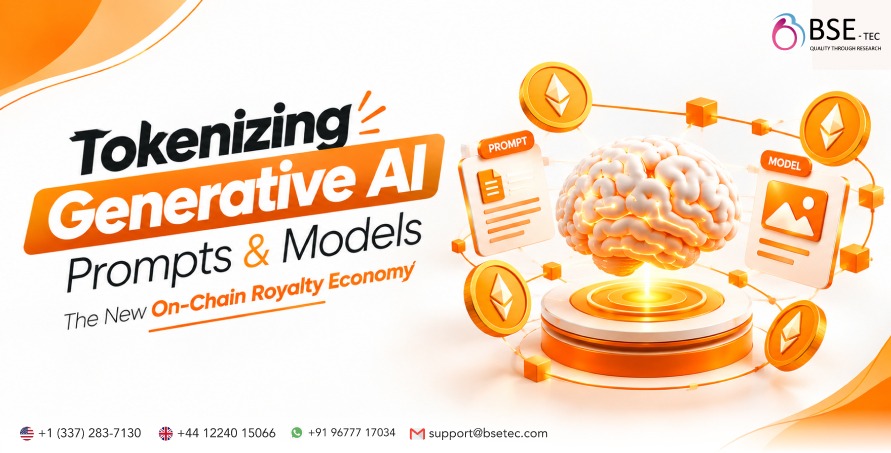
Instead of treating AI models and prompts as simple digital files, blockchain can turn them into programmable digital assets with ownership, licensing, usage rules, and royalty mechanisms built around them.
As Generative AI continues to grow, this could create a new way for creators, developers, and businesses to monetize the intellectual property behind AI.
Why AI Models Are Becoming Digital Assets
Generative AI is creating a new category of valuable digital assets.
These can include:
- Custom AI models
- Fine-tuned models
- High-quality datasets
- Specialized prompts
- AI-generated workflows
- AI agents and their intellectual property
However, ownership and licensing can become complicated when these assets are shared across platforms.
A blockchain-based system can provide a transparent record of ownership and usage rights. Therefore, AI creators can potentially define how their models or other intellectual property can be used and how revenue should be shared.
BSEtec’s Generative AI solutions already cover custom AI models, AI-generated content, fine-tuning, and AI-assisted creativity tools.
What Does Tokenizing an AI Model Mean?
AI model tokenization means representing an AI model or its associated intellectual property through a blockchain-based digital asset.
The token does not necessarily contain the entire AI model itself.
Instead, it can represent ownership, licensing rights, access permissions, provenance, or economic rights connected to that model.
For example, an AI developer could register a specialized model and define:
Who can use it → What they can do with it → How much they pay → Who receives the royalty
That creates a programmable licensing layer around AI.
Prompts Could Become Valuable IP Too
The same idea can apply to Generative AI prompts.
A simple prompt may look like text. However, a carefully designed prompt system can contain significant research, testing, domain knowledge, and workflow logic.
For example, a professional prompt framework could help an AI system generate financial reports, marketing campaigns, product designs, or technical documentation.
Instead of sharing that prompt as a normal text file, its creator could attach licensing and usage conditions to it.
Consequently, businesses could pay for approved usage while the creator receives a predefined share.
The important shift is:
From selling a prompt once → to earning from its continued licensed use.
How Could On-Chain AI Royalties Work?
The process can be relatively simple.
Creator → Tokenized AI Asset → License → Usage → Smart Contract → Royalty Payment
First, the creator registers the AI asset and defines its licensing terms.
Next, users or businesses obtain permission to use it.
When a defined usage or commercial event occurs, a smart contract can calculate and distribute the agreed royalty.
For example, imagine a model licensed with a 5% royalty.
If the model generates $1,000 in eligible licensing revenue, the smart contract could automatically distribute the defined share according to the licensing agreement.
BSEtec’s existing work on smart contract royalties describes this same basic principle: smart contracts can automate royalty calculations and payments while keeping transactions transparent and trackable.
The 2026 Trend: AI Licensing Is Becoming More Important
This idea is moving beyond theory.
In January 2026, Story Protocol and OpenLedger announced a standard focused on rights-cleared AI training and automatic creator payments. Their approach aims to connect licensed intellectual property with AI training while making usage and compensation more traceable.
Story’s documentation also describes a model where intellectual property can be registered on-chain and given programmable licensing terms, including AI training data and other digital assets.
Meanwhile, legal discussions around AI training and copyright are also increasing. India’s DPIIT working paper on Generative AI and copyright examined approaches including licensing and royalty mechanisms, showing how AI-generated value is becoming a serious intellectual-property discussion.
So, the conversation is moving from:
“Who owns AI-generated content?”
to:
“How can AI-related intellectual property be licensed, tracked, and monetized?”
A New Revenue Model for AI Creators
Tokenization could create several revenue opportunities.
1. Model Licensing: Creators can license specialized AI models to businesses while defining usage and payment terms.
2. Prompt Licensing: Premium prompts or prompt systems can be licensed for specific commercial applications.
3. Revenue Sharing: Multiple contributors can receive predefined shares when an AI asset generates revenue.
4. Derivative Models: A model can potentially be adapted or fine-tuned while maintaining a connection to the original licensing terms.
5. AI Training Data: High-quality datasets can be registered and licensed for approved AI training use.
As a result, AI intellectual property can move from a static file toward a programmable economic asset.
But Tokenization Does Not Solve Everything
There is an important reality check.
Putting an AI model or prompt on blockchain does not automatically prove that the creator owns the underlying intellectual property.
Legal ownership, licensing agreements, copyright rules, and platform policies still matter.
Similarly, a blockchain can record that a transaction happened, but it cannot automatically determine whether an AI system illegally copied a model or prompt somewhere else.
Therefore, successful AI IP tokenization needs more than blockchain.
It requires:
Legal rights + identity + licensing + provenance + smart contracts + secure infrastructure
That combination is what makes the model practical.
Where BSEtec Fits In
This is where BSEtec can connect AI and blockchain infrastructure.
BSEtec’s existing capabilities include Generative AI development, smart contract development, AI-powered blockchain solutions, NFT marketplace technology, token development, and AI-blockchain integration.
For an AI IP platform, the technology stack could include:
- AI Model Development – Build or fine-tune specialized models.
- Tokenization – Represent AI models, prompts, datasets, or related rights as digital assets.
- Smart Contracts – Automate licensing rules and royalty distribution.
- Rights Management – Track ownership, permissions, and usage conditions.
- Royalty Infrastructure – Enable automated payments between creators, platforms, and contributors.
- AI + Blockchain Integration – Connect AI applications with on-chain identity, transactions, and provenance.
BSEtec also works on AI-powered smart contracts, where AI and blockchain work together to automate decisions, transactions, and digital workflows.
What Comes Next?
The next creator economy may not be built around simply selling AI models.
Instead, creators could license them.
Businesses could pay based on usage.
Contributors could receive automated revenue shares.
AI agents could potentially discover licensed models and negotiate access programmatically.
This becomes even more interesting when AI agents + smart contracts + blockchain payments work together. BSEtec’s recent work on AI-to-AI payments and autonomous AI agents reflects this broader shift toward machine-driven digital transactions.
The result could be a new form of programmable AI commerce, where intellectual property can move, generate value, and distribute revenue through predefined rules.
Final Thoughts
Tokenizing Generative AI prompts and models could change how AI intellectual property is owned, licensed, and monetized.
Instead of selling an AI asset once, creators could potentially build ongoing revenue models around its licensed usage.
However, the real opportunity is not simply putting AI models on a blockchain.
It is creating an ecosystem where ownership, licensing, provenance, usage, and royalties work together.
This is where BSEtec brings together its Generative AI and blockchain expertise. From AI model development and tokenization to smart contracts, royalty automation, NFT marketplace infrastructure, and AI-blockchain integration, BSEtec can help businesses build digital ecosystems around AI intellectual property.
Explore BSEtec’s Generative AI Solutions
Explore BSEtec’s Blockchain Solutions
The future of AI may not only be about who builds the most powerful model.
It may also be about who owns the intelligence, who can license it, and who gets paid when it creates value.