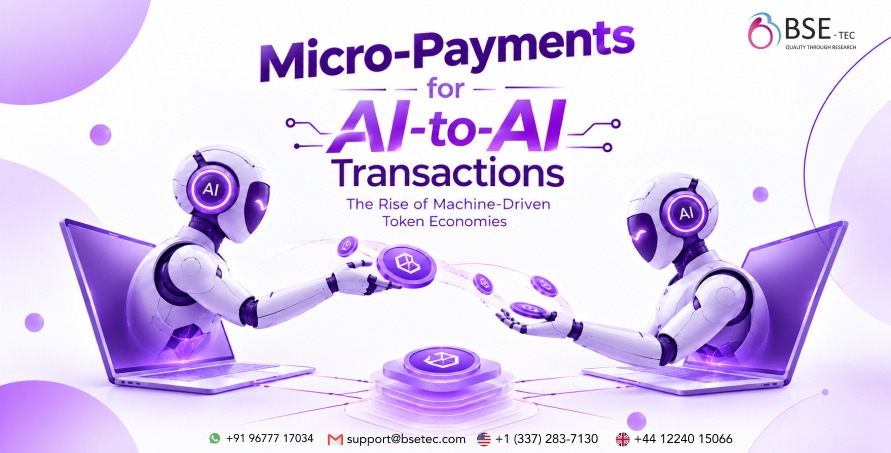
At BSEtec, we are already seeing the next payment layer taking shape around autonomous AI agents. The important shift is not simply that AI can make decisions. It is that one AI system can increasingly pay another system to complete part of a task.
Imagine an AI agent researching a market. It needs a premium dataset, pays another AI service for the information, uses a separate model for analysis, purchases additional compute, and continues the workflow.
No checkout page. manual invoice.
No employee approving every transaction.
Instead, the machines exchange tiny amounts of value as the work happens.
That is the promise behind AI-to-AI micropayments. As autonomous agents become more active economic participants, Web3 payment rails, stablecoins, programmable wallets, and machine-readable payment protocols could become critical infrastructure.
When Software Starts Paying Software
For years, digital payments assumed that a person was sitting behind the transaction.
Agentic systems change that model.
An AI agent may need to make hundreds or thousands of small purchases while completing a single objective. One payment could be for an API call. Another might unlock a piece of data. A third could pay for inference, storage, bandwidth, or compute.
Consequently, the economics of these transactions are very different from traditional ecommerce.
Paying a processing fee that is larger than a $0.001 service is obviously inefficient.
That is why micropayments become much more important when the buyer is software.
BSEtec recently explored this exact shift in AI-to-AI Payments: The Future of Machine Commerce, highlighting how agents could continuously purchase APIs, cloud computing, AI inference, data access, storage, bandwidth, and other digital resources.
The $0.001 Transaction Problem
The interesting part of the machine economy is not necessarily the size of each transaction.
It is the volume.
An agent might spend a fraction of a cent to access one piece of information and repeat that action thousands of times.
For example, a financial AI agent could purchase market data only when it needs it. A coding agent could pay for additional compute during a heavy workload. A research agent could pay for individual premium documents instead of maintaining several subscriptions.
Therefore, the payment infrastructure has to support:
- Very small transaction values.
- High transaction frequency.
- Automated authorization.
- Fast settlement.
- Programmable spending limits.
- Machine-readable payment instructions.
Traditional payment systems were not designed around this exact workflow.
Web3 rails, particularly stablecoin-based systems, are increasingly being tested for it.
Web3 Gives Bots a Way to Pay
The wallet is becoming one of the most important components in this architecture.
An AI agent needs more than intelligence. It needs a controlled way to hold value, sign transactions, and interact with payment infrastructure.
That does not mean giving an agent unrestricted access to a company’s treasury.
Instead, programmable wallet infrastructure can define what the agent is allowed to spend and where it can transact.
This is where BSEtec’s work around autonomous AI agents, smart wallets, smart contracts, and blockchain infrastructure becomes directly relevant. BSEtec’s current AI + blockchain offering includes on-chain autonomous AI agents and smart wallets alongside smart-contract and token infrastructure.
The architecture can look like:
AI Agent → Identity → Spending Policy → Smart Wallet → Micropayment → Service
As a result, the agent gets economic capability without receiving unlimited authority.
From API Calls to Paid AI Services
This is where AI-to-AI payments become commercially interesting.
An API can become a service that an AI agent discovers and pays for only when required.
Circle is already building around this model. Its Agent Stack allows agents to discover services and pay using USDC through mechanisms including x402 and nanopayments. Circle’s platform describes services ranging from AI inference and data access to compute, infrastructure, digital goods, and content.
In July 2026, Circle also described the model as an agent-ready revenue stream: an API provider can expose an endpoint, define a price, and accept USDC payments from autonomous agents without requiring a traditional checkout process.
That changes the commercial model.
A business could potentially move from:
Human → Website → Subscription → Service
toward:
AI Agent → API → Micropayment → Service
For digital businesses, that means every API call could become a potential revenue event.
The Payment Happens Inside the Workflow
The x402 model is especially interesting because it fits naturally into the way the internet already works.
An agent requests a paid resource.
The service responds with a machine-readable payment requirement.
The agent completes the payment.
The service verifies it.
Access is then provided.
AWS has now taken this concept into enterprise infrastructure. In August 2026, Amazon Bedrock AgentCore Payments became generally available, allowing AI agents to discover, access, and pay for paid APIs, MCP servers, and content. AWS supports wallet integrations, configurable payment limits, payment orchestration, and transaction observability.
AWS documentation also specifically describes micropayments as payments that can be below a dollar or fractions of a cent, where traditional payment fees can make the transaction uneconomical.
So, this is no longer just a theoretical Web3 use case.
The payment layer itself is becoming agent-aware.
$1B Starts With Millions of Tiny Transactions
The $1 billion idea becomes interesting when viewed through transaction volume rather than individual payment size.
A machine economy does not need every transaction to be large.
It needs millions of machines performing useful economic actions repeatedly.
BSEtec has reported 2026 ecosystem data showing AI agents settling more than $73 million across approximately 176 million blockchain transactions between May 2025 and April 2026, while BlockRun reported millions of API calls from autonomous agents alongside hundreds of thousands of on-chain USDC settlements in Q1 2026.
Those figures do not prove that Web3 agent micropayments will reach $1 billion. However, they show why transaction count may matter as much as transaction value.
Even a tiny payment becomes commercially meaningful when an autonomous system repeats it at internet scale.
The Agent Becomes the Customer
This is perhaps the biggest commercial change.
Today, businesses design digital services primarily for people.
Tomorrow, some services may need to be designed for AI buyers.
A research agent could purchase data.
A logistics agent could pay for tracking.
A coding agent could purchase compute.
A marketing agent could pay for enrichment data.
Another AI agent could even sell specialized reasoning or execution to a different agent.
BSEtec’s Agent-to-Agent Commerce work explores this broader transition, where AI agents can communicate, interact with blockchain wallets, and participate in transactions with other agents.
This creates a new category of customer:
The machine customer.
The Wallet Needs Rules, Not Just Funds
Autonomous payments introduce an obvious business requirement: control.
A company cannot simply give an AI agent access to an unrestricted wallet and expect the system to manage financial risk by itself.
Instead, the payment layer needs policies.
An enterprise could define:
Daily spending limits — how much an agent can spend.
Service restrictions — which APIs or vendors it can access.
Transaction limits — the maximum value of an individual payment.
Approved networks — where the agent can transact.
Human escalation — when a transaction requires additional approval.
This is where smart wallets, account abstraction, smart contracts, and policy engines become commercially valuable.
BSEtec also explores this architecture in Why AI Agents Need Smart Contracts Instead of APIs, including the model of AI agent → intent → policy verification → smart contract → blockchain settlement.
Building the Rails Behind Machine Commerce
For businesses entering this market, adding a wallet alone will not be enough.
The complete system may require:
Autonomous AI agents for decision-making.
Smart wallets for controlled asset management.
Stablecoin or token payments for settlement.
Smart contracts for transaction rules.
Identity infrastructure for agent verification.
APIs and payment protocols for service discovery and access.
Monitoring and controls for enterprise governance.
This is where BSEtec can build beyond the individual component.
With capabilities across AI agents, smart wallets, blockchain development, smart contracts, token development, tokenomics, and Web3 infrastructure, BSEtec can architect the payment layer around the actual business workflow rather than treating micropayments as an isolated feature.
For a data platform, that could mean pay-per-query AI access.
DePIN ecosystem, it could mean machine payments for compute or storage.
For an enterprise, it could mean autonomous procurement and service payments.
For an AI marketplace, it could mean agents buying and selling capabilities from one another.
The $1B Question Is Really About Scale
The future of AI-to-AI micropayments will not be decided by one large transaction.
It will be shaped by billions of small decisions that trigger economic activity.
As more services become accessible through machine-readable APIs, agents can become buyers. programmable wallets become safer, they can become transaction holders. As stablecoin and Web3 payment protocols mature, those transactions can settle without forcing every workflow through a human checkout.
The bigger opportunity is therefore not simply “AI payments.”
It is the creation of a machine-native economy.
Final Thoughts
AI-to-AI micropayments could become one of the most important financial layers of the agentic economy.
The real opportunity lies in connecting intelligence with execution: an AI agent discovers a service, evaluates its value, follows its spending policy, makes a tiny payment, receives the resource, and continues the task.
That workflow is already being supported by emerging 2026 infrastructure from companies such as AWS and Circle.
For businesses preparing for this shift, BSEtec can help build the infrastructure behind autonomous machine commerce — from AI agents and smart wallets to smart contracts, token economies, micropayment rails, and Web3 systems.
The next customer may not be a person sitting behind a screen.
It may be another AI agent — carrying its own wallet, making its own decisions, and paying for the next service it needs.