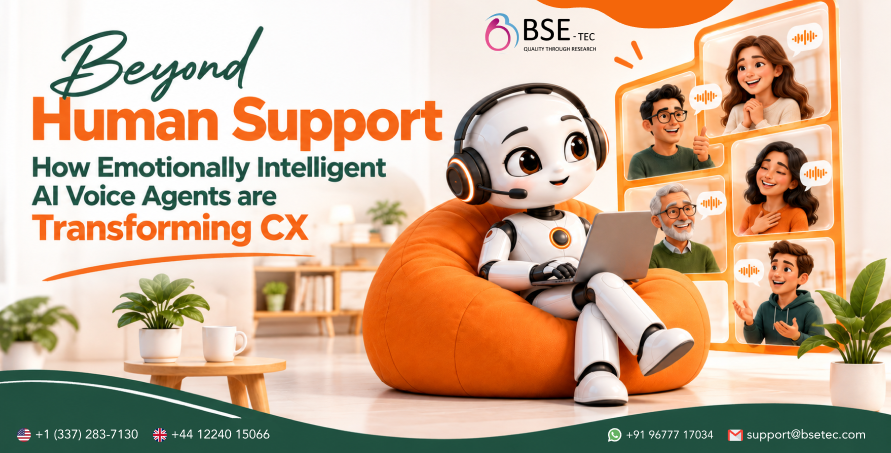
At BSEtec, we believe the future of customer experience depends on more than faster responses. Businesses need technology that understands customer intent, responds naturally, and recognises when a conversation requires extra attention.
This is where emotionally intelligent AI voice agents are changing customer support. Unlike traditional voice bots that follow fixed scripts, modern AI voice agents use speech recognition, conversational AI, and contextual understanding to create more natural interactions.
Imagine a customer calling a bank after a failed transaction. A traditional automated system may ask the caller to select multiple options. However, an intelligent voice agent can understand the issue, recognise signs of frustration, acknowledge the concern, and guide the customer towards a solution.
As a result, businesses can move beyond basic call automation and create more personal, responsive customer experiences.
Why Traditional Customer Support Needs an Upgrade
Customers expect quick answers, clear explanations, and minimal effort. However, long waiting times, repetitive IVR menus, and multiple transfers often make support frustrating.
For businesses, these challenges become more noticeable during peak seasons, product launches, and unexpected service disruptions. Hiring additional agents can increase costs, while basic automation may leave customers feeling unheard.
Emotionally intelligent AI voice agents offer a balanced approach. They can manage routine enquiries, provide immediate assistance, and transfer complex situations to human employees when necessary. Therefore, businesses can improve support without removing the human element.
What Makes an AI Voice Agent Emotionally Intelligent?
An AI voice agent combines speech recognition, language models, and business-system integrations. Emotional intelligence adds the ability to interpret conversational signals and adapt responses to the situation.
1. Recognising Emotional Signals
AI systems can analyse words, speaking speed, tone, and pauses to estimate whether a customer sounds frustrated, confused, or satisfied.
For example, when someone says, “I have contacted support three times, and nobody has fixed this issue,” the agent can acknowledge the repeated effort and offer a clear next step.
However, voice-based emotion recognition only estimates emotional signals. It cannot reliably identify a person’s true feelings, so businesses should use it carefully.
2. Creating Natural Conversations
Traditional bots often depend on predefined prompts. In contrast, conversational AI allows customers to explain problems in everyday language.
For instance, a customer might say, “My payment went through, but my order still shows pending.” The agent can identify the issue, retrieve relevant information through approved integrations, and explain the available options.
3. Maintaining Conversation Context
Modern voice agents can remember relevant details shared earlier in a call. Consequently, customers do not need to repeat the same information whenever they ask a follow-up question.
For example, an agent discussing a delayed delivery can also understand a later request to change the delivery address.
4. Knowing When Human Support Matters
Not every conversation belongs to AI. Financial disputes, sensitive complaints, and complex requests may require human judgement.
In such situations, the agent should transfer the call with a useful conversation summary. That way, the customer can continue without explaining the entire problem again.
How AI Voice Agents Improve Customer Experience
The real value of voice AI comes from connecting intelligent conversations with everyday business operations.
Personalised support: By connecting with approved CRM systems, booking platforms, and order databases, voice agents can provide information relevant to each customer instead of repeating generic answers.
24/7 assistance: Customers may need help outside regular business hours. AI agents can handle suitable routine enquiries at any time and manage multiple conversations within system capacity.
Multilingual communication: Modern speech technologies can support conversations in different languages. For businesses serving Indian customers, this can include English, Hindi, Tamil, Telugu, and other regional languages. Nevertheless, teams must test accents, pronunciation, and language accuracy before deployment.
Better agent productivity: AI can handle routine questions, order checks, and standard service enquiries. Meanwhile, human employees can focus on complex complaints, customer retention, and situations that require personal attention.
Together, these capabilities can reduce customer effort and help businesses deliver more consistent support.
Real-World Case Studies: AI Voice Support in Action
Kissht: Managing Sensitive Customer Enquiries
Indian digital lending platform Kissht introduced voice AI for inbound support, including loan-rejection enquiries and mandate or NOC cancellation requests.
According to Arrowhead AI’s published case study, the deployment reached 40% of total inbound support volume within two months. It also reported that the AI system resolved 88% of the calls it handled without human involvement and reduced average handling time by approximately 30% compared with human specialists.
The key lesson is that businesses can start with clearly defined support problems where accurate, consistent explanations matter.
TELUS Digital: More Proactive Customer Care
TELUS Digital explored AI voice technology to improve onboarding for newly activated internet customers. Its AI voice agent, powered by ElevenLabs technology, contacted customers during their first 90 days to address concerns such as first-bill confusion, self-service options, and available discounts.
The initial programme covered approximately 2,300 outbound calls. TELUS Digital reported an average customer satisfaction score of 8.5 out of 10. It also reported that 30-day cancellations among customers who received an AI welcome call were less than half the rate of the broader new internet activation group.
This example shows how businesses can use AI voice agents proactively instead of waiting for customers to raise problems.
2026 Trends Shaping Emotionally Intelligent AI Voice Agents
AI voice technology continues to evolve. In 2026, several developments are influencing how businesses approach customer conversations.
1. From Voice Bots to Agentic AI
Earlier voice bots mainly followed fixed conversation paths. However, agentic AI can interact with connected business tools and complete approved tasks.
For example, a customer requesting an appointment change could receive available time slots and confirm a new booking through an integrated system.
2. Real-Time Speech-to-Speech Conversations
Newer speech-to-speech approaches aim to make conversations more natural by reducing delays between customer speech and AI responses. As these systems improve, they can better handle interruptions and changing requests.
3. Emotion-Aware Responses
Voice AI systems increasingly explore ways to adapt their delivery according to conversational signals. For example, an agent may use a calmer pace when a customer sounds upset. However, businesses should treat emotion estimates as signals rather than facts.
4. Omnichannel Customer Experiences
Customers move between websites, mobile apps, messaging platforms, and phone calls. Therefore, businesses are connecting these channels so AI systems can retain relevant context and reduce repeated explanations.
5. Stronger AI Security and Governance
As voice agents access customer records, businesses must protect personal information, recordings, and connected systems. Clear consent, access controls, data-retention policies, and human escalation rules are essential.
What Businesses Should Consider Before Implementation
Successful AI voice deployment requires more than selecting a voice model. Businesses should first identify suitable use cases, such as appointment scheduling, order tracking, and routine service enquiries.
Next, they should connect reliable business data through secure APIs and define clear rules for human escalation. Furthermore, testing should cover different accents, background noise, interruptions, and unexpected questions.
Finally, businesses should measure resolution rates, repeat calls, customer satisfaction, escalation rates, and response accuracy. These metrics reveal whether AI genuinely improves customer experience rather than simply reducing call volume.
How BSEtec Helps Build AI-Powered Customer Experiences
At BSEtec, we help businesses explore intelligent digital solutions that connect AI capabilities with practical business requirements. An AI voice agent should do more than sound natural. It should understand customer needs, connect with business systems, and support reliable outcomes.
Through our Artificial Intelligence Development Services, businesses can explore solutions involving:
- AI Application Development: Intelligent applications for customer interactions and business workflows.
- Conversational AI Integration: Natural-language experiences for customer-facing services.
- Custom AI Agent Development: Task-oriented agents that work with approved business tools.
- API and System Integration: Connections between AI applications, CRM platforms, and business databases.
- AI Workflow Automation: Reduced repetitive work and more efficient operations.
- Cloud Infrastructure: Scalable environments for growing digital applications.
Additionally, BSEtec offers expertise in blockchain development solutions for businesses exploring wider digital transformation.
Every organisation has different customer expectations and technical requirements. Therefore, BSEtec focuses on understanding the business need before shaping the right development and integration approach.
Conclusion: Better Conversations Create Better Customer Experiences
Customer support is moving beyond automated menus and scripted replies. Emotionally intelligent AI voice agents give businesses new ways to deliver personalised assistance, manage routine enquiries, and improve customer interactions.
However, the goal is not to automate every conversation. Instead, businesses should combine AI efficiency with human judgement to create support experiences that customers can trust.
At BSEtec, we see this transformation as an opportunity to help businesses turn AI innovation into practical solutions. Through AI development, intelligent automation, and system integration, BSEtec supports organisations looking to build more connected and customer-focused digital experiences.
The future of customer support will not depend on how many calls AI answers, but on how effectively every conversation helps the customer move forward.