Wall Street is no longer asking whether blockchain has a place in finance. It is starting to use blockchain to redesign how assets are issued, owned, transferred, and settled.
The bigger opportunity is not another digital collectible. It is real estate, private equity, private funds, and other traditionally illiquid assets moving onto programmable financial infrastructure.
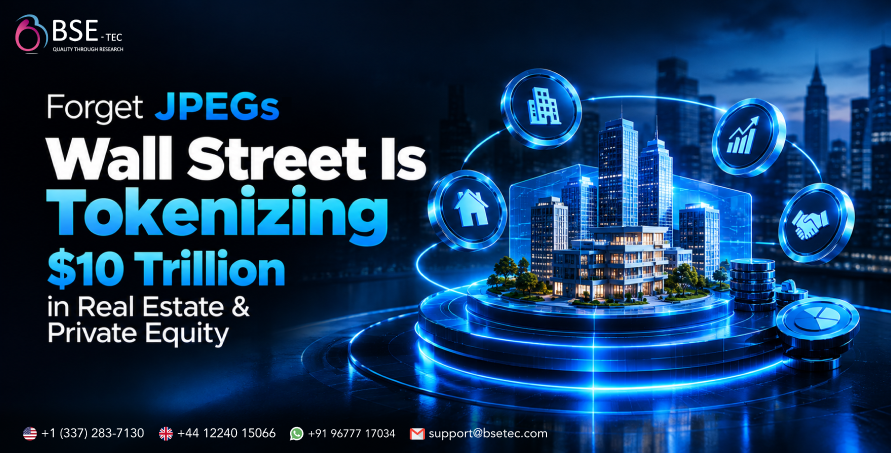
Industry forecasts already point toward a massive opportunity. Roland Berger estimates that tokenized assets could exceed $10 trillion by 2030, with real estate and financial assets expected to represent major portions of the market.
At BSEtec, this shift connects directly with our work across RWA tokenization, blockchain development, smart contracts, and institutional Web3 infrastructure. The question is no longer simply:
Can an asset be tokenized?
It is:
Can the entire investment lifecycle become programmable?
Wall Street Is Moving Ownership On-Chain
Traditional finance still depends on separate systems for investor onboarding, ownership records, compliance, transfers, reporting, and settlement.
Tokenization can bring these workflows closer together.
A blockchain token can represent an ownership interest, while smart contracts can enforce rules around eligibility, transfers, distributions, and settlement. As a result, blockchain becomes more than a database.
It becomes part of the financial infrastructure.
That matters especially in private markets, where access and administration remain complex. In May 2026, Hamilton Lane launched a tokenized share class of its Global Private Assets Fund, with BBVA Asset Management as the first investor and exclusive distributor for institutional portfolios. The initiative targets greater efficiency, transparency, and access across international private markets.
The $10T Opportunity Starts With Illiquid Assets
Real estate and private equity have one major characteristic in common: large amounts of capital are locked inside assets that are difficult to transfer quickly.
Tokenization changes the infrastructure around that ownership.
Instead of relying entirely on traditional certificates and fragmented records, an investment can be represented through blockchain-based tokens with programmable rules.
That can support:
- Digital ownership records
- Automated transfer restrictions
- Investor eligibility checks
- Programmable distributions
- Faster settlement workflows
- New distribution channels where regulations allow
Therefore, the value of tokenization is not simply fractional ownership.
It is programmable ownership.
Dubai Is Testing What Happens After Tokenization
Real estate provides an even clearer example.
Tokenizing a property is only the first step. The bigger challenge is what happens when an investor wants to transfer or resell that position.
Dubai is now testing that next stage.
In February 2026, the Dubai Land Department launched Phase II of its Real Estate Tokenisation Project, enabling controlled secondary-market resale of approximately 7.8 million real estate tokens. The pilot focuses on market efficiency, operational readiness, transparency, governance, and investor protection.
The model is moving toward:
Property → Tokenization → Digital Ownership → Resale → Secondary Market
That progression matters because it moves real estate tokenization beyond issuance.
The next battleground is liquidity and market infrastructure.
BlackRock Shows How Tokenized Funds Can Become Financial Infrastructure
BlackRock’s BUIDL provides another important signal.
Launched in 2024, BUIDL became the asset manager’s first tokenized fund on a public blockchain. By March 2025, it had crossed $1 billion in assets under management.
However, the more interesting development is what happened afterward.
In 2026, BUIDL became connected to additional on-chain liquidity and institutional collateral workflows. Securitize reported that BUIDL could be used as yield-bearing collateral through a framework involving BlackRock, OKX, and Standard Chartered.
Securitize and Uniswap Labs also introduced a pathway for eligible BUIDL investors to trade shares using UniswapX technology.
So, the token is no longer simply representing a fund.
It is becoming usable financial infrastructure.
Smart Contracts Could Replace Fragmented Financial Workflows
The real institutional opportunity begins when tokenization connects with smart contracts.
Consider a tokenized private fund.
Investor eligibility can be checked before participation. Transfer restrictions can be encoded into the asset. Distribution rules can be automated. Settlement can happen through connected blockchain infrastructure.
The workflow starts to look like:
Asset → Tokenization → Investor Verification → Smart Contract Rules → Transfer → Settlement → Reporting
Consequently, financial institutions can move from simply digitizing ownership to automating parts of the investment lifecycle.
That is where institutional Web3 becomes commercially important.
The 2026 Tokenization Race Is Moving Beyond Issuance
Two developments are becoming difficult to ignore.
Private markets are moving on-chain. Hamilton Lane’s 2026 tokenized fund activity demonstrates how established private-market managers are experimenting with blockchain-based distribution and access.
Real estate tokenization is moving toward secondary markets. Dubai’s Phase II shows that the industry is beginning to test what happens after digital ownership is created.
Meanwhile, tokenized funds are expanding across chains and financial workflows. Securitize reported more than $4 billion in AUM and continued expansion of institutional tokenized assets and multichain infrastructure in Q2 2026.
Together, these developments point to a larger shift:
Tokenization is evolving from digital asset representation into programmable market infrastructure.
BSEtec: Building the Infrastructure Behind RWA Tokenization
For financial institutions, creating a token is only one part of the project.
The underlying architecture must support ownership logic, smart contracts, compliance requirements, investor access, transfers, and institutional controls.
BSEtec works across RWA tokenization, blockchain development, smart contracts, permissioned blockchain infrastructure, and institutional Web3 solutions.
Relevant capabilities include:
- RWA Tokenization — Represent eligible real-world assets through blockchain-based structures.
- Smart Contract Development — Automate ownership, transfers, distributions, and business rules.
- Permissioned Blockchain Infrastructure — Build controlled environments for regulated financial workflows.
- Tokenized Fund Infrastructure — Support digital fund structures and investor-facing blockchain systems.
- Institutional Compliance Architecture — Design access controls and transaction logic around business and regulatory requirements.
BSEtec also explores permissioned sidechains for institutional RWA tokenization, helping businesses balance blockchain programmability with institutional control.
What Comes Next?
The next phase will not be measured only by the number of properties or funds receiving tokens.
Instead, the important metric will be how much of the financial workflow becomes programmable.
Private equity, real estate, private credit, treasury products, and investment funds can increasingly connect ownership with automated compliance, settlement, distribution, and reporting.
At the same time, secondary markets could become as important as primary issuance.
The $10 trillion projection is therefore less about one asset class. It represents a broader possibility: traditional financial assets becoming software-enabled financial products.
Final Thoughts
Wall Street is not replacing finance with blockchain overnight.
It is gradually rebuilding parts of financial infrastructure around blockchain.
Private markets are moving toward tokenized distribution. Real estate is beginning to explore tokenized secondary trading. Institutional funds such as BUIDL are showing how blockchain-based assets can connect with liquidity, collateral, and settlement workflows.
The biggest opportunity, therefore, is not the token itself.
It is the infrastructure behind the token.
With expertise across RWA tokenization, smart contracts, blockchain development, permissioned infrastructure, and institutional Web3, BSEtec can help businesses move from simply tokenizing assets to building programmable financial ecosystems.
Wall Street may not be moving away from traditional finance. It may be quietly rebuilding the infrastructure underneath it.