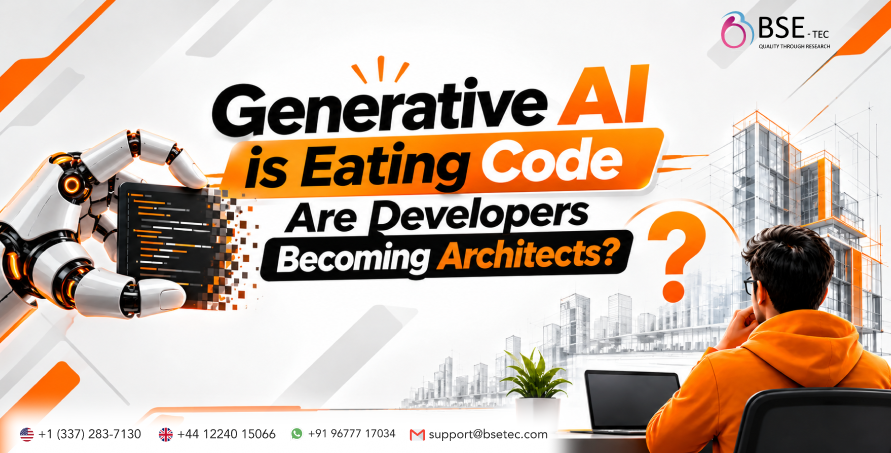
As AI writes more code, developers are shifting toward architecture, system thinking, and product engineering. Software development has entered a new phase. For years, engineers measured productivity by the number of features they shipped and the amount of code they wrote. Now, Generative AI can create functions, generate tests, refactor legacy code, explain unfamiliar repositories, and accelerate implementation in seconds.
That shift raises a bigger question than whether AI can write code.
If AI handles implementation faster than ever, do developers become architects instead of coders?
The answer points toward a broader transformation. Modern engineering increasingly rewards people who design systems, define business logic, review AI-generated output, and connect intelligence with reliable software.
For companies building AI-powered products, BSEtec already works across Generative AI, AI-powered applications, full-stack engineering, and intelligent automation, helping businesses move from conventional software toward AI-native digital experiences.
The New Productivity Race Is No Longer About Writing More Code
Writing code used to consume most of a developer’s day. Today, AI coding assistants can generate boilerplate, suggest implementations, create documentation, and explain existing codebases almost instantly.
Consequently, development teams are spending less time typing repetitive code and more time reviewing architecture, validating business logic, and improving product quality.
The shift is already measurable.
JetBrains’ 2026 Developer Ecosystem Survey found that 90% of surveyed developers use AI coding tools at least weekly, while 68% use them every day. Instead of replacing developers, AI has become part of the everyday engineering workflow.
However, faster code generation creates a new challenge.
Shipping code faster does not automatically create better software.
The Developer’s Biggest Job Is Becoming System Thinking
AI can generate individual files remarkably well. Nevertheless, it cannot automatically decide how an entire product should evolve.
Developers still make decisions that determine whether software succeeds.
They choose service boundaries, design APIs, plan database architecture, define security rules, manage scalability, and balance technical trade-offs.
For example, an AI tool might generate a complete authentication module. Yet an experienced engineer still decides how authentication connects with user roles, permissions, compliance requirements, and future product growth.
Therefore, the competitive advantage is shifting.
Architecture is becoming the skill that AI cannot simply autocomplete.
AI Can Generate Features. Engineers Define the Product.
A working feature does not necessarily solve the right business problem.
Generative AI responds to context. If requirements are incomplete, the generated solution can still miss the actual objective.
That makes problem definition more valuable than ever.
Instead of starting with implementation, modern engineering increasingly follows this sequence:
Business goal → System design → AI-assisted implementation → Human validation
This approach reduces unnecessary rework while helping teams build software that aligns with business objectives instead of simply producing more code.
How AI-Native Engineering Is Changing the Full-Stack Role
Full-stack developers have traditionally worked across the frontend, backend, and database to build complete applications. However, the growing use of AI is adding new responsibilities to their role.
Developers now need to decide how an application uses AI, which models best suit different tasks, and how the system accesses relevant business data. They must also determine when an AI agent can complete a task independently and when human approval is necessary.
Security remains equally important, especially when AI can trigger actions or interact with sensitive information.
As a result, full-stack development is moving beyond connecting application components. Developers are increasingly responsible for bringing AI, data, and software together to create intelligent applications that work reliably from start to finish.
The Skills AI Cannot Easily Replace
Generative AI can speed up coding, but developers still need the right skills to build reliable software. As AI takes care of more routine tasks, skills such as system design, security, and problem-solving become even more important.
System Architecture
Developers need to plan how different parts of an application work together, ensuring the system remains scalable, reliable, and easy to maintain.
Security Engineering
AI-generated code can still contain vulnerabilities. Developers must review the code, identify potential risks, and protect sensitive business data.
Product Thinking
Before building a feature, developers need to understand the actual business problem and decide how the solution should meet user needs.
AI Workflow Design
Modern applications often combine AI models, APIs, data retrieval, and automation. Developers need to connect these components so they work together effectively.
Code Review
AI can generate code quickly, but developers must check whether it works correctly, meets requirements, and is ready for production.
Together, these skills help developers move beyond writing code and take greater responsibility for designing reliable, business-focused software.
What Happens to Junior Developers?
With AI taking over more coding tasks, many beginners are wondering whether companies will still need junior developers. The reality is that the role is changing rather than disappearing completely.
AI tools can now generate basic code, suggest fixes, and help with documentation. As a result, beginners who rely only on writing simple code may find it harder to stand out.
At the same time, AI gives junior developers new ways to learn. They can understand unfamiliar code, explore different approaches, and solve problems with guidance from AI tools.
The key is how they use AI. Relying on it to do every task can limit their growth. Using it to understand concepts, test ideas, and improve problem-solving skills can help them become more confident developers.
The Rise of AI-Native Engineering in 2026
Software development is moving beyond autocomplete. Instead, AI is becoming part of the engineering process itself. Three trends stand out.
AI Agents Are Building Larger Features
Coding agents increasingly work across multiple files instead of generating isolated snippets. Developers now supervise implementation rather than writing every line manually.
Engineering Quality Beats Raw Speed
More code does not automatically mean better products. Successful teams increasingly measure maintainability, security, testing quality, and long-term reliability.
Human Oversight Remains Critical
AI still makes incorrect assumptions. Therefore, engineers continue validating architecture, reviewing outputs, and protecting production systems before deployment. The strongest teams combine AI speed with experienced technical judgment.
Real-World Shift: Engineering Teams Are Changing How They Build
The biggest transformation is happening inside engineering workflows.
Instead of assigning developers only implementation tasks, many teams now use AI throughout planning, coding, testing, debugging, and documentation. A typical workflow increasingly looks like this:
Requirement → AI-assisted draft → Human review → Testing → Deployment
That sequence changes how engineers spend their time. Rather than competing with AI over typing speed, developers focus on designing better systems, improving quality, and making technical decisions that AI cannot reliably make alone.
This explains why architecture discussions are becoming more valuable across modern engineering teams.
Why Businesses Are Investing in AI-Native Products
Companies are not adopting generative AI simply because coding becomes faster.
- They want products that can:
- understand customer intent,
- automate repetitive workflows,
- assist decision-making,
- personalize user experiences,
- reduce operational friction.
However, these products require much more than an AI model. They need secure architecture, reliable backend services, intelligent workflows, and scalable engineering.
That is where AI-native development becomes a business advantage rather than just a technical upgrade.
How BSEtec Helps Build AI-Native Software
Building AI-native applications requires more than connecting an LLM to an existing product.
The complete solution combines Generative AI, full-stack engineering, backend development, intelligent automation, and scalable application architecture.
BSEtec helps businesses build this foundation through:
- Generative AI development for intelligent application experiences.
- AI-powered application development for modern digital products.
- Full-stack engineering across frontend and backend systems.
- Intelligent workflow automation for business operations.
- Scalable AI integration for enterprise-ready software.
Businesses exploring AI-native applications can also explore BSEtec’s related resources:
Together, these capabilities help organizations move beyond conventional software and build applications designed for the next generation of AI-powered experiences.
Final Thoughts
Generative AI is changing software development, but it is not eliminating the need for skilled engineers. Instead, it is changing where developers create the most value. Architecture matters more. System thinking matters more. Business understanding matters more. Code review matters more.
The strongest developers will not compete with AI over typing speed. Instead, they will design better systems, guide intelligent workflows, and build software that combines automation with reliable engineering.
As businesses prepare for that transition, BSEtec helps organizations combine Generative AI, full-stack engineering, intelligent automation, and scalable software architecture to build AI-native products that deliver long-term business value.
The future developer may write fewer lines of code—but they will design far more of the intelligence behind modern software.