Predictive UX, have you noticed how some apps seem to know exactly what you need before you even look for it?
You open your favorite shopping app, and the product you were planning to buy is already sitting on the homepage. check your banking app, and it reminds you about a payment due tomorrow. You launch a food delivery app, and your usual Friday night order is waiting for you with a single-tap checkout.
A few years ago, experiences like these felt impressive.
In 2026, users simply expect them.
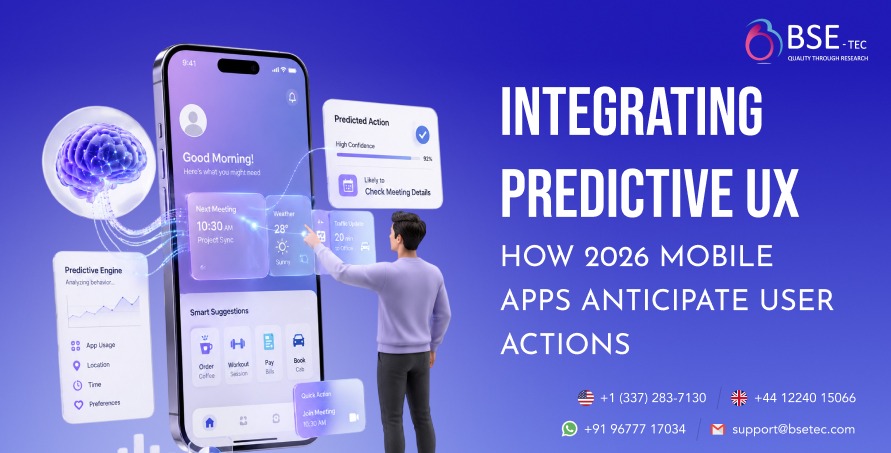
That’s because we’re entering a new era of mobile experiences powered by Predictive UX, a design approach where apps don’t just respond to your actions but actually anticipate them.
And honestly, this shift is changing everything.
To Begin With, Why Predictive UX Is Becoming Essential
For years, mobile apps were built around a simple idea: wait for the user to do something, then respond. But today’s users are busier, expectations are higher, and attention spans are shorter. Nobody wants to spend five minutes searching through menus when an app could show the right option immediately.
This is exactly why Predictive UX is becoming one of the biggest mobile app trends of 2026.
According to recent industry reports, global mobile app revenue is projected to exceed $150 billion in 2026, while AI-powered applications continue to see double-digit growth across industries. At the same time, studies show that users are more likely to stay engaged with apps that offer personalized experiences tailored to their behavior and preferences.
Instead of asking you what you want every single time, intelligent applications are learning from your behavior. They look at things like your browsing history, purchase patterns, usage habits, preferred times of activity, and even contextual signals such as location or device activity. Then they use AI to predict what you’re most likely to do next.
Think about your daily routine for a moment.
If you order coffee every weekday morning, why should an app make you search for it again and again?
check cryptocurrency prices several times a day, why shouldn’t the app automatically display your watchlist the moment you open it?
frequently book rides after work, why not have the destination already suggested before you type a single word?
The best mobile experiences in 2026 aren’t asking users to do more—they’re helping users do less.
That’s where the real value lies.
Meanwhile: The Technology Making It Possible
The technology behind Predictive UX is advancing faster than ever. With the rise of on-device AI, modern smartphones can now process intelligent recommendations directly on the device itself. This means faster performance, stronger privacy, and more accurate personalization.
In fact, leading smartphone manufacturers are investing heavily in AI chips capable of handling machine learning tasks locally. This shift reduces dependency on cloud processing and enables real-time predictions without compromising user privacy.
Combined with machine learning models, behavioral analytics, and real-time data processing, mobile apps are becoming significantly smarter than they were just a few years ago.
What’s even more interesting is how these technologies are working together. Apps can now analyze user behavior, location patterns, purchase history, device activity, and contextual signals simultaneously to deliver highly relevant recommendations within seconds.
Furthermore, Predictive UX Is Expanding Across Industries
While consumer apps were among the first to adopt predictive experiences, the trend is now spreading across multiple sectors.
Healthcare platforms are using predictive systems to help patients stay on track with medications and appointments. Some healthcare apps can even identify patterns that indicate a patient may miss a scheduled consultation and send proactive reminders.
Fintech companies are proactively warning users about unusual spending activity, upcoming bills, and potential budgeting issues before they become problems. According to recent fintech adoption reports, AI-driven financial insights have significantly improved customer engagement and retention rates.
Fitness apps are also becoming more intelligent. Instead of offering generic workout plans, they analyze recovery data, sleep patterns, wearable device metrics, and previous performance to recommend personalized training sessions.
Even enterprise applications are beginning to predict employee workflows, automate repetitive tasks, and surface relevant information before users actively search for it.
The result is simple:
- Less friction
- Faster decisions
- Better experiences
- Higher engagement
- And ultimately, happier users.
However, Building Predictive Experiences Requires Expertise
Of course, building this level of intelligence isn’t as simple as adding an AI chatbot to an existing application.
Creating truly predictive experiences requires the right combination of AI development, data analytics, user behavior modeling, automation, cloud infrastructure, and mobile architecture. Businesses must also ensure that predictive systems remain accurate, scalable, secure, and compliant with evolving privacy regulations.
This is where many organizations face challenges.
Collecting data is one thing. Turning that data into meaningful user experiences is something entirely different.
How BSEtec Helps Businesses Stay Ahead
As organizations increasingly invest in AI-powered digital products, BSEtec is helping businesses transform traditional mobile applications into intelligent platforms that understand and anticipate user needs.
With expertise in AI development, mobile app solutions, machine learning integration, enterprise software, blockchain technologies, and digital transformation services, BSEtec enables businesses to create experiences that feel more personal, more responsive, and significantly more engaging.
Imagine running an e-commerce platform where your application can predict customer preferences before products are searched. Or a healthcare application that helps patients take action before missing critical appointments.
By leveraging predictive analytics, recommendation engines, intelligent automation, and real-time behavioral insights, BSEtec helps organizations build applications that align with modern user expectations while driving measurable business outcomes.
What the Future Holds for Predictive UX
These aren’t future possibilities.
They’re already becoming a reality in 2026.
And that’s what makes Predictive UX so exciting.
It isn’t about making apps look smarter. It’s about making life easier for the people using them.
As we move further into the AI-first era, the most successful mobile applications won’t necessarily be the ones with the most features. They’ll be the ones who understand users better than ever before.
Industry analysts predict that AI-driven personalization and predictive experiences will become standard features across most mobile applications within the next few years. Businesses that embrace this shift early will be better positioned to improve customer satisfaction, increase retention, and gain a competitive advantage.
Because in the end, people don’t remember how many buttons your app had.
They remember how easy it felt to get things done.
And thanks to AI, Predictive UX, and innovative technology partners like BSEtec, that future is arriving much faster than most businesses expected.