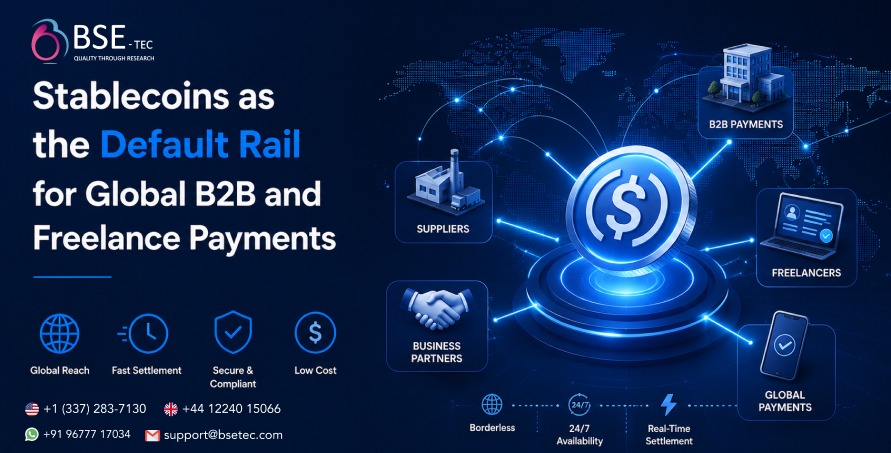
For years, international payments have followed the same path. A business in India pays a supplier in Singapore. A freelancer in Chennai invoices a client in the US. A software agency works with customers across Europe. The process sounds simple. Yet behind the scenes, payments often travel through multiple banks, incur foreign-exchange markups, incur hidden fees, and take days to settle. Now imagine receiving the same payment in minutes instead of days. That is exactly why stablecoins are becoming the default payment rail for global B2B transactions and freelance payments in 2026.
And if you are running a business, managing remote teams, or serving international clients, this shift is no longer something to watch from the sidelines. It is something you need to understand today.
The Biggest Payment Transformation Nobody Is Talking About
When people hear the word “crypto,” they often think of trading. However, the real story of 2026 is not trading.
It is payments.
According to recent industry research, real-world stablecoin payments reached approximately $390 billion in 2025. More importantly, B2B transactions accounted for nearly $226 billion of that volume, making business payments the largest stablecoin use case globally. B2B stablecoin payments also grew by an astonishing 733% year-over-year.
That growth is sending a clear message. Businesses are not adopting stablecoins because they are trendy. They are adopting them because traditional cross-border payment systems are becoming too slow and expensive for a digital-first economy.
Why Businesses Are Moving Away From Traditional Payment Rails
Let’s be honest. If you have ever received an international payment, you already know the frustration. You send an invoice.
The client pays. Then you wait. And wait. And sometimes wait even longer.
Meanwhile, intermediary banks deduct fees, exchange rates fluctuate, and tracking the payment becomes a challenge. Stablecoins solve many of these problems simultaneously. Instead of relying on a chain of correspondent banks, value moves directly across blockchain networks with near-instant settlement and 24/7 availability.
As a result, businesses can reduce payment settlement times, lower transaction costs, improve cash flow management, simplify international transactions, and eliminate unnecessary banking intermediaries
In a world where speed directly impacts business growth, these advantages are becoming impossible to ignore.
Freelancers Are Among the Biggest Winners
Now let’s talk about you.
If you are a freelancer, agency owner, consultant, developer, designer, marketer, or remote professional, stablecoins could completely change how you get paid.
Traditionally, receiving international payments means dealing with:
- Bank transfer delays
- High conversion charges
- Platform withdrawal fees
- Payment holds
- Currency volatility
Stablecoins introduce a different model.
A client can pay you directly. You receive funds within minutes. No waiting for banking hours, no weekend delays, no dependency on multiple intermediaries.
This is especially important because the global freelance economy is expanding rapidly, while businesses increasingly hire talent across borders.
The faster payments move, the faster professionals can access their earnings.
The Rise of Global Payroll on Stablecoins
Another major trend emerging in 2026 is stablecoin-powered payroll. Remote teams are now distributed across dozens of countries. Managing salary payments through traditional banking infrastructure creates unnecessary complexity.
Consequently, companies are exploring stablecoin-based payroll systems that allow them to pay employees, contractors, and freelancers across multiple regions through a unified payment infrastructure.
What started as an experiment has evolved into a practical business strategy. In fact, industry analysts now view stablecoins as one of the fastest-growing components of global workforce payments.
Why 2026 Feels Different From Previous Years
Stablecoins have existed for years. So why is adoption accelerating now?
The answer lies in three major developments.
1. Regulatory Clarity Is Improving: Governments and financial institutions are no longer ignoring stablecoins. Instead, many jurisdictions are creating clearer frameworks around digital payment infrastructure and stablecoin usage. This regulatory progress is increasing confidence among enterprises and financial institutions.
2. Enterprise Infrastructure Has Matured: Businesses no longer need to interact directly with blockchain technology. Modern payment platforms abstract the complexity and provide enterprise-grade compliance, treasury management, reporting, and security features.
3. Global Commerce Is Becoming Borderless: Companies increasingly operate internationally from day one. As businesses become global, they naturally seek payment systems that are also global. Stablecoins fit that requirement perfectly.
The Technology Layer Matters More Than the Coin
Interestingly, the biggest opportunity is not the stablecoin itself.
It is the infrastructure powering it.
The companies building payment gateways, treasury systems, settlement layers, compliance tools, wallet integrations, and enterprise payment platforms are becoming the backbone of the next financial era.
This is where technology partners play a critical role.
As organizations explore stablecoin-based payment systems, they need secure blockchain infrastructure, enterprise-grade integrations, automation workflows, smart contract development, and compliance-focused architecture.
That is why forward-thinking businesses increasingly work with experienced blockchain development company such as Bestec, where blockchain innovation is not treated as a standalone service but as part of a larger digital transformation strategy.
By helping businesses develop secure payment gateways, smart contract-powered payment automation, wallet integrations, and scalable blockchain infrastructure, Bestec enables organizations to move beyond traditional payment limitations and embrace faster, more efficient global transactions.
Whether the goal is automating global payouts, enabling cross-border settlements, or integrating stablecoin payment rails into existing business operations, the ability to bridge blockchain technology with real business workflows becomes a competitive advantage. With expertise in building enterprise-grade blockchain solutions, Bestec helps businesses transform stablecoin adoption into a practical and scalable payment strategy for the modern digital economy.
Stablecoins Are Becoming Financial Infrastructure
The conversation around stablecoins has fundamentally changed. While a few years ago the discussion centered around crypto, today it centers around infrastructure.
Consequently, payment networks, fintech companies, banks, payroll providers, and enterprise software platforms are all exploring how stablecoins can improve global value transfer. Moreover, major payment players are investing heavily in stablecoin settlement capabilities and enterprise adoption.
As a result, this signals something important.
In fact, stablecoins are gradually moving from an alternative payment method to a foundational payment layer. Furthermore, once infrastructure becomes invisible, adoption accelerates.
What This Means for Businesses in 2026
If your company works with international suppliers, overseas contractors, remote employees, global customers, or cross-border marketplaces, the question is no longer whether stablecoin payments will grow.
The data already answers that.
As the landscape continues to evolve, the real question is whether your business will be ready when stablecoin rails become a standard expectation rather than an emerging option.
Organizations that begin exploring blockchain-powered payment infrastructure today will be better positioned to reduce costs, improve efficiency, and create smoother global payment experiences tomorrow.
Moreover, this is precisely where companies like Bestec are helping businesses bridge the gap between traditional finance and next-generation blockchain payment ecosystems, ensuring that innovation translates into measurable business outcomes rather than remaining just another technology trend.
Final thoughts
The future of global payments is not being built inside banking hours. It is being built on always-on networks. Stablecoins are enabling businesses to move money as easily as they move information.
For freelancers, that means faster access to earnings. Enterprises, it means more efficient global operations. The broader economy, it represents a shift toward programmable, borderless financial infrastructure.
As businesses increasingly adopt stablecoin-powered payment solutions, having the right technology partner becomes essential. At Bestec, we help organizations build secure, scalable, and efficient blockchain-powered payment systems tailored to modern business needs.
If you’re exploring stablecoin payments, cross-border transactions, or blockchain-based financial solutions, feel free to connect with the Bestec team.