The conversation around cryptocurrency has changed dramatically. A few years ago, enterprises primarily viewed crypto as a high-risk investment category. Today, however, the discussion is moving in a very different direction. Businesses are exploring stablecoins for payments, tokenization for financial assets, blockchain for settlement, and digital assets for treasury and investment strategies.
More importantly, this shift is no longer being driven only by crypto-native companies. Banks, asset managers, fintech firms, payment providers, and large enterprises are increasingly building digital-asset capabilities into their long-term strategies.
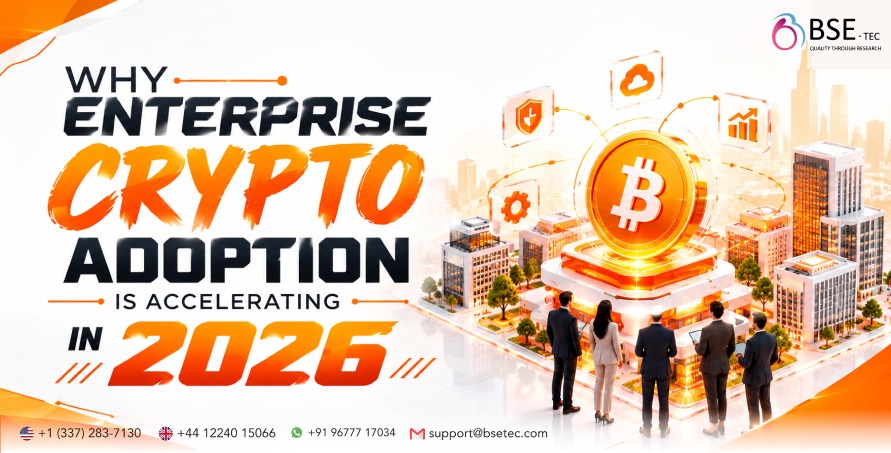
That is why enterprise crypto adoption is accelerating in 2026.
The change is particularly visible in institutional investment. A January 2026 survey of 351 institutional decision-makers by Coinbase and EY-Parthenon found that nearly three-quarters of institutions planned to increase their crypto allocations, while 74% expected crypto prices to rise over the following 12 months. At the same time, 66% reported exposure through spot crypto exchange-traded products, and 81% preferred gaining spot exposure through a registered vehicle.
So, what is really driving this transformation?
Crypto Is No Longer Just About Cryptocurrency
First of all, enterprise adoption is becoming broader than simply purchasing Bitcoin or Ether.
Instead, businesses are looking at the infrastructure surrounding digital assets.
For example, a multinational company may not want to hold large amounts of volatile cryptocurrency. Nevertheless, it may want to use a stablecoin to settle an international invoice. Similarly, an investment company may not want to create a completely new financial product, but it may want to tokenize an existing fund or bond.
Consequently, the enterprise blockchain conversation is shifting from “Which cryptocurrency should we buy?” to “Which business process can blockchain improve?”
That distinction is extremely important.
Blockchain can provide programmable settlement, transparent transaction records, automated rules, digital ownership, and 24/7 transferability. Therefore, enterprises increasingly see blockchain as a technology layer rather than simply a new asset class.
This is creating opportunities for companies working with experienced blockchain development companies such as BSEtec, particularly when businesses need customized wallets, smart contracts, tokenization platforms, decentralized applications, or enterprise blockchain infrastructure.
Stablecoins Are Becoming the Enterprise Gateway
Perhaps the strongest catalyst behind enterprise crypto adoption in 2026 is the growing importance of stablecoins.
Unlike highly volatile cryptocurrencies, stablecoins are designed to maintain a relatively stable value by being linked to assets such as the U.S. dollar. As a result, they are considerably more practical for payments, settlement, treasury operations, and cross-border transactions.
The latest institutional data demonstrates just how quickly this use case is expanding.
According to EY’s 2026 institutional digital-assets survey, 45% of surveyed firms already use or hold stablecoins, while another 41% do not currently use them but are interested. Moreover, among firms using or considering stablecoins, 88% are interested in T+0 securities settlement, while 85% identify internal cash management and money movement as a use case, and another 85% point to 24/7 trading.
In other words, stablecoins are gradually moving beyond crypto exchanges.
They are becoming potential financial rails.
For example, imagine a company that needs to move funds between two international subsidiaries outside traditional banking hours. Instead of waiting for conventional settlement windows, a blockchain-based payment system could potentially enable continuous movement of value.
Of course, regulatory compliance, liquidity, custody, and counterparty risk still matter. Nevertheless, the underlying opportunity is becoming increasingly difficult for enterprises to ignore.
Regulation Is Turning Uncertainty Into Opportunity
Regulation is becoming an important driver of enterprise blockchain adoption. As frameworks for stablecoins, digital assets, custody, and compliance become clearer, businesses can approach blockchain with greater confidence.
In the U.S., the GENIUS Act established a federal framework for payment stablecoins, while ongoing regulatory developments continue to clarify digital-asset oversight.
As a result, regulation is shifting from being viewed only as a barrier to becoming an adoption catalyst, particularly for institutions that require strong legal, compliance, security, and governance frameworks.
Tokenization Is Giving Traditional Assets a Digital Upgrade
Tokenization is becoming a major driver of enterprise blockchain adoption. By representing traditional assets digitally on blockchain infrastructure, businesses can enable more efficient ownership, transfers, settlement, and asset management.
In 2026, institutional interest is accelerating, with 63% of surveyed investors highly interested in tokenized assets, while 64% of asset managers are highly interested in tokenizing their own assets.
As a result, tokenization is moving beyond experimentation toward practical applications such as tokenized Treasuries, money-market funds, private credit, and other financial assets, creating a stronger bridge between traditional finance and blockchain.
Banks Are No Longer Standing on the Sidelines
Traditional banks are increasingly adopting digital assets, giving enterprises greater confidence in blockchain-based financial infrastructure. In 2026, major institutions are expanding into crypto trading, custody, stablecoins, and blockchain-based settlement.
As a result, businesses can access digital-asset services through established financial institutions instead of building everything independently. Traditional finance is no longer watching blockchain—it is becoming part of the blockchain ecosystem.
The Enterprise Mindset Is Changing
Interestingly, the biggest change may not be technological at all. It may be the way enterprises think about blockchain.
Earlier, companies often approached blockchain through experimental pilots. A small proof of concept would be developed, demonstrated, and then quietly abandoned. Now, the approach is becoming more practical.
Enterprises are asking questions such as:
Can this reduce settlement time? automate reconciliation? Improve liquidity management? Create a new payment channel? Make asset ownership more transparent? Connect AI systems to programmable financial infrastructure?
Security Is Becoming Just as Important as Innovation
As enterprise crypto adoption grows, security is becoming equally important. Businesses must protect custody, private keys, wallets, smart contracts, transactions, and compliance processes from the beginning.
In 2026, institutional investors are placing greater emphasis on secure custody and regulatory compliance. Therefore, enterprise blockchain solutions need strong authorization, monitoring, audit trails, and secure smart-contract architecture.
With its expertise in blockchain, AI, tokenization, smart contracts, and digital wallets, BSEtec helps businesses build secure and practical digital-asset solutions for the evolving enterprise landscape.
What Enterprise Crypto Adoption Will Look Like Next
Enterprise crypto adoption will take different forms, from stablecoin payments and tokenized assets to digital wallets, custody, and AI-powered blockchain systems.
However, they all share one foundation: programmable value. In 2026, money, assets, identity, contracts, and transactions are becoming increasingly programmable, positioning blockchain as a key infrastructure layer connecting finance, enterprises, AI, and digital assets.
Why 2026 Could Be the Turning Point
2026 could mark a major turning point for enterprise crypto adoption as regulation, stablecoins, tokenization, institutional custody, banking services, and AI converge.
The numbers reinforce this shift: nearly three-quarters of surveyed institutional investors planned to increase crypto allocations, while 63% showed strong interest in tokenized assets and 64% of asset managers were interested in tokenizing their own assets.
Together, these trends suggest that crypto is moving beyond speculation toward practical, programmable financial infrastructure for businesses.
Final thoughts
Enterprise crypto adoption in 2026 is not accelerating because companies suddenly became interested in cryptocurrency speculation.
It is accelerating because blockchain technology is becoming increasingly useful for real business problems.
Stablecoins can support faster movement of value. Tokenization can modernize asset infrastructure. Smart contracts can automate financial rules. Institutional custody can strengthen security. Meanwhile, AI agents can introduce a new generation of autonomous digital transactions.
Together, these developments are creating an entirely new enterprise technology landscape.
For businesses preparing for this transformation, the opportunity is not simply to “enter crypto.” Instead, it is to identify where programmable digital assets can create measurable value.
BSEtec is helping shape this transition by bringing together blockchain development, smart contracts, crypto wallets, tokenization, AI-powered solutions, and enterprise Web3 infrastructure.
Ultimately, the question for businesses in 2026 is no longer whether crypto belongs in the enterprise.
The more important question is how enterprises can build the right crypto infrastructure before the next wave of digital finance becomes the standard.