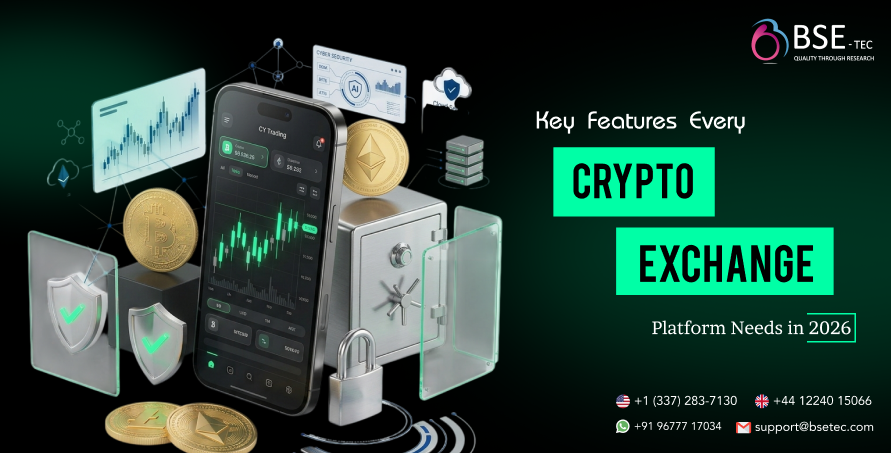
The cryptocurrency market has entered a new era in 2026. Today, users expect more than just a place to buy and sell digital assets. They demand institutional-grade security, lightning-fast transactions, AI-powered trading, regulatory compliance, and seamless multi-chain experiences. As global crypto adoption continues to accelerate, businesses planning to launch a crypto exchange must build platforms that are secure, scalable, and future-ready.
Moreover, regulatory frameworks across Europe, the Middle East, and Asia are becoming more structured, making compliance a competitive advantage rather than an option. At the same time, institutional investors are entering the market in greater numbers, increasing demand for enterprise-grade exchange infrastructure. Consequently, choosing the right technology partner has become one of the most important business decisions.
If you’re planning to build a next-generation exchange, here’s everything your platform needs in 2026.
Why Modern Crypto Exchanges Need More Than Basic Trading
The days of simple buy-and-sell crypto platforms are over. Instead, successful exchanges now function as complete digital asset ecosystems.
As of 2026, the global cryptocurrency market capitalization exceeds $2.2 trillion, with millions of users actively trading digital assets every day. Additionally, the implementation of MiCA regulations across Europe is pushing exchanges to prioritize stronger security, compliance, and transparency to meet evolving industry standards.
Recent industry trends show that hybrid exchanges, AI-powered risk detection, Multi-Party Computation (MPC) wallets, Proof of Reserves, cross-chain interoperability, and compliance automation are becoming industry standards. Moreover, enterprises are rapidly investing in modular exchange architectures that support AI integration, tokenized real-world assets (RWAs), and future blockchain innovations.
Therefore, businesses entering the market must think beyond trading functionality and focus on building secure, scalable, and regulation-ready platforms that earn long-term user trust.
1. Institutional-Grade Security
Security remains the number one priority for every crypto exchange. In 2026, users expect exchanges to protect digital assets using multiple security layers rather than relying on traditional wallet systems.
Essential security features include Multi-Party Computation (MPC) wallets, Cold wallet asset storage, Multi-signature transaction approvals, AI-powered fraud detection, Biometric authentication, Hardware Security Module (HSM) integration, End-to-end encryption, and Real-time threat monitoring
Furthermore, several infrastructure providers have begun introducing quantum-safe MPC technologies to prepare exchanges for future cybersecurity threats, highlighting how security standards continue to evolve.
2. AI-Powered Trading Experience
Artificial Intelligence is transforming crypto exchanges in 2026. Instead of merely executing trades, AI now helps users make smarter investment decisions.
Modern AI features include Personalized trading recommendations, Portfolio optimization, Market sentiment analysis, Smart price prediction, Automated portfolio balancing, Intelligent customer support, and Fraud behavior detection
As a result, exchanges improve user engagement while simultaneously reducing operational costs.
3. High-Speed Matching Engine
No matter how attractive an exchange looks, users quickly leave if trading feels slow. A modern exchange requires an ultra-fast matching engine capable of processing thousands of transactions every second with minimal latency.
Core capabilities include Real-time order execution, Market orders, Limit orders, Stop-loss orders, Futures and derivatives support, and Deep liquidity management. Consequently, traders experience smoother execution even during periods of extreme market volatility.
4. Multi-Chain and Cross-Chain Support
Crypto users no longer operate on a single blockchain. Instead, they actively use Ethereum, Solana, Polygon, BNB Chain, Avalanche, Arbitrum, Base, and several Layer-2 networks.
Therefore, exchanges must provide Multi-chain wallet support, Cross-chain asset transfers, Native token bridges, Layer-2 compatibility, and Cross-chain swaps. This significantly improves user flexibility while expanding the platform’s trading ecosystem.
5. Regulatory Compliance & KYC Automation
Compliance has become a major differentiator in 2026. Governments worldwide are introducing stricter licensing, AML, and KYC requirements for digital asset businesses.
Essential compliance tools include Automated KYC verification, AML monitoring, Transaction screening, Risk scoring, OFAC screening, Audit logs, and Regulatory reporting
Additionally, compliance automation reduces manual work while improving operational efficiency.
6. Proof of Reserves & Transparency
After several high-profile industry failures, transparency has become a key trust factor. Users now expect exchanges to demonstrate that customer funds are fully backed.
Important transparency features include Proof of Reserves dashboards, On-chain asset verification, Independent security audits, Wallet transparency, and Public reserve reports
Consequently, exchanges that openly verify their reserves build stronger customer confidence.
7. Advanced Liquidity Management
Liquidity directly impacts trading quality. Without sufficient liquidity, traders face higher spreads and delayed order execution.
Successful exchanges integrate Liquidity aggregation, Market maker APIs, Cross-exchange liquidity, Automated market making, and Dynamic order books
Therefore, users enjoy smoother trading experiences with better pricing.
8. Staking, Earn & DeFi Integration
Modern exchanges are evolving into complete financial ecosystems. Rather than simply offering trading, they now provide multiple earning opportunities.
Popular services include Crypto staking, Fixed savings, Flexible yield products, DeFi integrations, Liquidity pools, Token launchpads, and Real-World Asset (RWA) token investments
This diversification increases user retention while creating additional revenue streams.
9. Mobile-First User Experience
Most crypto trading now happens on smartphones. As a result, mobile optimization has become essential rather than optional.
Must-have mobile features include One-click trading, Biometric login, Push notifications, Live portfolio tracking, Instant deposits, QR wallet payments, and Dark mode interface
A clean and intuitive design significantly improves user satisfaction and reduces onboarding friction.
10. AI Customer Support
Customer expectations continue to rise. Today’s exchanges cannot rely solely on traditional support teams.
Instead, AI-powered assistants provide 24/7 multilingual support, Instant ticket resolution, Trading guidance, Wallet assistance, KYC support, and Transaction tracking
Consequently, businesses improve customer satisfaction while lowering support costs.
11. Scalability for Future Growth
Crypto markets can experience sudden spikes in trading volume. Therefore, exchanges must be designed using scalable cloud-native architectures.
Key infrastructure features include Microservices architecture, Kubernetes deployment, Auto-scaling servers, Load balancing, Disaster recovery, and Global CDN support
This ensures uninterrupted performance even during peak market activity.
Why BSEtec is the Right Partner for Crypto Exchange Development
Building a crypto exchange in 2026 requires far more than coding a trading interface. Businesses need a technology partner with expertise in blockchain architecture, security, compliance, liquidity integration, and scalable infrastructure.
BSEtec specializes in developing enterprise-grade cryptocurrency exchange platforms tailored to startups, fintech companies, and global enterprises. From centralized (CEX) and decentralized (DEX) exchanges to hybrid trading platforms, BSEtec delivers secure, high-performance solutions equipped with AI-driven analytics, MPC wallet integration, cross-chain compatibility, compliance automation, and advanced trading engines.
As a trusted Blockchain development company, BSEtec helps businesses launch feature-rich crypto exchanges that are designed for performance, security, and long-term scalability. Whether you’re creating a new trading platform or upgrading an existing one, BSEtec provides end-to-end blockchain development services that align with the latest 2026 industry standards.
Final Thoughts
The crypto exchange landscape in 2026 is more competitive than ever. However, platforms that prioritize security, transparency, compliance, AI automation, scalability, and exceptional user experiences will stand out in a rapidly evolving market.
If you’re planning to launch a next-generation cryptocurrency exchange, partnering with an experienced Blockchain development company is essential. With BSEtec’s deep expertise in blockchain technology and crypto exchange development, you can build a secure, scalable, and future-ready platform that meets the demands of today’s users while staying prepared for tomorrow’s innovations.