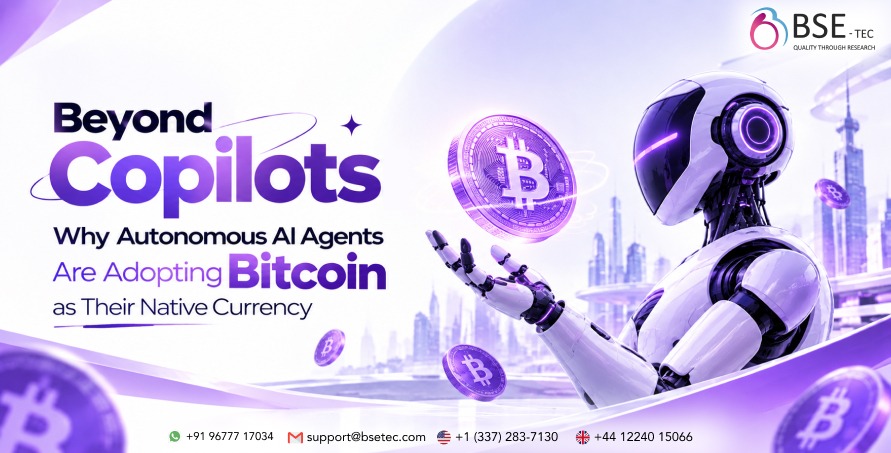
AI is moving beyond answering questions.
The old model was simple:
Human → AI → Human takes action
Now, agentic AI is changing the workflow:
Human → AI Agent → Action
The next step could be even bigger. An AI agent may discover a service, evaluate its price, pay for it, receive the result, and even hire another agent to complete the next task.
At that point, AI is no longer just an assistant. It becomes a software system capable of making economic decisions within predefined permissions.
That creates a new question:
When software can act independently, what kind of money is actually designed for software?
The answer points toward programmatic payments, micropayments, always-on transactions, and machine-native financial infrastructure.
BSEtec works at this intersection of AI, blockchain, smart wallets, smart contracts, and autonomous on-chain systems, helping businesses explore what comes after traditional AI assistants.
When AI Needs to Pay, Traditional Finance Starts Showing Friction
Traditional financial systems were designed around human identity and interaction.
A typical payment involves:
Bank Account → Identity → KYC → Card → Authentication → Approval → Settlement
An autonomous agent needs something different:
Programmatic Access → Instant Settlement → Micropayments → 24/7 Availability → Automated Budgeting
This difference becomes important when an agent needs to purchase a digital service.
Imagine an AI research agent needing one piece of market data for $0.001. A monthly subscription makes little sense. Manual checkout makes even less sense.
Instead, the agent could pay only for the information it needs.
Consequently, machine commerce requires payment infrastructure that supports small, automated, frequent, and permission-based transactions.
What Happens When AI Models Choose Their Own Money?
A March 2026 Bitcoin Policy Institute study tested 36 frontier AI models across 9,072 controlled economic scenarios.
Bitcoin appeared in 48.3% of overall responses, while stablecoins accounted for 33.2%. More than 90% of responses favored digitally native monetary instruments over traditional fiat or bank money.
However, the most interesting result was the difference between saving and spending.
For store-of-value scenarios, Bitcoin received 79.1% of selections.
For payment scenarios, stablecoins led at 53.2%, compared with 36% for Bitcoin.
That suggests a possible two-tier model:
Bitcoin → Long-term value preservation
Stablecoins → Day-to-day machine spending
This is experimental evidence, not proof that AI has already chosen its future currency. Still, it highlights an important possibility: different digital assets may serve different roles inside the machine economy.
Why Bitcoin Needs Lightning for the Machine Economy
Bitcoin has properties that can fit autonomous software: permissionless access, global reach, and software-controlled wallets.
Yet Bitcoin’s base layer is not designed for every tiny AI payment.
That is where the Lightning Network becomes important.
Instead of settling every small transaction directly on Bitcoin’s base layer, Lightning enables faster and lower-cost payments that can better fit certain machine-to-machine use cases.
The architecture becomes:
Bitcoin → Lightning → AI Agent → Digital Service
This makes Bitcoin more interesting as part of a broader machine-payment stack rather than as a standalone solution for every AI transaction.
L402 Turns an API Request Into a Payment
One of the clearest examples is L402, developed by Lightning Labs.
The concept combines HTTP’s 402 Payment Required response with Lightning payments and authentication.
The flow is simple:
Agent requests API
↓
Server returns payment requirement
↓
Agent receives invoice
↓
Agent pays through Lightning
↓
Payment is verified
↓
Agent receives the resource
The important shift is that payment becomes part of the API interaction itself.
Instead of:
Signup → Credit Card → Subscription → API Key
The model can become:
Request → Payment → Access
That is a much more natural workflow for autonomous software.
From API Calls to AI-to-AI Commerce
Once agents can make controlled payments, entirely new digital business models become possible.
For example, a research agent could purchase premium data only when a specific task requires it. During development, another agent might pay for additional computing power or a specialized coding service. In financial workflows, an autonomous system could purchase market intelligence from an external provider without waiting for human approval.
The model can go even further. One AI agent could outsource a specific task to another specialized agent, pay for the completed work, verify the result, and continue its workflow automatically.
Therefore, software could move from simply using APIs to buying digital capabilities on demand.
BSEtec has already explored this direction through its work on AI-to-AI Payments and AI Agents with Crypto Wallets.
Autonomous Money Needs Guardrails
Giving an AI agent access to money also creates a new security challenge.
A faulty agent could repeatedly purchase an unnecessary service. A malicious API could send deceptive payment requests. Prompt injection could influence transaction decisions. A compromised wallet could expose funds.
Therefore, autonomous does not mean unrestricted.
A safer architecture can combine:
- Spending limits
- Approved services
- Wallet isolation
- Transaction monitoring
- Policy-based permissions
- Human escalation for high-value transactions
The principle is straightforward:
Let AI decide within boundaries. Let infrastructure enforce those boundaries.
This becomes essential as AI agents move from generating recommendations to controlling real economic resources.
Bitcoin Saves. Stablecoins Spend.
The future machine economy may not depend on one universal digital currency.
Instead, different assets could perform different jobs.
Bitcoin can serve as a longer-term reserve or value-preservation asset.
Stablecoins can provide predictable operating capital for API calls, data, compute, and other recurring expenses.
An autonomous wallet could therefore operate with:
BTC → Reserve
Stablecoins → Operating Budget
This two-tier model is consistent with the BPI study’s observed difference between Bitcoin’s store-of-value preference and stablecoins’ stronger payment preference.
However, volatility, regulation, infrastructure complexity, and security still need to be solved before autonomous machine payments can operate at large scale.
How BSEtec Can Build the AI Payment Layer
Building an AI payment system requires more than connecting an AI model to a crypto wallet.
The infrastructure needs AI agents, blockchain networks, wallets, smart contracts, payment logic, and security controls working together.
BSEtec can support businesses exploring:
- Autonomous AI Agents — Build agents capable of executing defined workflows.
- Smart Wallets — Create controlled wallets with spending permissions.
- Blockchain Payments — Connect programmable payment infrastructure with AI workflows.
- Smart Contracts — Enforce transaction and business rules.
- Agent-to-Agent Commerce — Enable autonomous systems to exchange services and payments.
- Security Controls — Add monitoring, limits, authorization, and escalation mechanisms.
The goal is not simply to give AI access to money.
It is to create a controlled financial execution layer for autonomous software.
Final Thoughts
AI agents are moving beyond simple assistance. They are beginning to discover services, execute workflows, and potentially participate in economic transactions.
That shift creates a new requirement: financial infrastructure designed for software rather than only for humans.
Bitcoin offers a compelling foundation for this direction, particularly when paired with scalable payment infrastructure such as Lightning. At the same time, stablecoins, security controls, payment protocols, regulation, and adoption will determine how the machine economy actually develops.
So the biggest story is not simply AI using Bitcoin.
It is software becoming an economic actor.
With expertise across AI, blockchain, smart wallets, smart contracts, and autonomous systems, BSEtec can help businesses build the infrastructure needed for secure machine-to-machine commerce.
The next generation of AI may not just use the internet. It may earn, spend, negotiate, and pay on it.