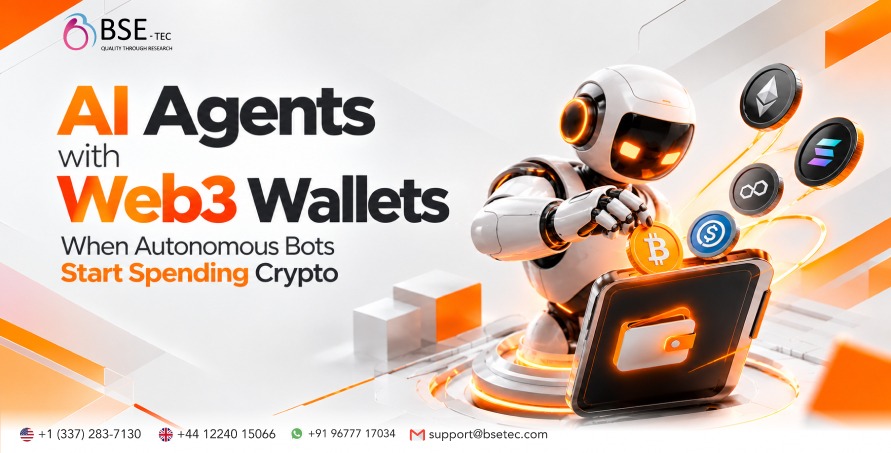
AI agents are moving beyond answering questions. They can call APIs, execute workflows, access enterprise systems, and make decisions with increasing independence.
Now, another capability is entering the stack: spending money.
A Web3 wallet can give an AI agent controlled access to digital assets, allowing it to pay for services, interact with smart contracts, and execute approved transactions. BSEtec is building toward this convergence of AI, blockchain, smart wallets, and autonomous systems.
The bigger shift is simple: AI agents are becoming economic participants.
When AI Stops Asking for Permission to Pay
An AI agent may know exactly what it needs to complete a task, yet payment can still interrupt the workflow.
Imagine a research agent that needs premium market data. It finds the provider, checks the price, and requests access. In a traditional workflow, a human may still need to approve the payment.
A programmable wallet changes that.
The agent can operate with a predefined balance, spending limit, approved providers, and transaction rules. Once the conditions match, it can complete the payment and continue its task.
Agent → Wallet → Policy Check → Payment → Service → Result
This creates autonomy without giving the agent unlimited financial control.
Web3 Wallets Are Becoming an Agent Control Layer
A normal crypto wallet gives a user access to digital assets. An agent wallet needs more.
It must connect identity, permissions, spending policies, transaction execution, and monitoring.
That shift is already appearing in the market. Coinbase introduced Agentic Wallets in 2026 to support AI agents that can spend, earn, and trade within programmable controls. OKX has also introduced agentic wallet infrastructure for AI-driven on-chain actions.
Therefore, the wallet is becoming more than a place to store crypto.
It is becoming the financial control layer for autonomous software.
The Real Innovation Is Controlled Spending
Giving an AI agent unrestricted wallet access creates an obvious security risk. Instead, businesses can define exactly what the agent can do.
A production-ready agent wallet can enforce:
- Transaction limits
- Daily or monthly spending budgets
- Approved wallet addresses
- Allowed tokens and smart contracts
- Specific transaction types
- Human approval for high-value actions
For example, an enterprise agent could receive a fixed operating budget for APIs, compute, or data. Smaller approved payments could happen automatically, while larger transactions trigger human approval.
So, autonomy does not mean unlimited authority.
It means programmable authority.
From Paying APIs to Buying Compute
Once agents can make controlled payments, their economic role expands.
A coding agent could purchase additional GPU capacity when demand increases. Research agent could pay for premium datasets. Logistics agent could purchase external tracking services. Meanwhile, an enterprise agent could pay another specialized AI system to complete a task.
The important change is that agents can discover and purchase the resources required to complete their objectives.
That creates a new software economy where AI does not simply consume resources assigned by humans. It can acquire approved resources independently.
When One Agent Starts Hiring Another
The next step is agent-to-agent commerce.
Imagine a business agent receiving a complex request. It needs market research but does not have the capability internally. Instead of stopping, it could discover a specialized research agent, verify its identity, agree on a price, authorize the payment, and receive the result.
The workflow could become:
Business Agent → Research Agent → Payment → Data → Final Decision
A larger workflow could involve separate agents for research, data processing, computing, and verification.
Blockchain infrastructure can provide the payment and settlement layer between these participants.
BSEtec already explores this model through its AI Agents with Crypto Wallets work, where autonomous bots can interact with wallets and other blockchain-based services.
Smart Contracts Put Rules Around Autonomous Money
A wallet gives an agent access to assets. A smart contract can define what happens with those assets.
For example, a contract can establish approved participants, payment conditions, spending rules, and settlement logic. Funds could remain locked until a service meets predefined conditions.
This becomes especially useful when autonomous agents transact with one another.
Service → Price → Conditions → Verification → Payment
As a result, machine commerce does not need to depend entirely on trust between software systems. Programmable rules can handle part of the relationship.
Crypto Payments Open the Machine Economy
AI agents may eventually make many small payments for APIs, inference, storage, datasets, bandwidth, and compute.
Traditional payment workflows can introduce friction because they often depend on human approval. Blockchain-based payments can operate programmatically, while stablecoins can provide a practical settlement mechanism for digital services.
BSEtec’s AI-to-AI Payments work explores this emerging model, where agents can pay for digital resources without requiring a human to manually approve every small transaction.
The opportunity is therefore bigger than crypto payments.
It is continuous machine-to-machine commerce.
Autonomous Money Creates a New Security Problem
Financial autonomy also creates a new attack surface.
An agent could misunderstand an instruction. A malicious API could manipulate its workflow. A compromised integration could redirect funds. Therefore, agent wallets need multiple defensive layers.
Spending limits can cap exposure. Whitelisted addresses can restrict destinations. Session permissions can limit access. Transaction monitoring can detect unusual behaviour. Human approval can protect high-value operations. Emergency controls can stop an agent when its behaviour crosses predefined boundaries.
BSEtec’s Autonomous Bitcoin Agent Infrastructure follows this controlled-autonomy approach with scoped wallet architecture, spending limits, whitelisted actions, monitoring, and human override mechanisms.
The goal is not to eliminate autonomy.
The goal is to make autonomy measurable and controllable.
Identity Becomes as Important as the Wallet
Once agents start spending money, businesses need to know who is behind each transaction.
A wallet address alone may not answer:
- Which agent initiated the transaction?
- Which organisation authorised it?
- What is the agent allowed to purchase?
- Can another agent verify its identity?
- Does it have a trustworthy transaction history?
That makes identity and reputation important parts of autonomous commerce.
BSEtec’s Agent-to-Agent Commerce work explores how wallets, smart contracts, digital identity, and blockchain infrastructure can support machine-to-machine transactions.
BSEtec: Building the Stack Behind Autonomous Spending
The challenge is not simply connecting an AI model to a crypto wallet.
A production system may require AI agent development, Web3 wallet architecture, smart contracts, identity, authorization, spending policies, blockchain integration, transaction monitoring, security controls, and multi-agent orchestration.
BSEtec brings these capabilities together across AI agents, blockchain, smart contracts, Web3 wallets, and autonomous systems.
Its focus on AI × Blockchain & Autonomous Agents can help businesses move from experimental AI assistants toward controlled, transaction-capable digital workers.
What Comes Next: Agents With Their Own Operating Budgets
The next generation of AI agents may receive more than instructions.
They may receive objectives, permissions, and budgets.
An agent could discover a service, compare providers, evaluate cost, make an approved payment, verify the result, and continue the workflow.
The model becomes:
Objective → Intelligence → Identity → Wallet → Policy → Payment → Settlement → Result
At that point, AI is no longer simply performing a task.
It is participating in a machine economy.
Final Thoughts
Web3 wallets give AI agents something they have largely lacked: controlled financial agency.
The opportunity goes beyond allowing a bot to send crypto. Agents could purchase data, rent compute, access APIs, hire other agents, execute DeFi workflows, and settle machine-to-machine transactions.
However, autonomous spending will only scale when businesses combine wallet access with identity, permissions, monitoring, smart contracts, and strong security controls.
That is where BSEtec fits into the emerging stack.
By combining AI agents, Web3 wallets, blockchain infrastructure, smart contracts, autonomous execution, and security controls, BSEtec can help businesses build systems where software does more than think.
It can act, transact, and operate within defined financial boundaries.
The machine economy starts when AI gets more than intelligence.
It gets the ability to spend.
When AI Agents Start Spending